Mushin
-
Posts
214 -
Joined
-
Last visited
-
Days Won
5
Content Type
Profiles
Forums
Events
Store
Downloads
Gallery
Everything posted by Mushin
-
Nicholas is a great guy and a pleasure to do business with!
- 1 reply
-
- 3
-

-
Woo-hoo! Very few of these stories have a happy ending these days. Count yourself blessed!
-
You do occasionally find Sue Bizen works with mitsu and even maru mune. They were almost certainly custom order requests or were done on a work forged for some important event. They are not common but not unknown either. Often they are associated with other "upgrades" like horimono, or extended length. (Stubby nakago katateuchi were the standard of the day.) Congrats!
-

Possible Paul Martin National Treasure Sword Book
Mushin replied to ckaiserca's topic in General Nihonto Related Discussion
Not on Facebook, but I am in. -
Thanks to all who came to the Orlando Sword Show this year! It was a great show, full of warmth and fun. Exhibition was terrific and the attendees were wonderful got to meet Sam and a few other people I only know by their names and posts here! So nice! Hope to see more of you next year!!!
-
Amazing achievement. Congrats
-
What has changed? NBTHK Shinsa
Mushin replied to MassiveMoonHeh's topic in General Nihonto Related Discussion
I have a very good friend and serious collector who shall remain nameless. He loves attending the various shinsa in Chicago, Tampa, Orlando and San Francisco. His favorite spot was outside the shinsa room where he would wait for the inevitable angry, disappointed collectors emerging with pink slips or attributions they didn't like. He would commiserate with them over the results, sympathize with their frustration, and then, more often than not, buy their swords and fittings from them for peanuts since they couldn't wait to be rid of their "failures." They walked away happy that they bumped into a "sucker" stupid enough to buy their "garbage." At least three Jūyō swords my friend owns today came from those very rejects. Other pieces received attributions to major names after a good polish. It just goes to show that not all shinsa are created equal, that a mei rejection is not necessarily the end of the story, and that one person's disappointment can become another person's opportunity—especially when that person knows what he is looking at. Knowledge truly is power. It also illustrates nicely the point I was making earlier: the blade itself did not change. Nothing about the workmanship, condition, or history was altered by the result. What changed was the owner's perception of the blade once it failed shinsa. For some, that shift in perception can be powerful enough to sever the emotional connection they once had with the piece. For others, it just creates the opportunity to acquire something exceptional at a fraction of its true value. -
What has changed? NBTHK Shinsa
Mushin replied to MassiveMoonHeh's topic in General Nihonto Related Discussion
Rohan, I agree with you, but only up to a point. While papers or designations don't change the steel or workmanship of a sword, what they can—and often do—change is our perception of the blade. When a sword that you hope will receive higher papers does, you are elated, feel proud or vindicated, and often develop a deeper connection to it, even though nothing has really changed about the piece other than the certificate that accompanies it. And when it doesn't happen, that emotional connection can be affected, sometimes profoundly. Darcy once told me that people would often get rid of blades after a failed Jūyō submission because, in the owner's mind, somehow the sword was no longer worthy of the same love, admiration, or ownership. I used to say that the only reason to pursue higher papers was to make a future sale or trade easier, or to leave your family something concrete and understandable when you eventually pop your clogs. But the truth is that collectors often behave exactly as Darcy described. And I get it. Collecting—and perhaps hoarding as well—are deeply human traits. Humans crave certainty. We want our choices validated. We want our judgment recognized and rewarded. When that happens, it strengthens our attachment to the object. When it doesn't, it can alter our relationship with it, even when logic tells us nothing has changed. I think the Buddha spent a great deal of time teaching that suffering is rooted in attachment and expectation. That may not make rational sense in the context of a sword that remains exactly the same before and after the shinsa results arrive, but it is what it is. We become attached not only to the object itself, but also to the story we tell ourselves about it and the hope that others will validate that story. Human nature being what it is, that attachment can be every bit as powerful as the sword itself. -
The Little Known Lives of Koto Swordsmiths
Mushin replied to Mushin's topic in General Nihonto Related Discussion
Jussi, while I don't know the story about Katsumitsu fleeing the village, what is clear is that by 1560, the situation in Osafune had changed considerably. The glory days of the Katsumitsu line were already in the past. The atelier appears to have been much smaller than it had been during the time of Ukyo no Suke Katsumitsu and Sakyo no Shin Munemitsu, and it was operating alongside a number of related Osafune branches, particularly the descendants of Jirobei Harumitsu, the second son of Jirozaemon no Jō Katsumitsu. The Harumitsu branch seems to have specialized in higher-quality and often more individual commissions, producing many tantō and the occasional longer uchigatana. Also, by the Eiroku era, the economics of sword production had shifted dramatically. Demand generated by the Sengoku wars encouraged the large-scale manufacture of kazuuchimono, and the principal beneficiaries of that market were the Kiyomitsu and Sukesada groups. These two houses grew into the dominant producers in Osafune, overshadowing many of the older family lines in both size and output. At the same time, Bizen's political landscape was also changing. Since the death of Akamatsu Masanori, the province had been dominated by the Uragami clan, who were also big patrons of the Katsumitsu. But by the mid-sixteenth century the Uragami were weakened by internal divisions and increasingly dependent upon their powerful retainer, Ukita Naoie. During the 1560s, Naoie expanded his influence while maintaining a nominal loyalty to his lords, eventually emerging as the effective ruler of Bizen. Such political and economic upheavals almost certainly affected the fortunes of the Katsumitsu line, as they did many other Osafune families. Against that backdrop, the placement of Kiyomitsu's name before Katsumitsu's becomes easier to understand. Whether the order reflects seniority, prestige, commercial influence, or simply the circumstances of the commission cannot be known with certainty. However, by the Eiroku period the Kiyomitsu workshops were among the most prominent and productive in Osafune, while the Katsumitsu line no longer occupied the commanding position it had enjoyed a century earlier. On the issue of Katsumits fleeing the village, I have not seen and can't find anything to support this, but I guess it's possible. The documentary record for many late-Bizen smiths is fragmentary and not all of it is available online. What is striking,though, is that when the Yoshii River flood of 1590 devastated Osafune and effectively brought the great Bizen tradition to an end, the powerful Kiyomitsu line disappeared from history. Among the few branches that survived were members of the Sukesada line and descendants of the Harumitsu branch. In that sense, although the Katsumitsu family had long since lost its former prominence, its bloodline appears to have been among the last remnants of the classical Osafune tradition. -
It's looking promising! Fingers crossed!!!!
-
The Little Known Lives of Koto Swordsmiths
Mushin replied to Mushin's topic in General Nihonto Related Discussion
Kosho (1455-57)! That would mean that Munemitsu, if born in 1436/37, was somewhere between 18 to 21 when this was made. It's not impossible, but more likely this is by the 4th generation whose working period is listed as 1444-1449. Markus' A-Z of Japanese Sword smiths says the earliest known signature for Sakyo no Shin is 1469, but we are constantly seeing pieces coming out of the woodwork that are upending those dates. The work looks nice as and you can see the transition moving to Sue Bizen. I like it! What are the dimensions of the blade? -
The Little Known Lives of Koto Swordsmiths
Mushin replied to Mushin's topic in General Nihonto Related Discussion
Thank you again for all the great feedback. And absolutely, Lewis, the practice was not uncommon heading into the Muromachi to inscribe more information on nakago, including patrons, places and even prayers. Here's an example of the later (again by Ukyo no Suke Katsumitsu) on the mune of a tanto: https://sanmei.com/contents/media/T2174_T5010_PUP_E.html Also interesting is the practice of gassaku with other Bizen smiths outside their immediate circle seemed to be a thing for a while around the late Meio and Eisho eras. There is one on the market now between Tadamitsu and Muneumitsu: https://sanmei.com/contents/media/T2174_T5010_PUP_E.html. But there are even earlier ones with Norimitsu. Then of course, there is the famous Tokubestu Juyo nagainata jointly made by Jirozaemon no Jo Katsumitsu and the Shodai Yosozaemon Sukesada below. Interesting work in Bizen between Bunmei and Daei in particular but it carried forward by others like Kiyomitsu as you pointed out.
-
The Little Known Lives of Koto Swordsmiths
Mushin replied to Mushin's topic in General Nihonto Related Discussion
Thanks for all the kind words. I really enjoyed this project and I am glad you are as well. Thanks! -
The Little Known Lives of Koto Swordsmiths
Mushin replied to Mushin's topic in General Nihonto Related Discussion
From signatures, it looks like they took turns, and at other times made use of specialized assistants who signed for them. Remember they marched into Kyoto with a 60 assistants! They had a real studio. Not sure who they took with them when they were on the run but it's interesting. My gassaku, for instance, looks to have been inscribed by Munemitsu. Almost always Katsumtisu's name was first, But after Ukyo no Suke died and Munemitsu started working with his nephew Jirozaemon, Munemitsu's name was first. Seniority is what I assume. -
The Little Known Lives of Koto Swordsmiths
Mushin replied to Mushin's topic in General Nihonto Related Discussion
Just a design feature... -
The Little Known Lives of Koto Swordsmiths
Mushin replied to Mushin's topic in General Nihonto Related Discussion
Here is the PDF version Smiths_Soldiers_Diplomats_Block_Sesko-FINAL.pdf -
The Little Known Lives of Koto Swordsmiths
Mushin replied to Mushin's topic in General Nihonto Related Discussion
Please feel free Brian. The idea is to share. Thanks!! -
Smiths_Soldiers_Diplomats_Block_Sesko-FINAL.pSmiths_Soldiers_Diplomats_Block_Sesko-FINAL.pdf Markus Sesko and I used to talk about how much we knew about Horikawa Kunihiro's life and travels compared to virtually every other smith before 1600. Then I came across Koyama Kanami's 1977 study of Akamatsu Masanori and his associates Katsumitsu and Munemitsu, I realized Kunihiro wasn't the only pre-Edo smith hiding in plain sight in the historical record. Markus and I began talking about a deep dive, and the result is the attached paper, which I hope stands out in a field where we know far more about the metallurgical features of great swordsmiths than about the men themselves. I am sharing it here with you guys first. It could not have been written without Markus's translations, discussions, and editorial judgment, which are evident on every page. I Hope you enjoy Smiths_Soldiers_Diplomats_Block_Sesko-FINAL.pdf
- 24 replies
-
- 19
-

-
-

-
What happened?
-
Not sure if y'all followed this but I sold for about $10k above the ask. It's what I expected. Wish whoever bought it many years of enjoyment. Would love to see it in hand some day. Congrats to the winner.
-
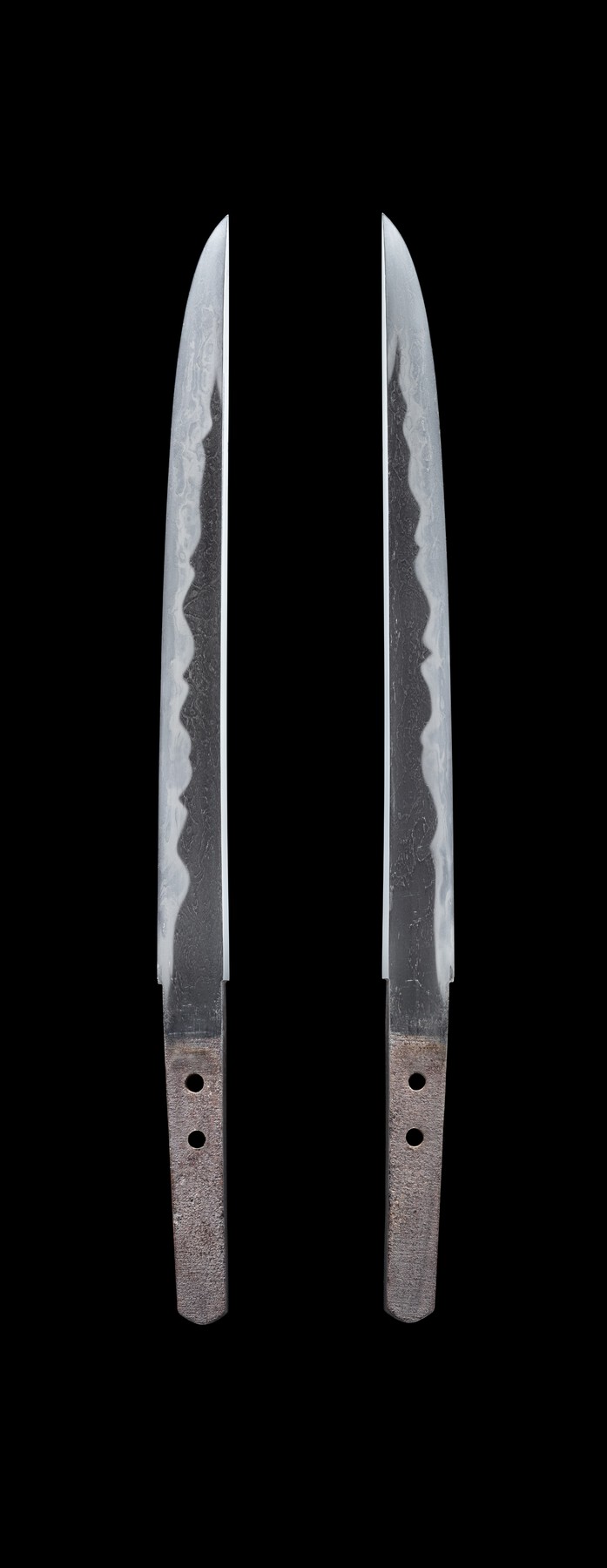
What makes this fascinating little blade so important is its date. It appears at least a full decade earlier than what has traditionally been considered Chōgi's established working period, making it a significant piece for students of Sōden-Bizen and the development of the Chōgi school. Unfortunately, the blade is showing its age. Condition issues including ware in the ha likely explain why it has remained at the Tokubetsu Hozon level despite its rarity and research value. Could it make Jūyō someday? Anything is possible, but I would not consider it likely. That said, it is probably the most reasonably priced zaimei Chōgi to appear on the market in quite some time. The blade was previously offered by Aoi Art roughly four years ago, though I do not know the asking price at the time. @Jussi Ekholm may have that information recorded. I am also curious why the current owner is parting with it after such a relatively short period, something some collectors may understandably view as a cautionary sign. The hitatsura is another point of interest. It is an outlier within Chōgi's body of work, recalling the work of Hiromitsu and, further back, the full-temper explorations seen in some works of Yukimitsu. Yet despite the treatment, Chōgi's hand still comes through clearly. The blade retains the dynamic,Sōshū-influenced Bizen character that makes his work so distinctive. Signed and dated Nanbokuchō-period works by Chōgi and his immediate circle rarely appear on the market. Even mumei examples are encountered infrequently. By comparison, the blade pictured below was offered by Aoi Art last year and received 2025 Tokubetsu Hozon papers to Kenchō—not Den Kenchō, but Kenchō himself, generally regarded as Chōgi's foremost student. Tanobe-sensei, however, attributed the blade to Chōgi in his sayagaki. Both opinions are entirely reasonable. The condition of that blade is exceptional. The zaimei example being offered here, however, provides something the Kenchō attribution debate cannot: a firmly signed and dated reference point from the formative years of the school. For collectors of top Nanbokucho Soshu works, that carries considerable importance. The asking price is not unreasonable for what is being offered, and I would not be surprised to see it rise before the auction closes, much as the zaimei Kanemitsu did last week. If I had an extra $40,000 available in these uncertain times, I would be very tempted. For collectors of Sōshū-influenced work, Sōden-Bizen, Nanbokuchō tantō, or blades exhibiting strong Masamune-style jihada, this is certainly worthy of serious consideration. As for me, I will remain content with my little mumei example.


-
Sa Yoshisada versus Den Iwato Ichimonji
Mushin replied to Elias6677's topic in General Nihonto Related Discussion
Michael, As usual, I agree with you wholeheartedly but I'm not sure I concur 100% on the above point. There are some ware in the Ichimonji hamon, small indeed, but pitting and openings in the ha kinda drive me crazy even on almost 700-year-old blades. Can't always be avoided and I get that. It's a purely personal thing. And when you say the Iwato jigane is tighter, I would argue that Bizen jigane is almost always going to be tighter than Sa School work, with the exception of maybe Yasuyoshi whose work appears to have been influenced by the Bizen school. The Iwato has flashes of brilliance but never quite gets there for my taste, but that's Iwato, I guess. It just doesn't have that "oomph" that the other Ichimonji schools have. Likewise, the Sa blade is well above average with a nice thick nioiguchi, but it's nowhere close to the top of the Sa School pile.At the same time neither of them are priced like they are national treasures. And I agree that by and large they on equal footing, both being stout Nanbokucho works done in notare, offering the qualities of their respective traditions. The ask isn't huge, but it is a big leap for most people. But I am with you in that Elias should walk away at this point and study until he knows what his heart desires, and a trip to DTI would be mind-opening. In fact, I need to go one of these years before I am a fully petrified fossil. PS: I am trying not to be a victim of my own Sa School fanboy inclinations but it's hard not to love what you love and not be swayed by that. -
Sa Yoshisada versus Den Iwato Ichimonji
Mushin replied to Elias6677's topic in General Nihonto Related Discussion
I am not trying to be difficult here but the questions really don't make a lot of sense to me. For example, please define what you mean by "history" of the blade? Are you talking provenance? The history of the period when it was made? How the smiths and schools were seen by history? Given that one sword is attributed to a smith who was the son of one of the most important sword makers in Japan, and the other is broadly attributed to a school, is that the kind of historical touchstone you are referring to? These decisions for many collectors are normally based on their own interests and collections. If you collect Nanbokucho Soshu, then the Sa blade fits. If you collect Kamakura Bizen then Ichimonji would be the way to go. Other collectors just buy what moves them. Some just buy Juyo. Some want blades w/cutting tests or battle damage. Some want swords from particular time periods or schools. Now, broadly speaking Iwato Ichimonji is viewed as the least prestigious of the four Ichimonji traditions, the others being Ko-Ichimonji, Fukuoka Ichimonji and Yoshioka Ichimonji. Hard core Ichimonji fans love the first two. But it ultimately depends on the sword, because even the worse Ichimonji can be great. That said I have seen MANY ho-hum Ichimonji. In fact, I was kind of unimpressed with the hype surrounding Ichimonji swords until seeing Paul Davidson's Yoshioka Ichimonji two years ago at Sothebys. It was like a revelation, like seeing a sword for the first time: a brilliant habuchi with choji that looked almost three dimensional; layers of floating utusuri like the clouds a plane passes through on its way to a landing. Never handled one like that before. I've seen some nice ones but this was the first and only one I ever handled where I remember thinking: "So this is what all the Ichimonji excitement is about." So, If my pocket were full of change, and if I were hunting for an Ichimonji blade, I would want something at least which approaches that. But that's aesthetics, not history. Elias, while I appreciate your desire to touch history, my recommendation is almost like a mantra or broken record on this board: keep your money in your pocket. Study. Look at as many swords as you can. And when you decide what school or time period moves you, then go shopping. Until then, keep your powder dry and your mind open. Buying swords is easy. Buying the right sword takes study. Best of luck. -
Sa Yoshisada versus Den Iwato Ichimonji
Mushin replied to Elias6677's topic in General Nihonto Related Discussion
The blades are radically different — different traditions, different aesthetics, different emotional impact. In some ways, asking whether the Jūyō Iwato Ichimonji or the Jūyō Sa Yoshisada is “better” is like asking which classic Hollywood star was more beautiful. There is no objective answer. The real question is: what are YOU looking for? Do you want the flamboyant, aristocratic elegance and luminous choji of Ichimonji? Or the darker, more intense, more inwardly powerful atmosphere of late-Soshu Sa work? Those are fundamentally different experiences. At the Jūyō level, you are already operating in rare air. Many collectors on this board have never even handled a Jūyō blade, let alone had the opportunity to choose between two. Is this an investment question? A market-value question? A “best bang for the buck” question? A school popularity question? Or is it about which sword actually moves you when you hold it? Because ultimately, that is the only thing that matters. The sword you keep coming back to in your mind — the one that pulls at you a little — is probably your answer. On the matter I will say only this: there appears to me to be no shortage of Ichimonji or Rai school blades out there in the market. If you miss one, another one will come along, both better and worse. The same can't be said for blades directly attributed to Sa School smiths. But, again, it all comes down to what moves YOU. Nobody here can answer that but YOU. -
Same just happened with a friend here in Florida. Bought some fittings from a well-known dealer in Japan. Arrived w/no problem from UPS and then months later, he got hit for almost $400 in taxes, fees and penalties. With the mess created by the tariffs and the issues we have had with thefts from USPS shipments from and to Japan, I have stopped buying from overseas altogether. Though there are some very desirable pieces I have seen of late on Japanese dealer websites, and the yen is so depressed v the dollar, it's just not worth the stress, worry and hidden costs. Looking forward to the remaining US shows and whatever my US dealer friends dig out of the woodwork or from older US collections. Sucks but it is what it is. I fear that the Golden Days of international sword trade may be behind us. Boo!