

Baka Gaijin
-
Posts
567 -
Joined
-
Last visited
-
Days Won
33
Content Type
Profiles
Forums
Events
Store
Downloads
Gallery
Everything posted by Baka Gaijin
-
Good morning everyone, I have a small stand with a perplexing inscription. I think it may be from Meiji, or possibly late Edo period. So far, I have So far, I think I have 用in the top line (Yo or Mochiru ?) and possibly 西 top character bottom line (Nishi or Sei?) followed by 田 (Ta or Ten?) Maybe Nishida? Thank you


-
I agree Piers, probably about 6hrs work, with the wind in the right direction.
-

Kondo Isami's "Kotetsu"
Baka Gaijin replied to Ray Singer's topic in General Nihonto Related Discussion
Shinsengumi seems to be flavour of the week, here's a blade in Koshirae with a stated link to Souji Okita, currently at a prestigious gallery in London: https://japanesegallery.com/katana-mumei-attributed-kashu-kiyomitsu-with-hozon-token -
Good morning Justin and Piers, Just in case, the Kamon depicted on post #5 are: Mukai Hato - two pigeons and Maru ni Mukai Hato - two pigeons within a circle There's a reference to the Mukaibato むかい ばと as a talismanic reference to the number 8 read as Hachi, and symbolism for Hachiman. Check this out, it may be a jumping off point: https://books.google.co.uk/books?id=Pf3PAgAAQBAJ&pg=PA98&lpg=PA98&dq=mukai+Hato&source=bl&ots=DMBB9iu86E&sig=ACfU3U2x5C-ah_MBAk5VH3gNiRCaUXT1gQ&hl=en&sa=X&ved=2ahUKEwjpprOH2ezpAhXfQxUIHYfhDYUQ6AEwAXoECAkQAQ#v=onepage&q=mukai%20Hato&f=false
-
Samurai Archer description of armour & rain coat or camoflauge!
Baka Gaijin replied to FletchSan's topic in Katchu
Good Evening everyone, The Getty Museum catalogues this as a hand coloured albumen silver print by Kusakabe Kimbei c. 1870 - 1890. -
Good afternoon Bernard, I am trying to lock down the name Shunki to a period around 1807, but the only name that I can come up with is Yasukawa Harusada II 1830 - 1887, who was known as Shunki 春暉. However, if there was a Yasukawa Harusada II, then, there was also a Yasukawa Harusada I, and, presumably the Shunki nickname is from the Haru in Harusada. We do need to go carefully, as one of the Utagawa Family also used Harusada in his art name. However, I came across a misnomer, and for a long while, an artist known as Shunko, was incorrectly referred to as Shunki, in Western textbooks available in the early 20th Century. Here he is, known as Katsukawa Shunko (1743 -1812): https://en.wikipedia.org/wiki/Katsukawa_Shunk%C5%8D_I Further work sounds like a job for Piers and Steve M. Great fun however, and thank you for sharing your collection..
-
Good morning all, Bernard, I think your print may be depicting something called "Kawabiraki", literally the River opening ceremony, which took place in a number of places, most famous being the area of the Ryougoku Bridge in Edo. Do you think it may have originally been a triptych, with another sheet on the left? A number of artists depicted it. Here's Utagawa Kunisada from c.1858, and also, as Ken observed, no one in foreground is looking at the fireworks in this one either.
-
Good afternoon Alexander, It looks like a Naval sword, and it's called a Kaigunto. People from the Military swords of Japan section will know quite a bit about it. You might repost it there, to get better response. http://www.militaria.co.za/nmb/forum/45-military-swords-of-Japan/ This will help as well: http://ohmura-study.net/945.html http://ohmura-study.net/903.html
-
At least it's not someone playing their drums at 02.30 Hrs.
-
Oh, the Ningyo bit!! That's doubly interesting, depicting Teppo as a Home defensive method of Intruder attitude re - adjustment, and also as a subject of a Puppet drama. Toyotake - za being a Bunraku theatre in Osaka: https://wepa.unima.org/en/toyotake-wakadayu/ Re the kamon useage on the pages, does this relate to puppet masters?
-
Apropos of nothing, From the National Diet Library database, here's an illustrated book published in 1700 called Ayatsuri Ebansuke あやつり画番附. アヤツリ エバンズケ It features, almost in Manga format, exploits of historic characters. Many interesting illustrations: In the link below, the image on the top right might be of some passing interest, possibly to one person living in Japan and two Vikings.... https://dl.ndl.go.jp/view/jpegOutput?itemId=info%3Andljp%2Fpid%2F2533295&contentNo=8&outputScale=4 This page is of NMB interest, unfortunately the forum settings won't allow me to upload the Jpeg directly: https://dl.ndl.go.jp/view/jpegOutput?itemId=info%3Andljp%2Fpid%2F2533295&contentNo=18&outputScale=4 Here's the link to the complete book, which is also on my page "Pre Modern Japanese Books and Illustrations" over on Facebook. https://dl.ndl.go.jp/info:ndljp/pid/2533295
-
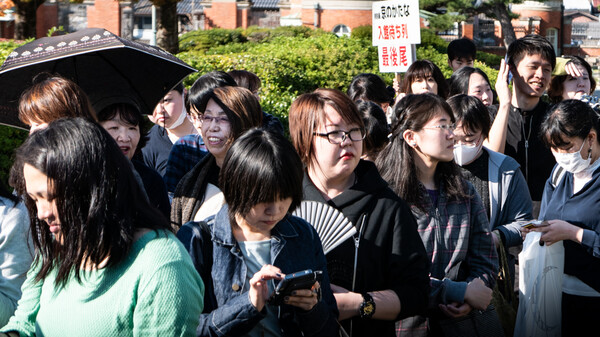
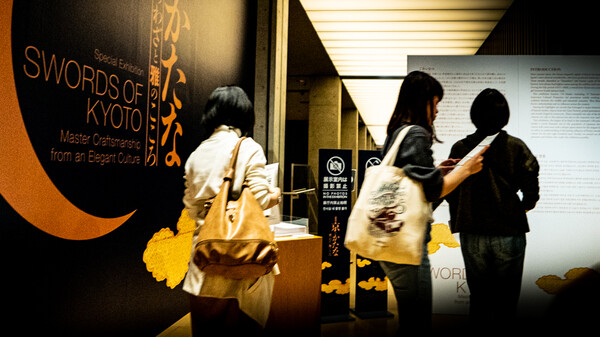
Good morning Greg, For a moment I thought you meant these Fans, patiently waiting to view "Swords of Kyoto" in 2018... Seriously though, the subject of Fans is really fascinating, as it encompasses so much, from a simple tool for keeping cool, part of an elegant game from the Heian Court, a devastating close quarter weapon, an object of Talismanic importance and a symbol which controlled the fortunes of men on the Battlefield. Here's a demonstration of Tessen against Sword at an Embu at Shiramine Shrine in Kyoto: https://www.youtube.com/watch?v=E1Tacd1JIkM
-
Good afternoon Nathan, Try researching "Igeta Ni Ichi Ji". Hi John, try researching "Futatsu Tsunagi Kanawa".
-
Good morning Piers, Excellent call from your wife. I'm not so sure about the Kampyo suggestion, as this looks to be rather a messy rural action, for the outdoors or the kitchen area. These fine Ladies in their elaborate Kimono are, as the say here in Bath, "Bon Ton". Closest I can get to an Edo period wringer is something called a Kinuta, a type of material dryer/ softener, involving one or multiple mallets: https://data.ukiyo-e.org/artelino/images/39825g1.jpg My thoughts would go to the Collections at both the Rekihaku Museum in Sakura, and the Edo - Tokyo Museum just down from the new NBTHK Hakubutsukan.
-
Good morning Bernard, I have tried to fathom out what the tool is in the second image. At first, observing that it was making something into a spiral, as evidenced by both the extrusion from the machine and the second example on the floor by the hasami scissors. I looked for spirals and the mosquito wheel came too mind briefly and was discarded. However, the white sheet that the second woman holds, may be the clue. It looks like a bolt of cloth I wonder if the machine is for turning out V shape cross section lengths of material for inner edging in Kimono? Or like the folded cotton Itomaki that is found on so called Satsuma Rebellion Tsuka. Your call Piers, as your knowledge of Arcane Edo period tools is legend.
-
53 Stations of the Tokaido by various artists
Baka Gaijin replied to Baka Gaijin's topic in Other Japanese Arts
Well done Brian, What Pietro said!!! Hi Piers, there's an interesting thing about the little pendant hanging from the shaft of the Yari in your print, given artistic licence. This demonstration of Owarikan - Ryu So Jutsu will show you what it is most likely for: https://www.youtube.com/watch?v=FGJa657qFOw PS from the Saya shape, it might be depicting a Jumonji (Magari) Yari blade, fighting with that is shown at 6.22. -
Thank you Ben, Doubly interesting subject matter, because we almost have the concept of Onna Bugeisha, which we mentioned earlier in the thread, as the print depicts two women engaging in what must surely be mortal combat. I suspect there is a more than little of "Hell hath no Fury" for one of the parties involved in the altercation. Katana v Bangasa? My money's on the one on the right!! PS, There's maybe a clue in the position of the Obi knot on the figure on the right, are we venturing into the distinction between Gaiko and "Belle de Nuit"? Any thoughts Piers or Steve?
-
I've found two in the National Diet Library Collection: I feel that the composition is an allegory upon the enormity of Nature and the fleeting insignificance of Man: Here in Volume 7 Frame 20, the theme is visited using large leaves: https://dl.ndl.go.jp/view/jpegOutput?itemId=info%3Andljp%2Fpid%2F851652&contentNo=20&outputScale=4 Volume 10 Frame 24, the theme using a mat against snow: https://dl.ndl.go.jp/view/jpegOutput?itemId=info%3Andljp%2Fpid%2F851655&contentNo=24&outputScale=4
-
Good call Steve, I'm currently checking out the 15 volumes of the Hokusai Manga at the National Diet Library. It's got the look of one of those image themes that an artist plays around with for years, until the right combination shows up. A bit like Rembrandt's images of beggars or Picasso's images of bulls.
-
Good Evening Bernard, Such names, Luminaries in the truest sense, despite this current age of instant online expertise. That which you have thus described, surely must fill in some valuable gaps in the perceived history of old school, "feet on the ground" 19th Century contributors to the burgeoning field of Pre and Early Modern Japanese Studies. Thank you
-
Good morning Bernard, I like the Hokusai attributed drawing, the question arises, which Katsushika? Katsushika Hokusai himself or Katsushika Oi? Fascinating story: https://en.wikipedia.org/wiki/Katsushika_%C5%8Ci Have a look under a glass of about 10x magnification and you will see thin and wispy pentimenti under and around the finalised ink in the main body and also amid the diagonal strokes. Well discovered Steve, re the collaboration between Urushibara and Brangwyn. Urushibara was quite a prolific artist in his own right, sometimes using the name Mokuchu, here is his rendition of a pile of old stones just down the road from me: This article from the "Grauniad" should fill in the gaps: https://www.theguardian.com/artanddesign/gallery/2017/feb/14/frank-brangwyn-yoshijiro-urushibara Re: "Grauniad" (UK Joke, you'll have to be a bit of a Private Eye to work it out).
-
Hi Brian, this would have been a preparatory drawing. The dealer Richard Kruml,who originally displayed it, described it as probably showing Satsuma troops battling with an Imperial soldier on a rearing horse. http://www.japaneseprints-london.com/1085/ As the production of a woodblock print involved the destruction of the artist's final drawing, a number of preparatory sketches would be done to get the balance correct, then a crisp line drawing would have been produced, which would be pasted to the first block and the Master block carver would start the cutting process.. This final drawing was known as the Hanshita - e. This will fill in the gaps: http://www.aisf.or.jp/~jaanus/deta/h/hanshita.htm Here's a similar, albeit reversed rearing horse in this triptych by Yoshitoshi: https://data.ukiyo-e.org/bm/images/AN00694564_001_l.jpg
-
Good morning everyone, A few posts back, I used the term pentimenti, being the visible trace of other drawing beneath the final design. Literally "evidence of the hand", showing the decision making process as the artist works the layout of the elements of the drawing. Here's an example by Yoshitoshi.
-
Hi Guys, I'm Back, with perhaps a more appropriate username! Nothing to see here! Move on! The Artist previously known as Malcolm, now signing as Malcolm T, when he can work out how to do it, and zero ratings......... ROFL. Cue for Handel's "Sarabande": https://www.youtube.com/watch?v=AWMR79IMQ-M Pip Pip Cheerio Mateys!!
-
With respect and thanks to Professor Oka for allowing free access to her monograph on this time honoured publication: https://dept.sophia.ac.jp/monumenta/news.php Bettina Gramlich-Oka Chief Editor, Monumenta Nipponica Professor, Japanese History Faculty of Liberal Arts & Graduate School of Global Studies Sophia University




