Lewis B
-
Posts
1,807 -
Joined
-
Last visited
-
Days Won
10
Content Type
Profiles
Forums
Events
Store
Downloads
Gallery
Everything posted by Lewis B
-
The idea of sabbatical for experienced smiths where styles of different schools were intermingled and knowledge on sword making exchanged, was not a new idea. There are the famous Goban Kaji who were summoned to the forges set up by Emperor Gotoba in the early 13th century. With the participation of 42 smiths this wasn't an inconsequential undertaking. They spent a month or 2 working in Kyoto, then to be replaced by another group. Seems like a very good way for the styles of the principle Gokaden of the time to cross pollinate.
-
From the Soshuden Museum. The idea being these 10 makers were already established swordsmiths and just implemented some of Masamune's ideas into their own style. That would certainly explain some of the divergence from traditional Soshuden style from the likes of Go (Yamato), Norishige (Ko-hoki), Chogi and Naotsuna. The Masamune no Jittetsu were already well established swordsmiths who worked in their own tradition as well as studying the techniques of Masamune. There is a legend about Masamune's jittetsu (followers/disciples) that came from the depths of centuries and is known to everyone in Japan now. They were 10 as the saying goes and they studied the art of sword-making with Masamune implementing their own ideas and methods of blade forging. [Gō Yoshihiro (江義弘), Saeki Norishige (佐伯則重), Bizen Kanemitsu (備前兼光), Bizen Chōgi (備前長義), Hasabe Kunishige (長谷部国重), Sekishū Naotsuna (石州直綱), Chikuzen Samonji (筑前左文字), Yamashiro Rai Kunitsugu (山城来国次), Mino Shizu Kaneuji (美濃志津兼氏), and Mino Kinjū (美濃金重)] Probably it was one of the first kind of workshops attended not only by beginners, but experienced and well-known sword smiths. The composition of the so-called Masamune’s ten best disciples was determined in different ways at different times and by different specialists. In modern literature, its composition is uniform and includes ten masters. This list did not always consist of ten smiths: sometimes it was supplemented by Kongōbyōe Moritaka and, at one time, it did not include Rai Kunitsugu, Naotsuna or Chōgi (Nagayoshi). From nihonto.us: As with the smith, Shizu Kaneuji (志津兼氏), swords exist from Yoshihiro (義弘) that are dated to a time before his study under Masamune (正宗). Early blades such as these show a strong Yamato (大和) influence. I don't think there are any existing signed and dated Go Yoshihiro pieces. The earlier dated Yoshihiro works are likely Senjuin Yoshihiro (possibly Go's father).
-

What exactly determines the price of a nihonto?
Lewis B replied to Ikko Ikki's topic in General Nihonto Related Discussion
Some blades seem to completely embrace the Shintetsu vibe. Take this Juyo Sekishu Naotsuna
-
No I wasn't making any suggestion Go was a real candidate for that blade, merely following Kirill's kantei thought process to exclude his attribution from the list of possibles. As for Giordy's reference, it certainly adds to the dichotomy of what is accepted as Go Yoshihiro. He clearly has a leaning towards Yamato, yet Soshuden, with which he is most closely associated in the reference books, is said to have had its roots in the Yamashiro gokaden. How much would he have been allowed to improvise if a student of a master like Masamune, who has quite a different style. I would have expected more Soshuden influence had he apprenticed in Sagami. He was clearly a gifted prodigy and its possible to imagine he was able to absorb different techniques and create something unique that appealed to his artistic and technical capabilities.
-
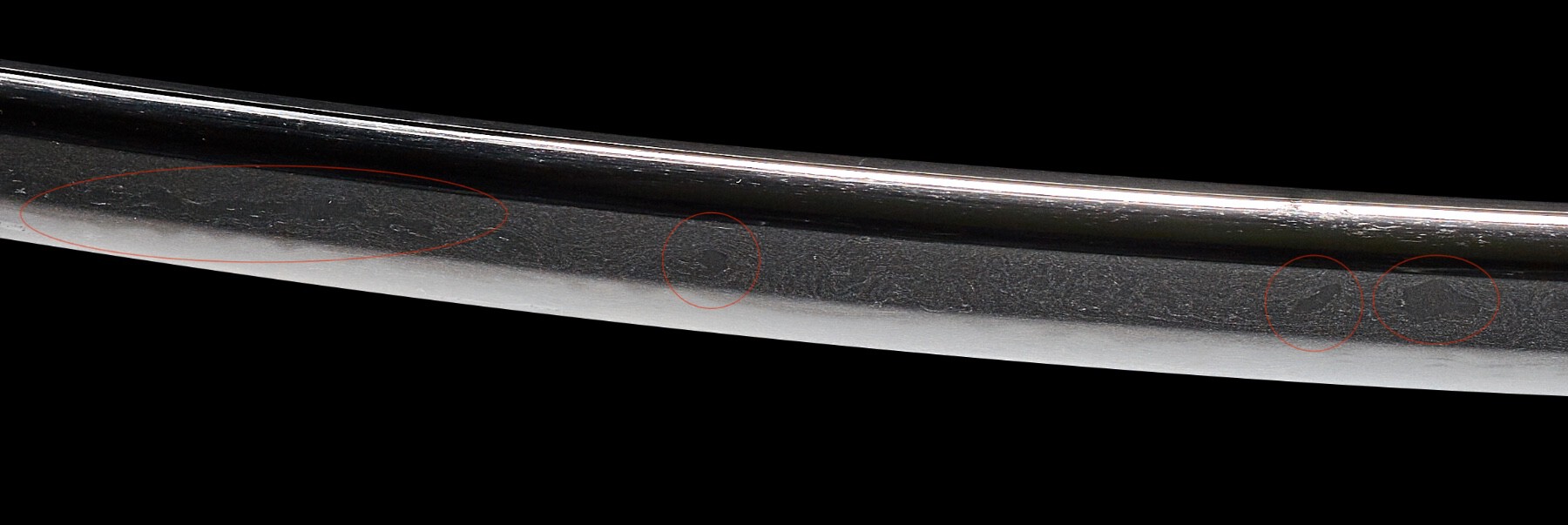
Can you highlight the areas? I'm having a problem seeing anything resembling what you describe. I'm sure you're not referring to the Nie particles indicated below. To me this appears like a healthy blade based on the limited photos with some inconsistency in the nioiguchi along the Hamon line as Kirill mentioned (lighting might be playing tricks).

-
Go is said to have had a close relationship with Norishige (geographically and in sword making) so he may have been influenced by several styles incorporating Soshuden Masamune, Norishige's Ko-hoki/Soshuden and his father's Yamato (Senjuin) style where he may have cut his teeth. It's fun to speculate although we can never 100% secure in such suppositions.
-
Senjuin Yoshihiro. Juyo papered https://winners-auct.../productDetail/26999


-
Here are a couple of swords attributed to Senjuin Yoshihiro. Style seems quite different to the subject of this Kantei at least regarding the jihada but the ko-maru boshi is very close. https://winners-auct...p/productDetail/2667 This one has more detailed closeup images of a Juyo SY. https://winners-auct.../productDetail/26999
-
Hi Giordy, I was familiar with the Nabeshima Go although I'm not sure that shows the masame hada that seems obligatory for Yamato, certainly Senjuin which is the school most likely associated with early Go. Yamato boshi tends to have varying degrees of hakikake covering the full spectrum all the way to full on kaen, although Senjuin Yoshihiro has a tendency towards o-maru from the example in the Kantei thread and the example below. And in that kantei thread, Go Yoshihiro was sort of excluded mainly due to the style of boshi. Kamakura era Senjuin Yoshihiro, who it is postulated to have been Go's father, may be the smith. I wonder if these 'early Yamato inspired Go blades' referred to on nihonto.com are really by Go's father. Go was supposedly born around 1300, so his father could have been around long enough to have made the dated short sword signed Senjuin Yoshihiro from 1353. Certainly not out of the realms of possibility Go included some of his fathers Yamato-den forging style while apprenticing with Masamune, especially given his young age and experience.
-
Reading up about blades with both Yamato and Soshu characteristics, there are references to Go Yoshihiro and Yamato Yoshihiro (early and late generations) and that Go Yoshihiro was in fact a Yamato swordsmith (at least in his early career). Early Yamato Yoshihiro possibly being Go's father. The biographical work here for Go Yoshihiro https://nihonto.com/go-yoshihiro/ states that his early work shows a strong Yamato influence but I have yet to find an early blade that has been definitively attributed with these characteristics. His later Soshu era blades also appear to show Masame hada mixed with Itame? I believe it was Kazuo Tokuno who theorized that Go was in fact a Yamato swordsmith and then incorporated Soshu features, without actually apprenticing with Masamune, such was the diffusion of knowledge and techniques at the time. Does anyone have any examples of early Go work that exhibit these postulated Yamato features, beyond the Masame/Itame hada?
-
@PromoSorry for the hijack. I just read the whole thread and what an amazing journey. I wish I was able to attend the next NBTHK EB meeting in Manching to see it in person. It's become quite a celebrity piece on NMB it seems. It's unfortunate it didn't pass Juyo last Shinsa but I think 2023 was an odd one by all accounts. I'm glad Markus was able to shed so knowledgeable light on the blade and Sayagaki. My Shikkake also has Yuhin nari kanji (優品) and a suggestion by Tanobe sensei that it was a Juyo candidate. Might be worth resubmitting a few years down the road if you feel so inclined. Otherwise I'm sure you're basking in the pleasure of a special blade, with a wonderful and unique story, back in your possession. This ranks up there with Andrew's National Treasure Norishige Ebay find.
-
AI has a lot to learn. In my efforts to understand swordsmiths who combine both Yamato and Soshuden characteristics this is what ChatGPT has decided I need to know..... back to the books Here is an artistic rendering of a nihonto sword blending both Yamato and Soshu characteristics, as described. It captures the elegance and robustness of both styles. ....

-
Unrelated but is there a list of future NBTHK EB meetings and locations? Where are these announced?
-
SWORDSMITH OKIMONO FOR YOUR LITTLE TABLE
Lewis B replied to BIG's topic in Auctions and Online Sales or Sellers
With the Chonmage hair adornment I would suggest it depicts a samurai inspecting his blades. -
Identification of this antique Japanese Sword (signature)
Lewis B replied to Dagamas's topic in Military Swords of Japan
The Chinese are past masters at fakery eg Rolex and LV knockoffs. These swords are lazy attempts to deceive. -
There is a book called "Sword Art Book" by Kazuo Tokuno who seems to have a some interesting theories. He states ``This shows that Yoshihiro Etchue was one of a group of Senjuin blacksmiths who migrated from Yamato to Hokuriku. There are no characteristics that indicate a master-pupil relationship with Soshu Masamune, as was said in ancient times. In the same way, the characteristics of the Yamato tradition passed down within the Soshu blacksmiths who gave birth to Masamune are reflected in Masamune's swords. The characteristics of the Yamato tradition are also reflected in the swords made by Yoshihiro E, a Yamato blacksmith.If there is anything in common between the two, This is not a common feature among the Soshu-den blacksmiths, but rather a commonality between the Yamato-den blacksmiths over time. Named after the area of Yoshihiro Senjuin's work, the ground iron has a flowing texture and is stained with earthenware, and the hamon is all burnt in the bay. There was a streak of lightning running, and the hat was scattered and swept, suggesting a connection to Etchu's Yoshihiro. " Mr. Kazuo Tokuno has also been suggested, and among the interpretations of the Hon'ami family in the early Edo period, Mr. Tokuno is also said to have implied the connection between ``Yamato Shizu'' and ``Shizu,'' ``Senjuin Yoshihiro,'' and ``E Yoshihiro.''
-
This was a fascinating exercise and one I will be refering to as I try to unravel some of the complicated attribution history of my newly acquired blade. I think it will be necessary to refer to some Japanese language source materials.
-
Try reaching out to these guys. Very helpful and speak English. You might able to get some additional information especially as they sell a lot of older pieces. https://shop.kurashige-tools.com/en-us
-
What exactly determines the price of a nihonto?
Lewis B replied to Ikko Ikki's topic in General Nihonto Related Discussion
Older Koto blades eg Yamato, don't have core steel. The construction is hyoshigi-gitae. You can see how they are constructed in this article, which might explain why it is not a positive feature. Personally I think it detracts from the overall aesthetic as the exposed Shigane is often featureless and contrasts badly with the activity that the smith intended to show. It could also weaken the blade as the outer hardened surface, if that was the intention of the smith, is now absent. https://www.mandarin...hods-Japanese-swords -
Yes, I have already gleened some interesting research leads for my new sword after reading up about Yamato and Soshu Gokaden. Invaluable is the correct word.
-
He's sold from both Japan and USA for as long as I can remember? The latter seem to be more 'questionable' pieces.
-
The more I come across 'Komonji' as a seller the less I like. I wouldn't touch one of his blades with a barge pole, just out of principle, no matter how good the apparent 'deal'. Ray posted genuine Mei for Yasutoshi in the linked thread, and stylistically these kanji aren't even close.
-
Here is a partial translation of the Tanobe Sayagaki: 和州千手院 大磨上無銘而細身小鋒ノ華奢な形態ヲ呈し板目刃寄リニ 流レル肌合ニ地沸厚ク地景入リ刃文ハ直調小互乃目ガ草ニ乱レテ盛ン ニ沸付キテ輝キ砂流、金筋ガ頻リニ絡ミ随所ニ湯走リガ形成サレ更ニ火 炎帽子トナルナド大和傳ト相州傳ノ折衷的ナ感ノ出来口ヲ示候 古来他 四派ニ見ナヒ程ニ盛ンニ乱レタ者ヲ同派ニ極メル傾向ニアリ其意味カラ 所伝ハ妥当也 刃長貮尺寸四分半 歳甲辰菊月探山識花押 "Washu (Yamato) Senjuin: O-suriage-mumei, it has a slender and delicate shape. (Jigane is based on) itame with nagare-hada (running pattern) along the hamon. (It is covered with) thick ji-nie and chikei. The hamon is sugu-cho with tasteful ko-gunome midare and full of shiny nie, sunagashi and kinsuji. Yubashiri is formed here and there, and even more, boshi is Kaen. It shows an eclectic feel of both the Yamato-den and Soshu-den. There has long been a tendency to attribute Senjuin to styles with midare-ba with rich hataraki not seen in the other four schools of Yamato-den, so the identification of this sword as Senjuin is appropriate. Edge length 2 shaku sun 4 bu han (a half) Date Kinoe Tatsu (2024) Kiku zuki (September ) Tanzan wrote kao. "
-
After doing a bit of research on this suggestion I'm not 100% there. The jihada for Shikkake from that era tends to be less well executed and more rustic. Here is an example of a Nambokucho Shikkake katana. It's certainly worlds away from my late Kamakura era Yamato Shikkake. http://www.nihontocr...ikkake_Tokubetsu.htm The sword has another attribution which we can discuss after I receive the blade and have had a chance to see it in person. This was an interesting comparo, The top kissaki is from a signed Norishige wakizashi from his early period. And no, the Senjuin wasn't given a Norishige attribution.