

Mark S.
-
Posts
2,062 -
Joined
-
Last visited
-
Days Won
5
Content Type
Profiles
Forums
Events
Store
Downloads
Gallery
Everything posted by Mark S.
-

How Many Vintage Swords Still Exist?
Mark S. replied to Vermithrax16's topic in General Nihonto Related Discussion
What I am always fascinated by is how blades survived over the years, all they have been through, and what they have seen. 1) Use at the time it was made and in following years? 2) Daily carry or combat? 3) One or more sword collections/confiscations? 4) Traded back and forth, given as rewards? 5) Dropped on the battlefield and subsequently picked up for use? 6) Sat in a castle storeroom? 7) Shortened once or more times? 8.) Polished ? times? 9) Remounted for WW2? 10) Survived mass collection and destruction orders... or the GI who brought it home to slice the shrub hedge with it? 11) Survived the years since... Combine one or more factors above (and any others you wish to add) and it is amazing these blades are here today. Just how does a blade several hundred years old survive to today? Mark S. -
Thanks Brian... and all... Lesson(s) learned.
-
Jean, Yes, unfortunately it won't let you search for words less than 4 letters, so "den" was out. In the interim, another member kindly pointed me to exactly what I was looking for. Mark S.
-
Not trying to sidetrack this thread, but if my memory serves there was a thread or article or ? that discussed "Den" and its meaning and 'attribution' vs. 'in the style of'... does anyone remember it and have a link to that? All VERY interesting! Mark S.
-
Thought I saw some darker spots/areas of nie along edge of hamon (which is why I guessed Naotane) which may have been the pics, or just me looking for something a little 'different'.
-
Shinshinto Naotane
-
Anything special planned yet? Presentations, displays, etc? Thanks, Mark
-
Kanamuchi (Kanemuchi) Iron Whip
Mark S. replied to Marius's topic in General Nihonto Related Discussion
How much matcha DO you drink?!?! -
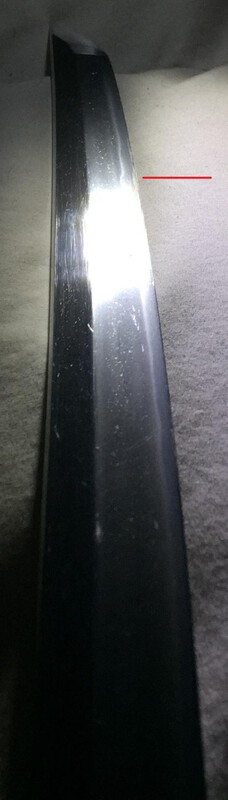
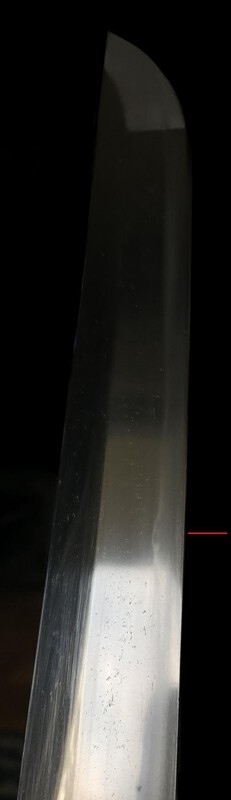
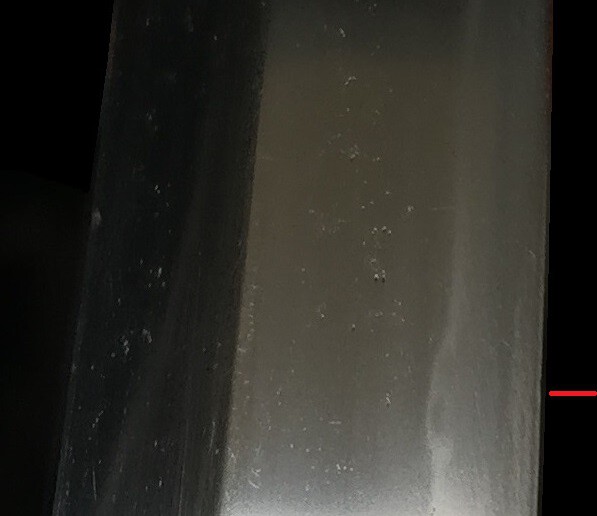
All, Just updating this a bit. Finally took a few photos that capture the activity I was asking about before. A small red line in each pic highlights the location. Most of the blade is suguha with a very tight nioi-deki, except at this one point. Upon closer inspection, it looks like two very small darker oval areas side by side surrounded by nioi. Is there a name for this activity? Still have not found a good pic of fuschi, so I am not sure if this is it, or would it simply be referred to as midare? The first pic just gives an overview of the suguha hamon. The second two highlight the activity. Thanks, Mark S.
-
My bid... Sue-Bizen Norimitsu. Mark S.
-
As I own 2 mumei blades and like them very much, my following comment has more to do with continuing the discussion vs starting an argument I would think any mumei blade's attribution can be 'questioned'... send a mumei blade to another organization (or even the same at a later date) and the results might be different depending on who is looking at it. Of course, if the blade has been inspected on more than one occasion and the results are the same... or very close to the same, then I think it is much more difficult to 'question'. However, that is one of the things I find interesting about mumei blades (at least relatively good ones). There is always something to find, or discuss, or research that either supports or refutes an attribution. Yes, a signed blade that has been authenticated is a safe bet. A mumei blade will always have a bit of mystery. For some, it is not their cup of tea, for others it is. Mark S.
-
Connoisseur's Book Re-Release
Mark S. replied to md02geist's topic in General Nihonto Related Discussion
May I ask if the drawings in the original are relatively dark (not black, but a darker grey) especially in the shinogiji areas of the drawings? They show a lot of detail, and there is quite a bit of contrast between the lighter and darker areas which I assume is supposed to highlight the details... but I have have also seen where 'copies of copes' do tend to get darker. I suppose this would take a side by side comparison. EDIT: Sorry, meant shinogiji area, not mune... -
Connoisseur's Book Re-Release
Mark S. replied to md02geist's topic in General Nihonto Related Discussion
If someone has an original and wants to check: Last numbered page is 355. It is the index. At the top of the page is "unchangeable smiths, 21". Last entry on the page is "Zoto Shinki Ho, 298". The last page before the glossary is page 335. At the top of the page that reads: "are seen, as is rugged patterning. Work- manship looks rather like that of Yamato- den." It is a continuation of smith info Hidari Mutsu Kaneyasu from page 334 On page 304 the last sentence on the page under PATTERN is: "Soshu tradition: Features identical to those of Masayoshi." Page 236 first sentence is: "Kinmichi, ha agari kurijiri is similarly rare in" Page 202 first sentence is: "of the Odawara Soshu school. The smiths" Page 143 first sentence is: "find examples of their work on occasion. The" Page 129 first sentence under PATTERN starts: "ji-nie becomes yubashiri..." Page 90 first sentence starts: "Yukimitsu..." Page 31 fifth sentence down contains a typo and reads: "civil war, in which savages battles were fought". S at end of "savages" does not belong. Only remember this because I read it not too long ago... I tried to randomly pick things as well as pick things that might be 'pushed back' if new info was added. Hope it helps. If any other info would help, let me know. -
Connoisseur's Book Re-Release
Mark S. replied to md02geist's topic in General Nihonto Related Discussion
Ok... guess I should have waited. While originally advertised by Amazon at $75 and then a price drop to $61... two other sources (which can be seen at Amazon) now have the book at $47 and change plus $4 shipping. All I can say is the book is one heck of a lot of invaluable info for around $50!!! Get em while the gettin' is good! -
Connoisseur's Book Re-Release
Mark S. replied to md02geist's topic in General Nihonto Related Discussion
Book arrived. -
Connoisseur's Book Re-Release
Mark S. replied to md02geist's topic in General Nihonto Related Discussion
Ordered Dec. 26 from Amazon Email confirmation that it shipped today Jan 19 Delivery date supposed to be Saturday. For anyone on the fence, I think you are safe to buy... -
Connoisseur's Book Re-Release
Mark S. replied to md02geist's topic in General Nihonto Related Discussion
I figured the best way to confirm all this was to call Oxford Press directly as today was the printing date. The customer service rep kindly confirmed that they "had current stock on these"... Looks like this is actually happening! So I guess the next big question in the future will be if this printing will be considered utsushimono... or simply gimei -
Pillar, post, spoke? I think I am tending toward "spoke" as in "spoke of a wheel".
-
In model building, parts on the 'parts tree' are attached by a 'sprue'.
-
Connoisseur's Book Re-Release
Mark S. replied to md02geist's topic in General Nihonto Related Discussion
Amazon just sent me an update email that a delivery date of Jan 25 - 28 has been set. AND the price dropped from an estimated $75 to $61.22 -
Sharpening Instead Of Polishing
Mark S. replied to Prewar70's topic in General Nihonto Related Discussion
Pumice is usually very gritty... The stone in the video appeared chalky... almost 'soapy' when the blade was drawn across it sharp edge first and seemed to shave several small pieces off. -
Connoisseur's Book Re-Release
Mark S. replied to md02geist's topic in General Nihonto Related Discussion
Pre-ordered Connoisseurs Book from Amazon as a Christmas present to myself... we shall see what happens. Between this re-release of the Connoisseurs Book, and the copy of Facts and Fundamentals I picked up from Amazon back on December 30, 2014 for the princely sum of $32!!!, I figure I have saved literally hundreds if not THOUSANDS of dollars!!! But the big question is... do we order several copies in the hopes that prices will be back in the thousands when they run out again? Mark S. -
Sharpening Instead Of Polishing
Mark S. replied to Prewar70's topic in General Nihonto Related Discussion
The stone used seems extremely soft... almost chalk-like... although drawing the blade across any surface like that will cause wear. Mark S. -
Must have been quite the 'double take' when you saw it in the store! One of those "Hey... wait a minute!" moments. Closest I have had was finding a tall wooden box (like the kind used for Japanese tea ceremony bowls) in a resale shop. There was a Shino-ware vase I also noticed sitting on the front counter. I walked over to look at the vase because I thought the vase and box were a match. A lady speaks up and says "I am buying that vase". So because I hate to see things split up, I explain that the box and vase 'might' go together thinking I will give up the box. She kindly says "It seems like you know more about this than I do... would you like the vase?" After the usual back and forth of "you don't have to", etc., I happily accept. I then payed for her items as well. So for $2 for the box, $5 for the vase and $5 for her items, I walked away with a very nice vase/box combo. Later learned the box and vase DID belong together. 5 minutes later and the vase would have walked out of the store with someone else... and without its box. Love these stories...
-
I guess I'll ask... Did you get the story behind how this ended up at an "old toy shop"?


