Markus
-
Posts
966 -
Joined
-
Last visited
-
Days Won
28
Content Type
Profiles
Forums
Events
Store
Downloads
Gallery
Everything posted by Markus
-

The Naoe Shizu That Was A Masamune
Markus replied to Jim P's topic in Auctions and Online Sales or Sellers
I second Dirk, it can be nice to have a (obviously great by its own) blade that was handed down as Masamune in feudal times, so to speak a blade that initiates chat like "you know, this one I have here was once treasured as Masamune within the XY family." But if already the Hon'ami paper is fake, and everything points towards that, I as a potential buyer would ask Tsuruta san to find out about the pre-origami provenance. So maybe either the origami was later faked to "underline" the provenance, or all the provenance just goes back to the fake paper. Former being ok and origami can be disregarded and left in the drawer, latter not ok (if you consider buying because of the alleged provenance)... -
I think the name might read "Nagayoshi" (長好).
-
Not commenting on your "theory" but you really have to be more careful selecting your references Karl. The Tadayoshi blade in the middle of the last pic, that is somehow presented as 1596/1601? work, is actually dated Ansei six (1859).
-
Reference Request: Sa Yukihide (Text)
Markus replied to Markus's topic in General Nihonto Related Discussion
Excellent Kunitaro! Search is over (although if some were preparing to send me scans from Kataoka's book, they are of course still highly welcomed). -
Year End Fund Raiser/raffle/etc
Markus replied to Brian's topic in General Nihonto Related Discussion
Would give vouchers of 50% off on any of my print books and several eBooks (full, no vouchers of course). Also have a signed copy of my Japan's Most Important Sword Fittings here that I will put in. [Edited as initial post didn't make much sense ] -
Reference Request: Sa Yukihide (Text)
Markus replied to Markus's topic in General Nihonto Related Discussion
Danke Peter! Unfortunately, no mention of his son or adopted son... Search continues. -
Hi Klaus, The mei reads: Tôto-jû Minamoto Yoshiharu saku 東都住源義治作
-
Hi guys, Is anyone able to provide me with scans of some of the text parts of the book "Sa Yukihide to Koyama Munetsugu Sono Ichirui" (Kataoka, 2000) or with scans of old Token Bijutsu issues, No. 118-223? Assistance would be much appreciated as I am trying to clarify some issues about his adopted and his natural son. Thank you!
-
Let me get that straight Karl: What you are preparing is an overview of the individual features of the character HI in HIZEN as used by several Hizen smiths, right? And what books are you talking about that are "totally wrong"? Well, I mean I honestly don't want to sound egocentric but as you mention "referring to at the moment", there IS a slight chance that one of my books is concerned. If so, I would be eager to know about possible errors or ambiguities (and transparent backing info) in order to correct them. Apart from that, the "full" Koyama Munetsugu mei is still in the pic (and titled 1602) and this smith is not at all related to the Hizen Munetsugu line. What I would recommend is that you also incorporate Yokoyama Manabu's extensive studies on Hizen-tô (as published in the Token Bijutsu) in which he also goes much into detail about various daimei and their individual features.
-
Why is there a Koyama Munetsugu reference in this pic titled 1602?
-
Indeed. The abbreviated form 広 of 廣 was not in use before the Meiji era (and only become common in the early Showa era). In olden times, 広 would have been abbreviated as 广 (if at all). http://www.kanken.or.jp/project/data/investigation_incentive_award_2010_yamashita.pdf#search=%27%E5%BA%83%E3%81%AE%E5%AD%97%E3%81%AF%E3%81%84%E3%81%A4%E3%81%8B%E3%82%89%27
-
Brainstorming: Gendai Project Online
Markus replied to Markus's topic in General Nihonto Related Discussion
@Joel: Thanks a lot for your offer! Still sorting out things how to tackle this one best and first of all, how to let it go through as a crowdfunding project. I am on vacation from tomorrow (7th) and back on Oct 19 and will PM you afterwards if I have any questions. -
"Rusu" (留守) was the minumum emergance part of a division that remained stationed in Japan whilst the actual unit was deployed to overseas/outside territories.
-
Not a big thing Joel and I also saw your reply to Tom. I just thought why not adding a short info in the first place, like "I found some interesting stuff here" and then the full quote, regardless of if Tom is on this board or not. No need to edit your post and also I didn't want to sound rude.
-
@Joel: Why not mention you got that 1:1 from Tom?
-
Jon, I have to see if I can make it to Tampa. There is an armor convention in Italy around that time that I am attending and I fear it might be on the very same weekend. But will be in Orlando in June for sure (although that's quite some time til then .
-
Excellent article! FYI, I briefly touched the subject of shin jûgo-mai a while ago on my site: http://markussesko.com/2013/02/15/rare-mentionings-of-forging-techniques-in-sword-signatures/
-
Just wanted to let you know.. Found via: http://markussesko.com/ Or directly: https://japaneseswordlegends.wordpress.com/
-
Brainstorming: Gendai Project Online
Markus replied to Markus's topic in General Nihonto Related Discussion
There will be a book of course in the end and I think it will be something like if you donate a certain amount to the crowdfunding you get the book, for a certain lower amount you get the eBook, and for a certain higher amoung you get both. Try to figure out which platform to use and how much I gonna need to make time available to feed the online database. Oh, and the sending of photos and oshigata is already going on for some months. Got quite a nice basis to work with in the meanwhile, thanks to NMB. -
It is indeed a work of Kotani Yoshizô Kaneyoshi. He was born in 1894 and mei like "Mino Yôrô-jû Kokaji Kaneyoshi saku" (美濃養老住小鍛治包義作) or "Mino Yôrô-sanroku-jû Kotani Kaneyoshi saku" (美濃養老山麓住小谷包義作) are his early signature variants. Later on, he was assisted in developing his cursive script mei by the local calligrapher Ôno Hyakuren (1864-1941). And as Peter said, Kokaji is just a nickname that refers to Sanjô Kokaji Munechika. More info on Kaneyoshi will be found in my upcoming Gendaito book but this is one of those cases where a living online database makes sense. One quick adjustment, and the info is updated (with pics), easily available for future generations of collectors.
-
A Kanji Discussion. Boys Day Sword. (Tomo ?) Nari.
Markus replied to kusunokimasahige's topic in Nihonto
It is actually the character for (友). Just an older way of writing it that resembles the character (支). See below mei of Ko-Bizen Tomonari (to whom I think this mei alludes to).
-
Brainstorming: Gendai Project Online
Markus replied to Markus's topic in General Nihonto Related Discussion
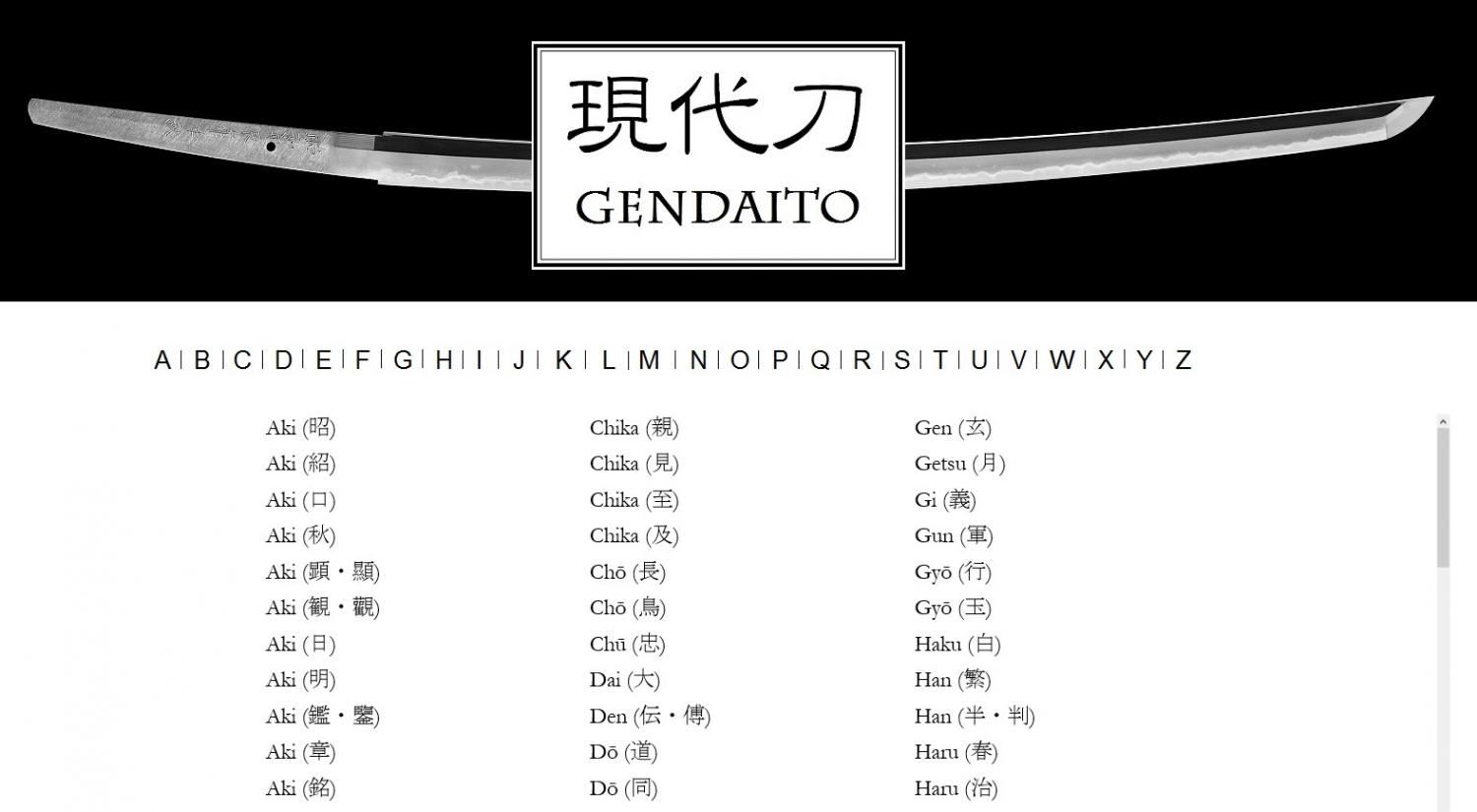
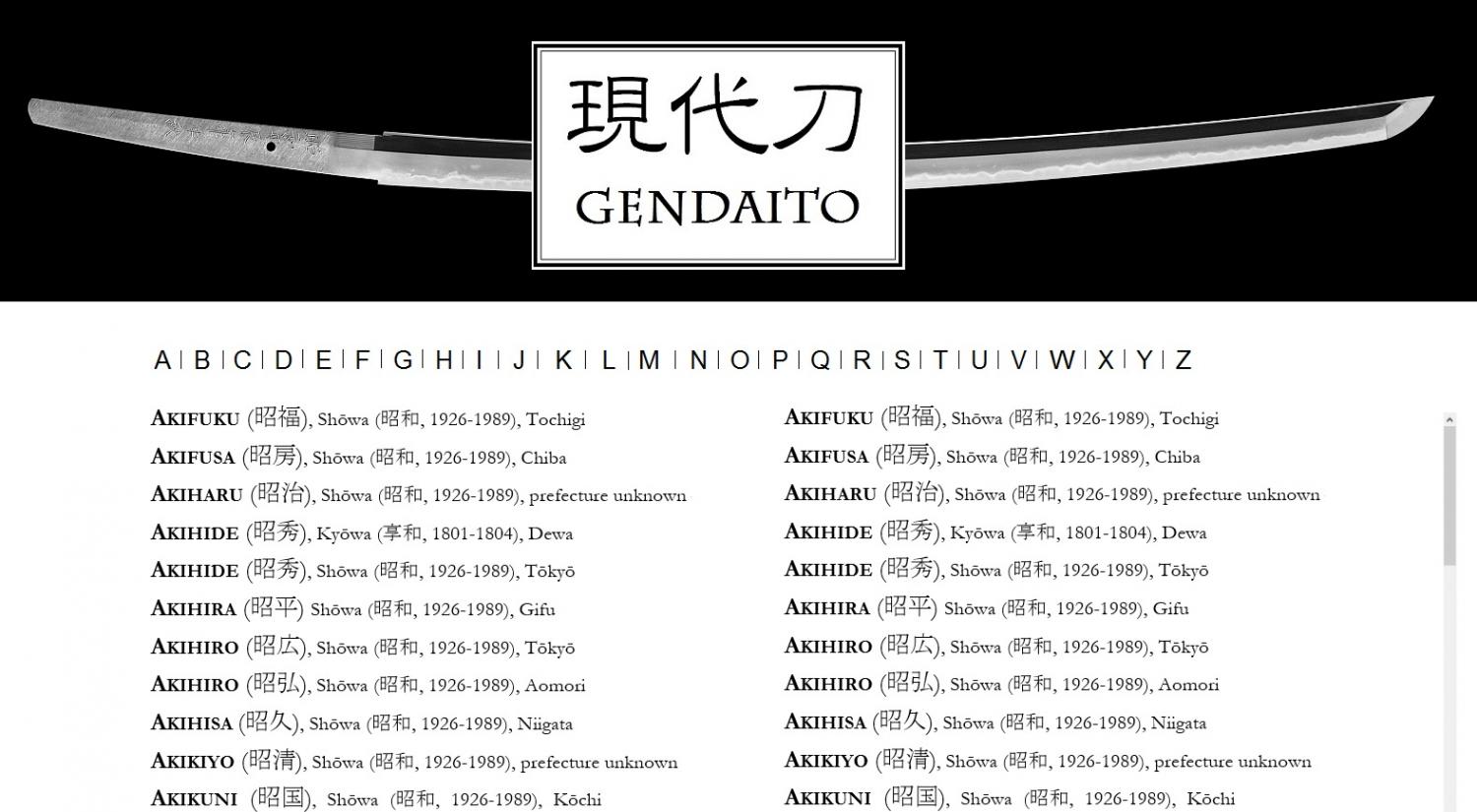
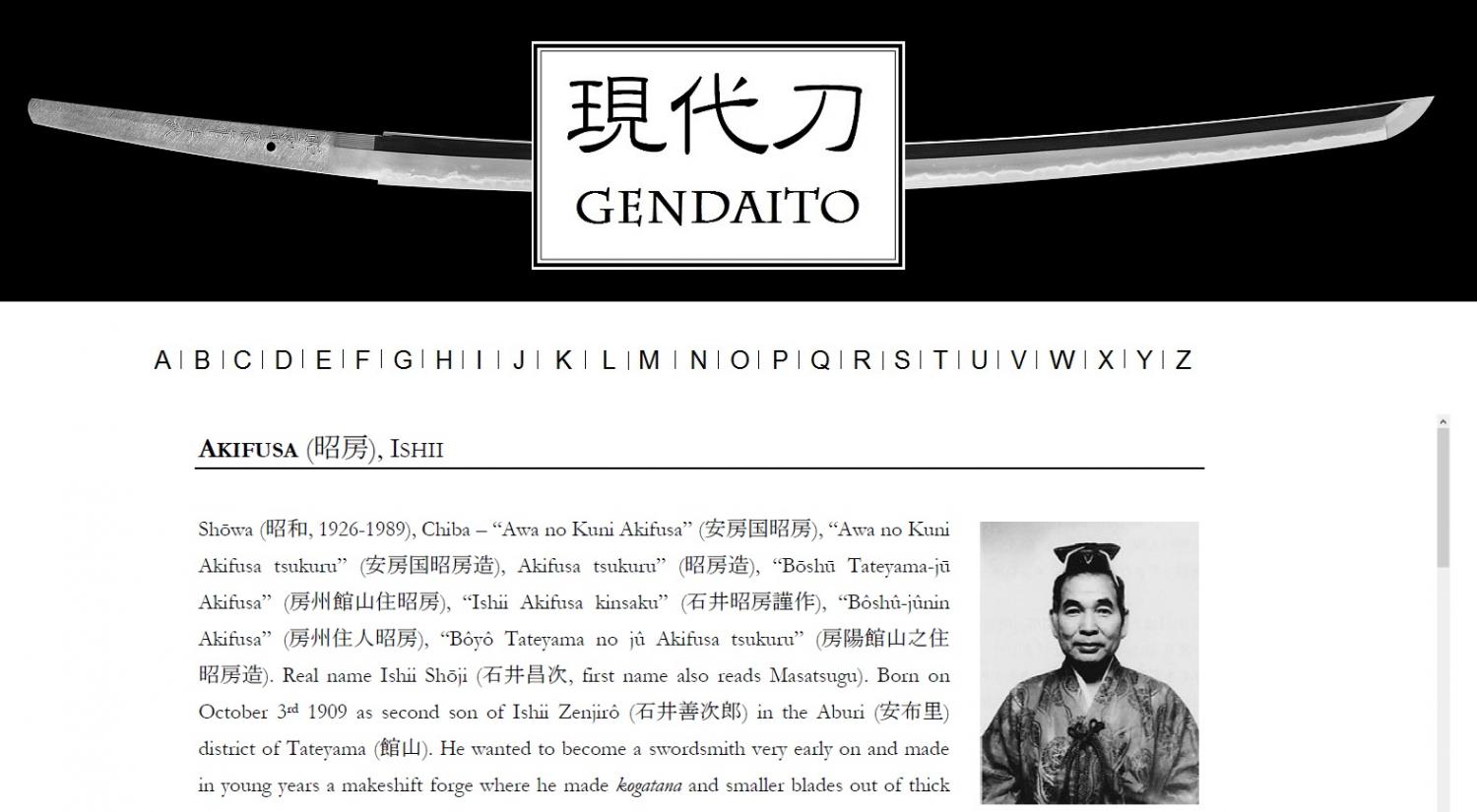
@Peter: That's true and an eBook will still be published but here too, I can't pack in everything and have to make cutbacks. That means, I have about 1,100 smiths what would potentially end up in a 2,000~3,000 pages eBook if I try to put in everything. Below I (very briefly) visualized what I am thinking of: A start page from where you click either on the alphabet or scroll down and click directly on the character, i.e. first part of the smith's name. This brings you to a page with all smiths using that character from where you pick one and get to the separate, detailed page that introduces all the data, oshigata, and pics.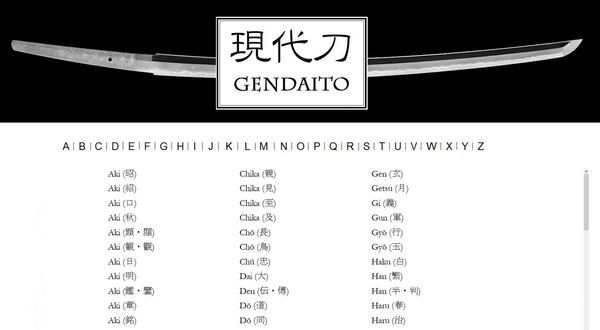


-
Brainstorming: Gendai Project Online
Markus replied to Markus's topic in General Nihonto Related Discussion
I will write that book because it will form the basis of everything. Online database should be a great and much more flexible reference, so to speak an extended, living and breathing big online brother of the book. Maybe book sales can flow into funding this project too (have to see how many copies I get sold, Nihonto book sales are VERY manageable ). @George: I received with thanks your pics/oshigata. Are all stored and waiting for selection process. @Robert: At the moment, I don't know how much I have to get to realize it. What also might be a "problem" is that this would be quasi a donation style thing as contributors don't get any physical output back. But possible would be if someone donates for example over a certain amount, he or she receives the print book. I mean I could do much myself but I don't want to let this end in an amateur makeshift site. That's why I mostly need the money, to pay someone professional who leaves me with an easy to maintain/update and nice looking HP. So that's why I posted it here to check feasibility and to see what doesn't make sense at all. What I am thinking about is a main page with alphabetical/kanji index. If you know how to read your smith you go to seach, for example KANEFUSA. Then you get a list of all Kanefusa with Kanji, family name, and place of residence so that you can go from there. If you don't know how to read the smith, there will be a site with KANJI and you pick one or two what brings you to the list of all smiths with this or these kanji. And if you have found him and click on your smith you get to a separate page that lists his bio and all other data available, much like in the preview I did a while ago.
-
Hi folks, Over the last couple of days, I came up with a (maybe) crazy idea concerning my upcoming Gendaito Project. What if I make that whole thing available as an online reference. I know that there us a lot of useful stuff out there, first and foremost Rich Stein's most hepful pages and Ohmura's page, which I absolutely don't want to overshadow. But still not that much is out there on the biographies of the Gendai smiths and an online database has just so many pros, like: * Fast and easily editable (when errors are spotted). * Very easy to update (when new data is discovered). * No whatsoever page limitations, so each and every info available on a smith can be collected and published (don't have to weight up what to publish and what not because of limited book pages) * Pictures can be added at will and no quality loss through (on demand) printing. * Easier to search in database than in book (of course does not apply to eBook). * Accessible on your phone or tablet when on the go (no book to carry around that might fall apart after a while). * No book-style eBook download and no downloads of eBook-style updates. * Links to sites and pictures which are indispensable but where I did not get the right to (re)publish them. * No expensive book puchase necessary as online database will be freely accessible, i.e. great for everyone. Cons: * No physical book. * Might need some print outs if you want to compare mei right next to your sword (but what shouldn't be that a problem). Well, as indicated in the last point of the pros, I would see this a free database but what in turn requires a Kickstarter initiative. Should not cost a fortune but the start up would exceed my possibilities, both in financial and coding/web design terms. In short, a professional web designer has to be paid with whom I would bring that to life but from where I can go by myself then (i.e. updating and editing). Also some $ would be necessary for maintenance and web hosting but biggest chunk of the (potential) money raised via Kickstarter would be for the coding/web design and for the time involved fitting the data base. Also I want something stunning, visually appealing, easy to work with, something "21st century." Not just line-based content. So this might require quite a few thousand but imagine how much more useful this could be than a physical book without cutting back and witholding data just because of page limits! Just wanted to see how response is on this idea and willingness to financially back a potential Kickstarter campaign or if I should better bury it right away. Any input is greatly welcomed! Didn't want to post that on my page but first here as NMB is so to speak the cradle of this entire project and most of my supporters for this project so far should be around here.
-
This is a very sensitive topic and I was thinking about those issues myself quite a bit over the last years. We all agree that we have to separate the great masters from the ordinary rank and file smiths. When talking about the great masters, we also agree that they knew pretty well what they were doing but also only to a certain extent. That means they had pretty much control over most parts of the forging and hardening process but certain things always remained a "mystery" or "the deities having their fingers in the pie" in those days. What I personally think is that decisions had to be made sometimes and I think that a perfectly uniform overall quality had probably priority over the intended course of certain areas of the hamon. In other words, if everything turned out uniform after yakiire, they might have left it that way instead of focusing too much on certain elements. Of course, if some of these elements turned out to be completely off (e.g. an inharmonic togari or just too much nie along the boshi), the smith would have given it another try at yakiire. At the same time, we also might face subtleties in wording here. From my experience as translator, I notice namely certain "trends" in sword and kodogu descriptions. Some are obvious, others are more between the lines. There were years where one aspect was stressed over and over again whereas in other years, every writer was mantra-like repeating another aspect. So maybe when these texts were written, there was a trend towards a greater focus on "what is deliberate and what is accidental" and every author tried to figure out which hamon turned out as desired by the smith and which one not so much.