Grey Doffin
-
Posts
4,239 -
Joined
-
Last visited
-
Days Won
31
Content Type
Profiles
Forums
Events
Store
Downloads
Gallery
Everything posted by Grey Doffin
-
Munehisa, I believe. Now, someone tell us how wrong I am. Grey
-
If the dealer who sold this on ebay was in Japan, and even with a few dealers in the West, I would expect it to have been repatinated before the sale if any patina was compromised. I don't think repatination of shakudo is that big a deal for a dealer in Japan. Of course, I'm just guessing here. This could be my 1 cents worth. Grey
-
The extreme wear to the nanako can't be natural. No amount of wearing a sword, fighting with a sword, or any other normal sword usage would erode the nanako that badly, no matter how old it is. Something had to have happened to this; either the nanako wasn't cut fully to begin with or it was removed all at once later. My 2 cents worth. Grey
-
Looks like Shunga (erotic art). The quality of work (not too great) is on par with much of the Shunga I've seen. What is the thing, by the way? Grey
-

Shin Gunto identification - What is this?
Grey Doffin replied to Comrade Rutherford's topic in Nihonto
Where is it that you plan to use the technique after you've learned it? Not on real Nihonto, I hope. Grey -
Henry, I suspect that if auto wax and vaseline did a Samurai sword any good, the old masters back in those feudal times would have invented them!! Grey
-
The proper amount of oil to put on a blade is applied thusly: Use white, unscented, not made from recycled fibers tissue paper or toilet paper, folded into a rectangle that will fold around the blade. Put just 3 or 4 drops of oil on the paper. Starting an inch above the nakago, with the paper wrapped around the back of the blade, wipe up towards the point and then go back to the same spot and wipe that last inch down towards the nakago. This ensures that you won't drag a rust particle from the nakago over the polished blade surface. Next, use a clean pad of the same paper to wipe off the oil you just applied, using the same technique. The tiny amount of oil that remains after wiping is all that is necessary to protect the blade. If you use too much it will bead on the blade and eventually will foul the inside of the scabbard. Grey
-
Would someone be so kind as to translate the 2 inscriptions for me please? Thanks. Grey


-
Email is now an option under my posts. If anyone else wants the articles feel free to write. Grey
-
I wrote a couple articles on oshigata for the JSS/US "Newsletter" a few years back. If you email me (link below) I can send them to you as an attachment on my return mail. Grey
-
If a sword has been polished so much that the ha-machi has disappeared the nakago can be reshaped; metal can be removed from the nakago ha, to make the sword appear more healthy. It's not possible to know how many old blades have had this done to them. You can't say, if the ha-machi is gone the blade is tired and if it still exists it isn't; it's more complicated than that. Tiredness refers to the condition of the blade's skin: coarse grain, openings, blisters, or core steel showing through. A sword with no ha-machi can be tired or not and a blade with a ha-machi can be tired or not. That said, it's always better to have a ha-machi and I would be leery of an ebay sale if the seller doesn't show the machi. Grey
-
For those of you who have access to PBS (public TV in the US), tonight on "Nova" the show is titled, "Secrets of the Samurai Sword". Should be worth a watch. Grey
-
I agree with the last post; this is a nakago that has been ground down. It looks too clumsy to have been done by the smith. Grey
-
Talk about heavy hitters!
Grey Doffin replied to Grey Doffin's topic in Auctions and Online Sales or Sellers
Brian, You need to read the description a bit more carefully. Grey -
There are no signed Sadamune. This is one of them. Grey
-
Should you wish to bid on this katana: http://cgi.ebay.com/Japanese-Hand-Forged-Katana-Gunto-27-Pierced-Tsuba_W0QQitemZ300156591560QQihZ020QQcategoryZ4080QQssPageNameZWDVWQQrdZ1QQcmdZViewItem you'll find you're up against some very serious competition. Grey
-
I heard also that one of the blades to come would be the O-Kanehira. Hard to believe that the National Museum and/or the Japanese government would allow it to travel but if it does make sure you get to see it. Even if you have to walk from Texas it will be worth the effort. Grey
-
A broken top of a katana fitted as a tanto in China. The yokote is at the wrong angle. The geometry seems clumsy. The koshirae are classic Chinese fake. I still think this is a fake; no doubt. Grey
-
I agree; it's a fake. Grey
-
This Kanehisa made it into none of the 60 or so references I've added to my index. It probably will be tough finding anything on the smith. Grey
-
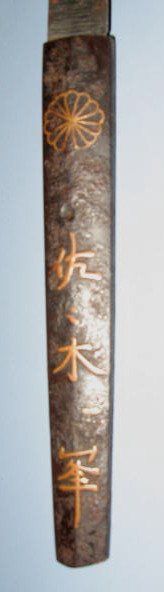
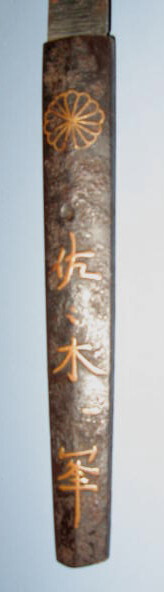
I just picked up a tanto with an interesting kotsuka. It's made of iron in the shape of a nakago (complete with a dimple to represent the mekugi-ana). I'm wondering if one of you can translate the inlay for me. Thanks, Grey
-
Grasshopper, What you should have noticed, what I can see from the photos: 1st pic: the ko-shinogi (continuation of the shinogi line in the kissaki) is straight. It should have a curve to match the curve of the kissaki. 2nd pic: what you are looking at here isn't hada. This is a mix of different metals put together and etched to bring out the differences. Real hada is crystaline structure in the steel body. Look at pictures of good swords and you'll see the difference. 3rd pic: The mei was cut with a dremel tool rather than with a chisel. A dremel removes metal with a spinning abrasive bit. A chisel doesn't remove metal; it moves it. 4th pic: The tsuka-ito is crudely wrapped, nothing at all like it should be. Real Japanese swords aren't mounted in fake mounts. Also in this pic: the saya is painted, not lacquered. Experience and study will help you recognize the difference. The fuchi and koi-guchi (fittings at the joint between tsuka and saya) are crudely made and meet at a weird angle, often the case with fakes. 5th pic: The ha-machi and mune-machi are too deep (the nakago is too narrow for the width of the blade). This is often seen on the Chinese fakes. Buy books and study. Grey
-
I agree with Stephen, an obvious fake. Study Grasshopper. Grey
-
I'm hoping one of you can help me identify something Japanese. Haven't seen it yet but this is how it has been described to me: It came along with a sword, purchased from a Pacific vet. It is a cylindrical rod of heavy, dense, black wood, 18" long and 1" in diameter, finely polished and with a cap of mother of pearl about 1/2" long at either end, all enclosed in a silk brocade bag. All help will be appreciated. Grey
-
Rice glue is best because it is reversible, it doesn't discolor the saya, it contains no chemicals that might discolor or corrode the blade, and it won't scratch the blade if some hardens inside the saya. I use Kokuho, a short grain white, which I get at Oriental groceries. If you google 'rice glue' you'll find directions to make the stuff at the 1st hit. For clamping I use either of 2 methods. I tear an old sheet into long strips and wrap them tightly around the saya. I also use the paper and masking tape bands that I mentioned on another thread. Wrap a strip of white paper, a bit wider than masking tape, 1 1/2 times around the saya a few inches below where you want the band to end up. Wrap the paper tightly in masking tape. Slide the paper/tape band up the saya till it's tight. Prepare enough of these to clamp all loose areas before you apply glue. Apply a tiny amount of glue, apply the clamps, and let it sit a few hours or more. I always let the saya dry for a day or so before I place the blade inside. Often, the 1st time I replace the blade the koiguchi (saya opening) is too tight. This could be due to temporary swelling of the wood from the moisture in the glue. If you wait a day or 2 the problem usually takes care of itself. This will work if done properly. There is no reason to use super glue or any other chemical based wood glue. Grey