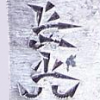
Drago Posted January 25, 2013 Report Posted January 25, 2013 Hi, I bought this many years ago. Now it sits on front of my kamidana. Story is that it belonged to a German envoy to Asia in the first half of the 20th century The Kanji on the sign reads 奉納 which means something like dedication or offering. The sign is upside down however, but it doesn't look like it was ever upright. The kamebara (feet) are both stamped 銀 and NAN, so it is made from silver. I would like know: 1. What kind of offering is that? Who from? To Whom? Why? 2. What does the NAN stamp mean? 3. Why might the sign be upside down? Thanks. Quote
Bugyotsuji Posted January 26, 2013 Report Posted January 26, 2013 Drago, how large is this piece, and can you post close-ups of the NAN (is it written like that in English capital letters?). Nanking? If it was made from parts by a western silversmith, or if it was broken and fixed at a later date, could the Hono sign possibly have been put back on upside down? Certainly it would be easier to do the work on your workbench with the Torii gate upside down! Quote
Drago Posted January 26, 2013 Author Report Posted January 26, 2013 Good morning Piers, thank you for your answer. The NAN stamp is written in capital English letters. The 銀stamp is kanji, they are separate stamps. And both feet have both stamps. The Torii is exactly 7cm high and 6,8cm wide. I tried to take a photo of the stamps (torii2). It's a bit blurry, but with one hand on the magifying glasses and the other on the camera I couldn't get a better one. I also attached a photo of the rear of the sign. To the left is the roof of the torii, to the right the feet. I don't see any major scratches on the torii that would indicate a later modification. The sign has a circular scratch on the back but I couldn't match that to any part of the torii itself, so I don't know where that came from. As you can see, the rims of the sign are slightly bent, but the one side on the right on the photo (where the tip of the 奉 is) is flat. I think that wasn't intentional. Tobias Quote
Bugyotsuji Posted January 26, 2013 Report Posted January 26, 2013 Theory Two. This was a memento to celebrate the 1919 opening of the 華南銀行 Kanan Bank in Taipei, Taiwan, a joint venture between Japan and rich Chinese merchants when Taiwan was under Japanese rule. It served most of Soth-East Asia and was called the Kanan Ginko, (or ”Nangin” for short) and that is why these letters are used NAN銀... http://ja.wikipedia.org/wiki/%E8%8F%AF% ... 0%E8%A1%8C Quote
Drago Posted January 26, 2013 Author Report Posted January 26, 2013 Hmm, interesting. Thanks. I'll look into that. Quote
sanjuro Posted January 29, 2013 Report Posted January 29, 2013 Hi. Just a bit of logic re the upside down kanji plaque. The little plaque looks as though it is held by a single pin. The circular scratch could be as a result of the little plaque swivelling on its pin and having become fixed in its inverted position. There seems to be a corresponding mark on the the face of the short central upright. Always give the simple answer a chance! (even if it sounds dumb when you say it) Quote

Recommended Posts
Join the conversation
You can post now and register later. If you have an account, sign in now to post with your account.