RATOYO
-
Posts
29 -
Joined
-
Last visited
-
Days Won
2
Content Type
Profiles
Forums
Events
Store
Downloads
Gallery
Everything posted by RATOYO
-
Excellent work — the eagle’s sharp, piercing gaze is truly striking.
-
It's a very clever design. It must look fantastic when mounted on a sword!
-
Hi, Viktor, I see your point, and I understand the importance of technical precision. I think we may simply be looking at these pieces from different perspectives. For me, beyond technique, I tend to focus more on expression and the overall presence of the figures. This is also why, in painting and sculpture, human figures are often considered more challenging than animals or landscapes — fine details alone are not enough. In any case, I appreciate the discussion.
-
You are absolutely right, and that is exactly why I find this field so fascinating. The more you look, the more subtle details in the craftsmanship reveal themselves. I also hope we will see more great publications in the future… and maybe one day they will include some of our own little treasures as well.
-
Thank you, Colin. I also enjoy looking through auction catalogues and past lots, and I spend quite a bit of time studying both Japanese and English books on tosogu. The more references and comparisons one can see, the better. That said, I still find some aspects confusing at times. My feeling is that Japanese tosogu craftsmanship, especially the metalwork on sword fittings, may still not be fully appreciated or understood on a broader international level.
-
As someone fairly new to studying tosogu, I sometimes find it a bit hard to understand why certain pieces in museum collections or catalogues are considered masterpieces. At first glance they don’t always look more elaborate or technically refined than other examples. I guess with more study and comparison the reasons become clearer, but for beginners like me it can still be a little confusing. So discussions like this are actually very helpful.
-
Thank you for sharing the article — the tsuba and the interpretations are very interesting. On a fuchi-kashira the scene is extremely small, and without strong magnification it is almost impossible to see so many details. I was quite surprised by the momentary expressions of both the eagle and the monkey, and by the sense of tension the artist managed to create in such a tiny space. Liang
-
固山宗俊
-
Hello, everyone, I would like to share one more fuchi-kashira depicting an eagle capturing a monkey, attributed to Risshū. I find the composition quite dynamic, especially the interaction between the eagle and the struggling monkey. One small detail that caught my attention is the treatment of the monkey’s head, where the hair seems to be rendered with irregular strokes, giving it a rather wild and lively appearance. I have also read that this motif has sometimes been interpreted as symbolizing authority or dominance, perhaps reflecting ideals associated with the warrior class, though I would be very interested to hear other views on the meaning of the scene. Any thoughts on the workmanship or comparable examples would be greatly appreciated. Liang


-
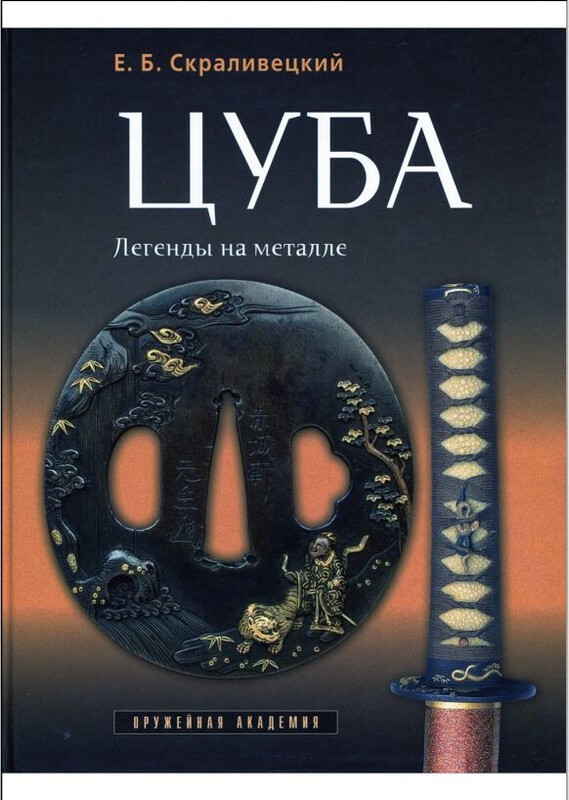
While looking through another reference, I came across a kozuka with a very similar Kanzan and Jittoku composition in a Russian publication on Japanese sword fittings. The treatment there appears somewhat simpler, but the overall arrangement of the figures is quite close. I thought it might be interesting to share it here for comparison.

-
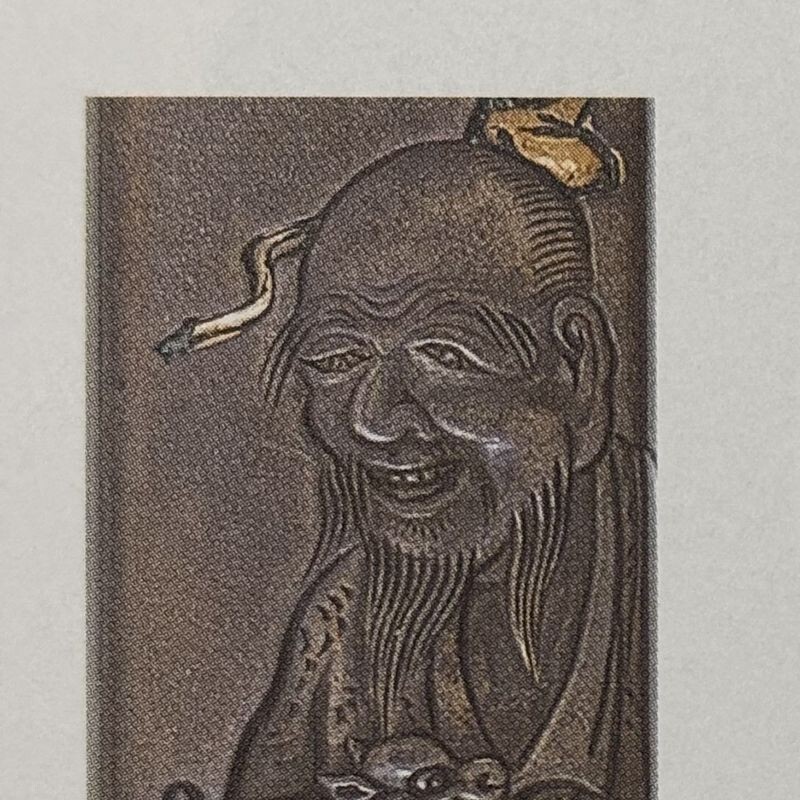
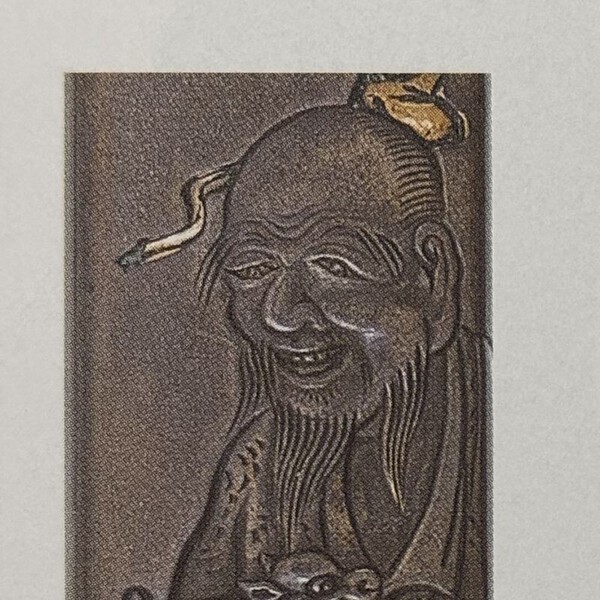
Regarding the comments about the inlay appearing rough and the ornament not being perfectly symmetrical, I wonder if this might relate to the carving approach used in some works attributed to Sugiura Jōi (Ichisandō Jōi). In the nikuaibori manner the figure is first established through carving and the inlay applied afterwards, so the edges of the inlay do not always completely disappear into the ground. As for the robe ornament, although the scrolling pattern is not strictly symmetrical, I noticed a very similar treatment in published examples of Jōi’s work. I am attaching a reference image from Fukushi Shigeo’s Machibori Meihin Shūsei (町彫名品聚成), where the illustrated piece is considered a representative work by Jōi and is designated an Important Art Object. Just to clarify, I’m not trying to defend my own piece — I’m mainly interested in discussing the technique itself. Liang



-
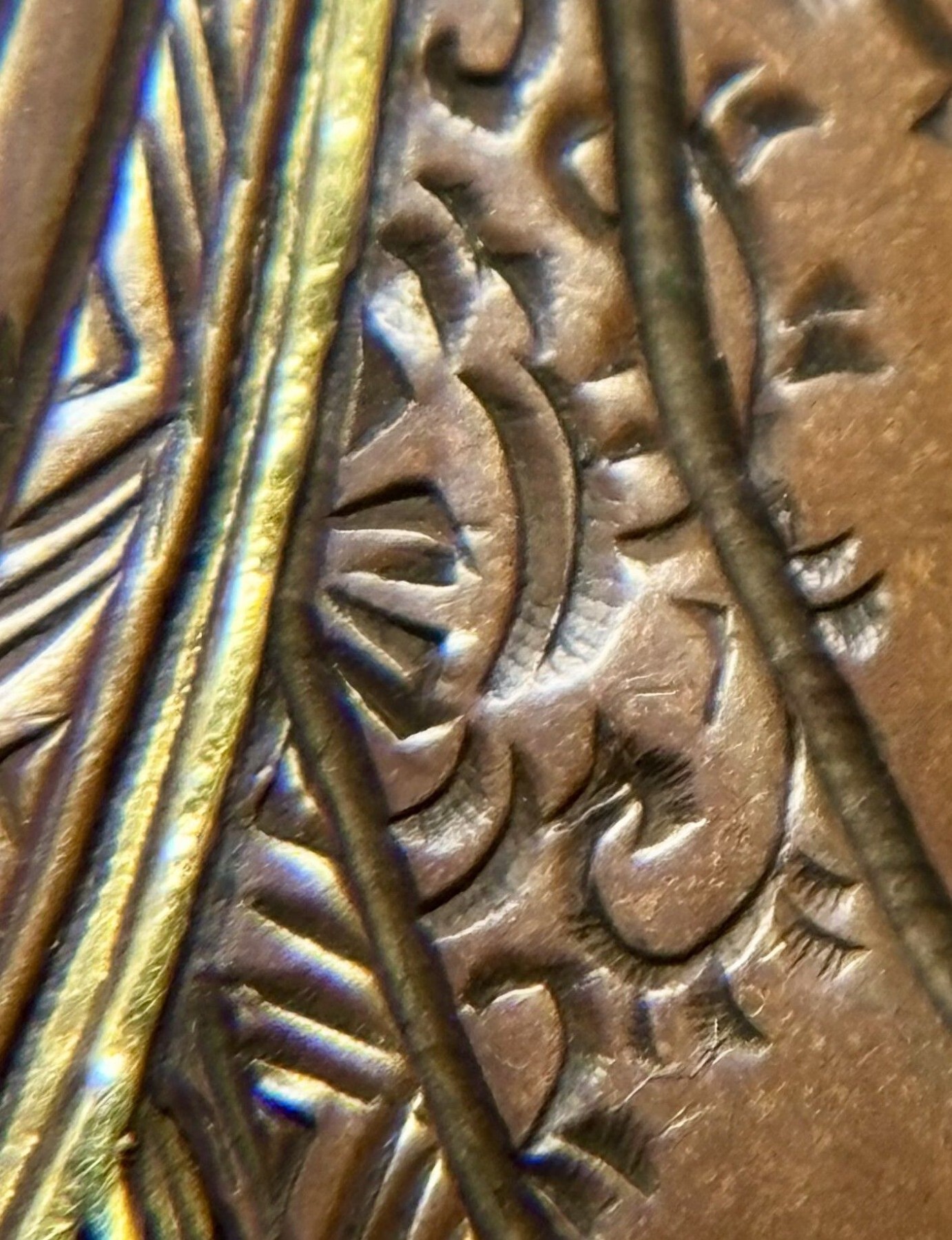
Dear Viktor, Thank you for pointing that out — it actually added something new to my understanding. Looking more closely, I can indeed see how the pattern may have been built up through many tiny push cuts, almost like a sequence of very small strokes. The decorative pattern on the robe seems even finer than the lines I usually see in signatures on many tsuba, which is what caught my attention. And thank you as well for the note about the deer hide — that was something I had not considered before, but it makes a lot of sense when compared with the paintings. Liang
-
Hello, Jake, If I may, let me add a little background. Jiang Ziya (also known as Jiang Taigong) is a famous figure in ancient Chinese history and mythology. He served as the chief strategist to the early Zhou rulers and helped King Wen and King Wu establish the Zhou dynasty. There is a well-known story about him fishing. When Jiang Ziya went fishing, he used a straight hook and did not put any bait on it. People who saw him thought he was crazy, because of course no fish would bite. But Jiang Ziya replied that he was not trying to force any fish to bite. If a fish truly wished to take the hook, it would come by itself. The saying that comes from this story is: “Jiang Taigong fishes — those who are willing will take the hook.” In Chinese culture the story is actually symbolic. It means waiting patiently for the right person or opportunity, rather than forcing things to happen. Liang
-
Dear Jake, This old man should be Taigong Jiang(姜太公). Jiang Ziya is a figure from Chinese mythology. There is a well-known saying about him: “Jiang Taigong fishes — those who are willing will take the bait.”
-
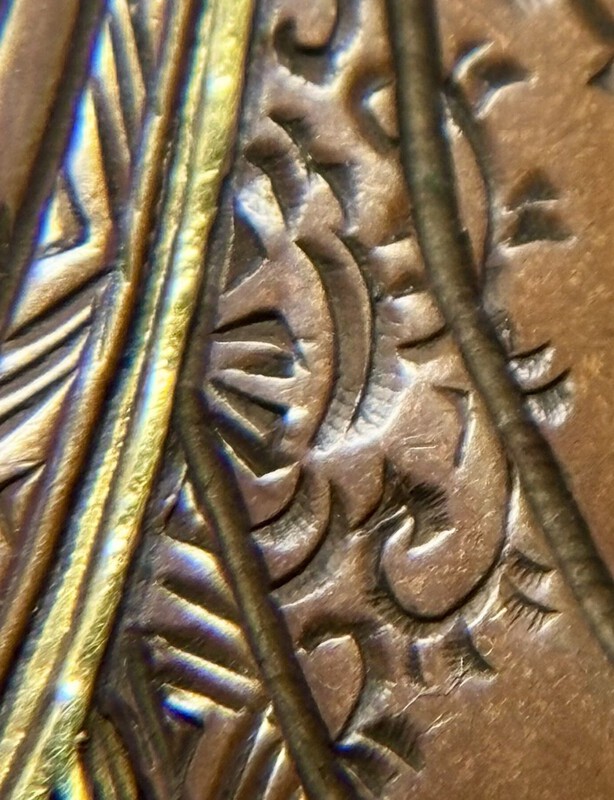
A small addition: just after posting my previous reply, I noticed another detail on the robe. Along each main chisel cut forming the texture, there appears to be a row of extremely fine secondary lines, almost like tiny eyelash-like strokes. These details are very difficult to see with the naked eye, and even with a 30× magnifying glass they are barely visible. It may perhaps be an attempt to imitate the texture of embroidery. Liang
-
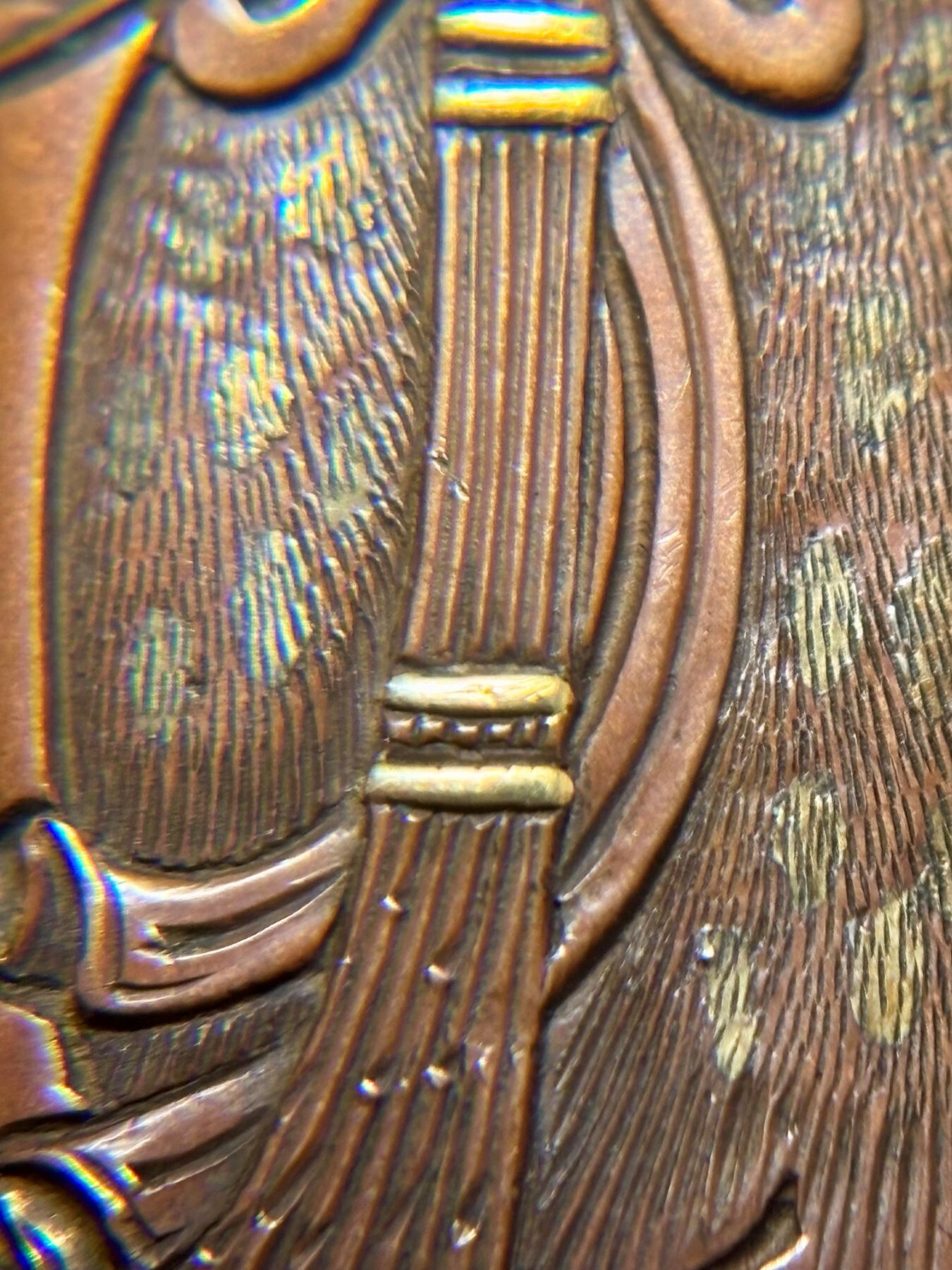
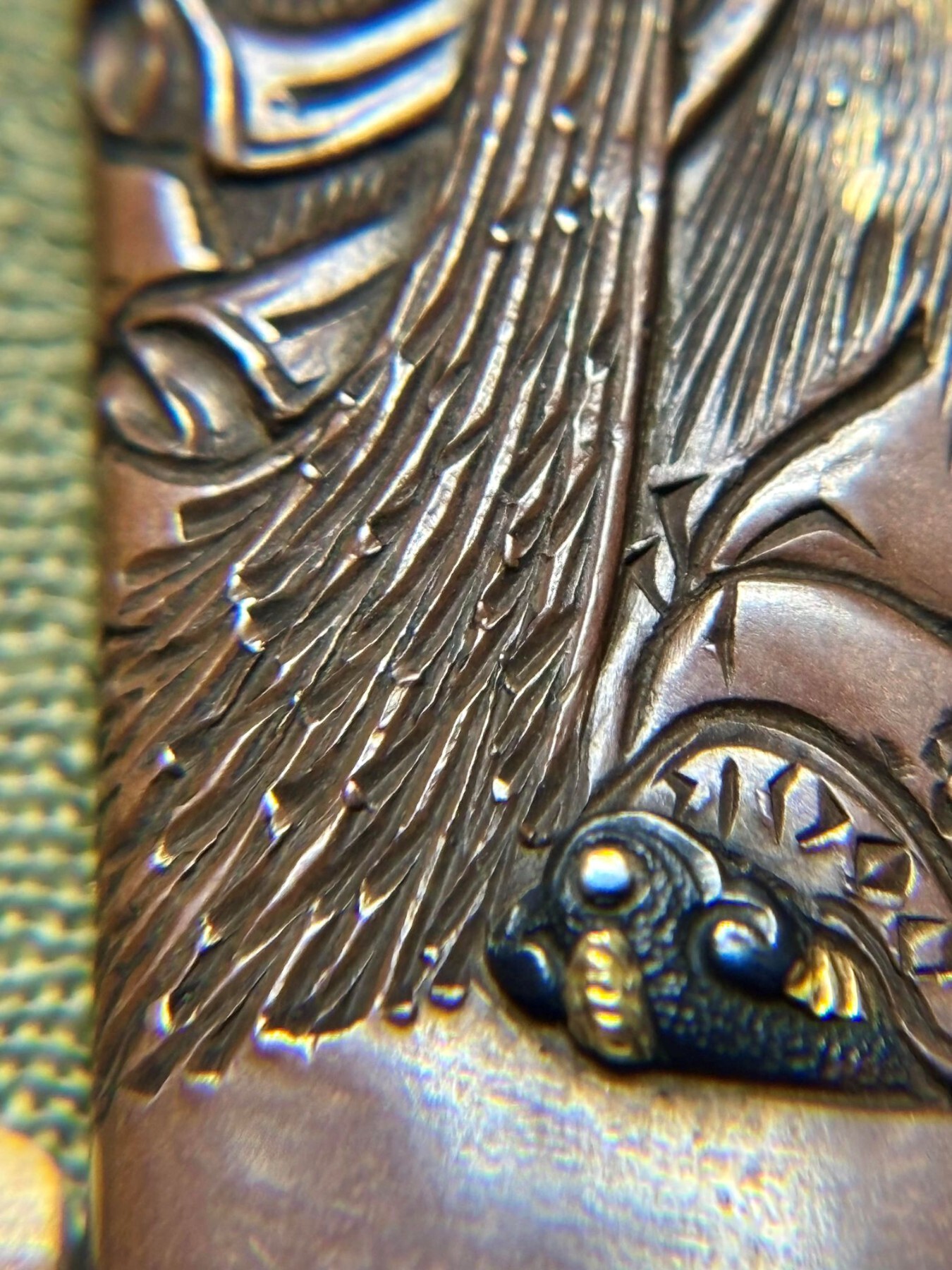
Thank you, Colin, for pointing that out and correcting my mistake once again. Due to limited equipment, I can only take simple magnified photos using my phone together with a magnifying glass. From these images it appears that the lower edge of the robe is indeed not nunome inlay. The inlay there does not seem to be gold, but rather brass or a copper alloy. One can clearly see an oxidation layer on the surface, and the color is noticeably different from the gold inlays nearby. Looking more closely at the magnified images, a number of small details also become visible: the patterns on the robe and the way the garment is modeled, the carved lines of the broom and the way it is bound together, details of the sandals, and the facial features. The eyes appear to be inlaid (likely dark shakudo), with gold inlay used for the teeth. One can also see the wavy hairstyle I mentioned before, as well as the folds of the eyelids. I also noticed for the first time some subtle details of the lips, and even what seem to be small dimples on the face. I am very happy that through this discussion I can discover more details of the piece — thoughtful discussions like this always lead to new observations.


-
Hello, everyone! I'm Liang. I currently live in Spain, although I am originally Chinese. Because I grew up using Chinese characters, it is somewhat easier for me to recognize and understand certain aspects of Japanese writing and culture. Since childhood I have always been drawn to finely made objects. Over the years I have enjoyed collecting different things, including amber, Leica cameras, silverware from Britain, the United States, and Denmark, as well as various forms of metalwork, sculpture, and some pieces of militaria. And of course, like many boys growing up, I have always had an interest in knives and firearms. Through this interest in craftsmanship I eventually discovered Japanese sword fittings. I find tosogu truly fascinating — the level of craftsmanship can be extraordinary, and the variety of subjects, schools, and techniques seems almost endless. It feels like a field that one could study and appreciate for a lifetime. While trying to learn more, I came across this forum. I have been reading many discussions here and I really appreciate the atmosphere and the knowledge generously shared by the members. I hope to learn from everyone here.
-
I love this story. A great reminder – thanks for sharing it.😁
-
Thank you very much for pointing that out – I had never considered that it might be intended to represent deerskin. Looking at it again after your comment, it really does resemble deerskin quite closely. My impression is that the spots may have been created with nunome-zōgan and then the hair-like texture was added with fine kebori to suggest the fur. It’s a very subtle effect and easy to overlook at first. I also really like the treatment of Hanshan’s head. The sculpting of the hair is quite distinctive – not only the topknot, but also the layered, slightly interlocking strands of the fringe, which I don’t often see on kozuka of this type.
-
Thank you both for these thoughtful perspectives. I couldn’t agree more. In a way, this is also one of the reasons I am drawn to the Kanzan sweeping scene. Perhaps he is not only sweeping a dusty courtyard, but also suggesting something more symbolic. As collectors, maybe we should not focus only on the signature, but also on the spirit and workmanship of the piece. I would also be very interested to hear more opinions about the design and workmanship of the piece itself.
-
Thank you all for the helpful comments. I’m very glad to meet and learn from everyone here. Personally, I am particularly fond of the kozuka on the left, depicting Kanzan sweeping. I find the nikubori-style carving very appealing and it reminds me somewhat of the style associated with Sugiura Joi. That said, I also have doubts about the signature, which is one of the reasons I decided to post these pieces here and ask for opinions. Since joining this forum and reading many discussions, I have also realized how common gimei can be in tosogu. As a relatively new student of this field, it has been quite eye-opening to see the different perspectives people have regarding signatures and even papers. I really appreciate everyone taking the time to share their knowledge and experience.
-
Hello everyone, I have a strong interest in Japanese sword fittings, especially kozuka. This is my first post here and I would like to share two pieces from my collection. Both kozuka are signed “Joi”, but they do not have papers, so I am not sure whether the signatures are genuine or gimei. The seal on the left kozuka (the Kanzan sweeping scene) is inlaid on a raised silver plaque. I would really appreciate any opinions or comments from more experienced collectors. Thank you. Liang