


anguilla1980
-
Posts
47 -
Joined
-
Last visited
Content Type
Profiles
Forums
Events
Store
Downloads
Gallery
Everything posted by anguilla1980
-
 I don't see a problem; these are similar to any other search results, and there are multiple places called out to view on the original site, and you are not able to buy through this site.
 -
This is fantastic, thank you! A couple of things I noted; Registration is not obvious. Missing some sites/dealers that I search. Other than that, I love the save search option and filters.
-
Indeed. Early on, I found it fascinating that jihada look, and the refined grain and utsuri, were attributable to the high-purity masa-satetsu iron sands with its low titanium content from the Chūgoku Mountains weathered granite. The chemical interaction between this specific iron ore and the charcoal from the surrounding forests was said to create a steel with both the resilience for combat and a unique aesthetic depth. I'd previously taken a deep-dive into tamahagane metallurgy, and this context about the blade shapes and polish styles really helps with additional context.
-
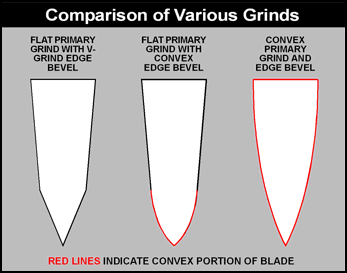
I wanted to post a brief update on what I’ve been learning about how blades like mine were originally shaped and finished in their period. The overall sugata of mine aligns with what is described as Tenshō-sugata: shinogi-zukuri construction; relatively wide motohaba, firm kasane, minimal funbari, and a robust chu-kissaki. This proportion set appears frequently in late 16th c Bizen work and reflects the practical requirements of the period. The edge geometry is best understood through the concept of niku (肉). Rather than a thin, flat bevel, these blades were shaped and maintained with a hamaguri-ba (蛤刃), a convex clam shell profile. This places more steel behind the ha, improving resistance to chipping or rolling when striking harder targets such as components of tōsei-gusoku. The convex surface also supports a smoother wedging action during the cut, reducing binding. I found this image posted previously on the forum which illustrates this: On the finishing side, I’ve been reading about sashikomi-togi (差し込み研ぎ) in contrast to hadori. In sashikomi, the hamon is not artificially outlined. Instead, the nioiguchi, nie, and internal activities such as ashi and sunagashi emerge naturally through the final hazuya, jizuya, and nugui stages. Earlier sashikomi approaches could rely on fine stone powders such as Tsushima-to during shiage, rather than heavier iron-oxide-based mixtures, resulting in a more integrated ji-ha contrast. - This approach is particularly relevant for late Kotō Bizen where features like utsuri may still be present. The choice of polish style has a direct effect on how utsuri, nie-deki, and gunome-midare are perceived. Studying the hamaguri-ba geometry together with sashikomi-togi has given me a clearer understanding of how blades of this period were shaped, sharpened, and intended to be used, and now viewed. It also explains why blades of this construction and metallurgy from Bizen in this period often show jihada which appeals to me much more so than others. I've never been a huge "look at that flamboyant hamon" fanboy, but man, dark/wet/active jihada just does it for me Also, early on when I started researching nihonto, I was greatly turned off by swords that appear mirror-like and overly polished, which can make the jihada hardly visible at all; it was partly down to the polish style and now I understand the differences. I hope I got all of the Japanese terms and my understanding right, I'm still learning.
-
Why i dislike this dealer
anguilla1980 replied to lonely panet's topic in Auctions and Online Sales or Sellers
I'm just a new guy here, but I've had a broad taste for various historical items/collectables over the decades. I always tend to do research on educating myself about a type of item I wish to acquire a couple of years in advance, if not more. That said, when something strikes me and ticks all of my boxes, I will impulse buy. However, that does not mean I don't know exactly what I'm buying. I also tend to buy just one example of an object I want, then move on to something else. In very rare cases, I become an extreme niche collector of a VERY specific form of a thing and over decades will acquire as many as I can of it. Anyway.... Caveat emptor always applies, and most everything has a variation of a compromise, even if slight, unless you have unlimited funds AND patience. I knew about a decade ago that I one day wanted a Sengoku period nihonto. Over time, casually researching, I found myself drawn to a certain style of hamon, and jihada especially. Then via more in-depth research, I found which regions and schools and in what time periods I would narrow my search to. After this, I compiled a list of dealers/websites to monitor. Over time, I noticed trends and browsed posts online about them. All of that to say, I believe a buyer should always do their due diligence (or hire an expert curator to acquire it for them) so that they can identify attributes of an item from all available sources (written, pictorial, documentation, etc.), often contacting a seller to request additional info due to gaps they may perceive in an ad/auction/etc. It's already been said in this thread that simply over time and volume, most sellers will exhibit patterns in their listing details and feedback. In the end, it comes down to the buyer's education and the seller's integrity, should there be an issue. I made a purchase almost 5 weeks ago from Aoi, and thus far, I've found the seller to be extremely responsive, professional, and accommodating. I found the listing details and images in my swords case, to have been comprehensive enough for me to make the purchase without further inquiry. I more or less knew exactly what I was buying (signed, dated, NBTHK, condition, etc.) and anything else was just a bonus. In my case, I found the koshirae (particularly the tsuka and tsuba) to be non-offensive and complimentary. The saya didn't even matter to me at all. When the sword arrives, I expect it will be just as shown, but if there is a problem for any reason, I'm also confident this seller will not "ghost" me if I reach out with one based on our correspondence thus far and having not seen any reports of this occurring to others. Which is good enough for me, what more could you ask of a business? Of course, there are always people who will buy whatever, totally uninformed, simply based on desire in the moment and at face-value of what a listing states (truth, lies, omissions, and all - just trust me bruh). More often than not, those people are totally happy with what they receive and never think twice about it. Mostly because they just don't care or sweat the details like most of us do. At the end of the day, no one is twisting your wrist to buy anything you don't have the warm fuzzies over. If you spot something that feels off, trust your instincts and move on. - But keep in mind, even the most terrible seller could one day come across exactly what you are looking for, then what will you do.... -
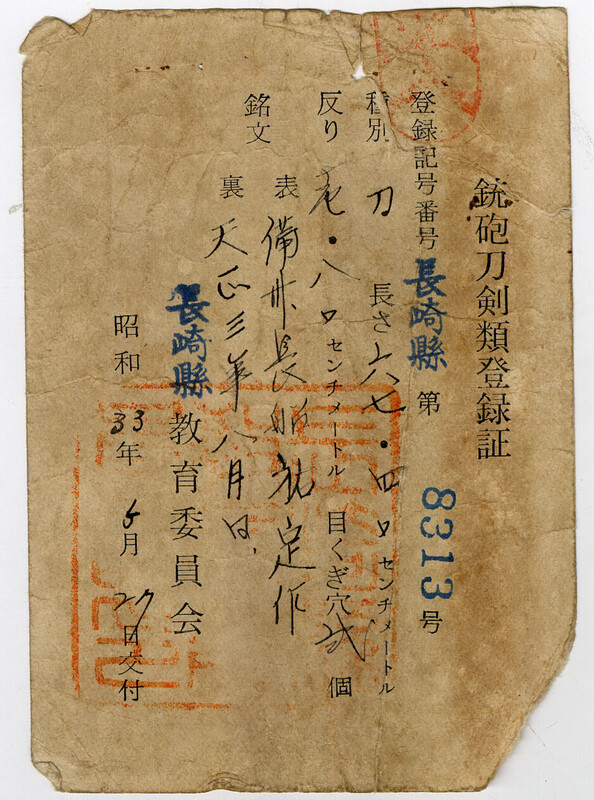
The dealer I purchased my sword from was good enough to provide me with a high-quality photo of the 1958 Torokusho registration. I know it has to be surrendered upon export in a couple of weeks, so I'm going to print it out life-size on to some cardstock to keep with the sword. I think it's cool to have. I've also done some further research on the craftsmen who signed the fuchi, Maruyama Sōzan. It looks like he was active from the Kyōhō to Hōreki era (ca. 1730s to 1750s). The Maruyama school was known for producing high-relief, sculptural fittings that combined traditional themes with a refined sense of balance. It's possible the tsuka has been re-wrapped since then, and it's in hineri-maki style. All of the mountings are a common and coherent motif for mid-Edo; dragon in clouds/waves (representing celestial authority, power, and dynamic force) on the fuchi and kashira, abstracted futatsudomoe forms (associated with natural forces such as wind and water) as the tsuba, and abstract vegetal imagery (evoking growth, vitality, and the sustaining rhythms of the natural world) for the menuki. I found this info in the Haynes Index and Markus Sesko's Signatures of Japanese Sword Fittings Artists. It's been a real joy diving into these little details and learning about them. For me, this is what it's all about when I buy an antique.
-
My nihonto book collection is growing. In addition to the usual generic classics I had before making my purchase, I've now acquired these since they are Bizen-specific and have received them: Osafune Chōshi - General Bizen Sword History Osafune Chōshi - 2 Vol Research Ed (this is the big mutha) Nihonto Koza - Vol IX - Koto Part III - Bizen I'll be busy the rest of this year going through them :D
-
I've learned something else. Aoi had the sword listed as 1576. But comparing the "Tenshō 3, 8th month" (天正三年八月日) inscription against a modern calendar, and knowing that in this time period the Senmyō-reki lunisolar calendar was used (which was the specific system in use during the Muromachi and Azuchi-Momoyama periods before the Jōkyō calendar reform) - it actually looks like my sword was made in 1575 and probably in September. The 8th lunar month in that year technically was a window between September 5 – October 4. Anyway, I'm sure this is the tip of the iceberg in learning about these swords. I gotta say though, it's pretty fun learning all this stuff.
-
Well s**t, good to know. Google told me there were multiple versions printed, and this was the combined single volume. So much for that lol. This is the Google Translate of the images of the book: "This book is 長船町史 刀剣編 (Osafune Chōshi, “Sword Section, General History”), the official Osafune town sword history volume published in 2000. It is not a general town history volume, and it is not an unrelated excerpt." So since it's just a general sword history, yeah, this wouldn't have all the detail of the 2-volume. Damn, ok. EDIT: Alright, I found the proper 2-volume detailed reference edition and purchased it. Thanks!
-
Thanks for pointing out that reference book exists, I just found and purchased a copy on Buyee - https://www.kosho.or.jp/products/detail.php?product_id=565488584
-
I kinda interpreted the data that dates of swords at this specific period of war, were reflecting practical production and military commissioning cycles rather than symbolic or ritual dating. But it looks like I could be wrong, and they are more symbolic dates with the NBTHK respecting that date as real out of superstition and respect. Certainly, with swords before and after I expect that to be the case, so yeah, the truth may be stretched here as well. As a new guy, I really appreciate the info!
-
That is a great little nugget of intel, thanks. From what I can tell, there is a bit of truth there, but it’s usually framed a bit too symbolically. Sue-Bizen blades do tend to cluster in the 2nd and 8th months based on my research, but this is generally understood as reflecting practical production and commissioning cycles during the Sengoku period. While Hachiman worship and numerological associations with “8” certainly existed, signed and dated blades that pass NBTHK scrutiny are normally taken at face value as real production dates rather than symbolic ones. So I'll just take it for what it is on the NBTHK cert, a literal date, but yes, I suppose I won't put too much weight in it. It could be the NBTHK just respecting the symbolic auspicious date at face value.
-
Interesting to see that rasp tool just for doing that. I'll be sure to give the saya a really good look, especially on the inside to ensure it's clean. If it's not a great fit, that just gives me an excuse to have one commissioned in the Tensho-era style of the day for a typical rank and file samurai. Very plain, wrapped in cloth then laquered over, etc. but at least it would be a perfect fit for the blade and restore some historical accuracy to the koshirae in a modest sense until I could do the rest of the mounting the same.
-
For sure, I don't disagree with either of you. It's well known that mountings come and go all the time over the centuries, and that there can be numerous ones owned for each blade at a given time. My observation was simply of the two mekugi, and when the second hole was made. I appreciate the observation on the ito, I hadn't noticed that. Yeah, they are slightly different widths, especially on the outside - which you'd think would be the best. Now the saya, that's an interesting point. I didn't know AOI was notorious for this. Never did it occur to me that a saya would be sold with a blade that hadn't been custom-made for it. Of course, it would also never occur to me to bother putting the mounting on the blade, let alone inserting it into the saya, but I would have trusted it to be made to an absolutely perfect custom fit whenever it was added. That's just dangerous to even sell an ill-fitting saya with a blade, and pretty irresponsible, frankly. Now you've done the opposite and made me so curious, I may carefully try it lol!
-
I wanted to post a brief follow-up and clarification to my original introduction, as further close study of the blade and mounting details has led to a more precise understanding of the sword’s remounting history, specifically regarding the second mekugi-ana. In my original post, I described the koshirae as a coherent mid-Edo remounting, and while that assessment remains broadly correct for the visible fittings themselves, closer examination of the nakago, mekugi-ana placement, and patina has refined when a critical remounting event may have actually occurred. The blade has two mekugi-ana, and after spending a frankly obsessive amount of time studying their placement, finish, and internal patina, it is now clear that the second mekugi-ana was not a late or decorative alteration, nor a simple reinforcement measure, but the result of a deliberate, planned remounting event. Both holes exhibit uniform age and undisturbed patina, with spacing that reflects a change in tsuka geometry rather than emergency field refitting or later display-driven modification. This I believe strongly places the addition of the second mekugi-ana in the late Momoyama to very early Edo period, most plausibly the Keichō era (circa 1596–1615). In other words, the blade appears to have been remounted structurally right at the transition from endemic Sengoku warfare into early Tokugawa peace, rather than centuries later. What this suggests, and what I find particularly compelling, is continuity of ownership. Rather than being replaced, discarded, or relegated to storage, this Sengoku-era blade seems to have been retained, trusted, and thoughtfully adapted as its owner survived into a new social and military reality. The later Edo-period fittings, including the Maruyama Sōzan work, are best understood as subsequent aesthetic or preservation updates, fitted to an already established tang configuration, not the moment that necessitated the second mekugi-ana. Importantly, this interpretation also addresses a common misconception I initially shared, namely that two mekugi-ana necessarily indicate “wartime reinforcement.” While extra holes do appear on Sengoku blades, they overwhelmingly reflect adaptation and remounting, not a doctrinal preference for dual pegs. A properly carved tsuka with a single well-fitted mekugi was standard even at the height of warfare, and the evidence on this blade aligns with planned remounting rather than battlefield expediency. Nothing about this refinement diminishes the coherence or quality of the koshirae as it exists today, but it does sharpen the sword’s life story in a way I find deeply satisfying. It reinforces the idea that this was a working blade that earned its keep, survived its era, and was carried forward with intention. I appreciate everyone’s patience indulging this level of detail, and I’m grateful to be part of a community where these nuances are appreciated - especially as part of the learning process. I'm also sure some other experts here may have already thought this, but hey, as a newbie to this, it's a realization to me lol. I’ll be sure to share higher-resolution images once the sword arrives and I can document it properly in hand. Thanks again, and I look forward to continuing to learn here. – Alex
-
Anyone have updates for this thread since September? I did a forum search for the word Tariff in the thread title and this was the only one that came up. AOI is currently waiting on my export permit and I paid 65,000 JPY / $414 for shipping which I presume will be UPS since even DHL is paused right now, I've read elsewhere. It sounds like, and correct me if I'm wrong, that UPS knows the process and will just have me pay on their site for the tariffs then deliver it, and only the USPS process mentioned by the OP is a disaster needing an import broker... is that correct? I've previously had UPS notify me to pay the tariffs online before for packages from Europe, which I always pay right away before it even leaves the source country. Hopefully, this is the same way.
-
Oh wow, gorgeous. Now that's a dedicated work of art right there. Thanks!
-
Do you happen to have a link to that one? I've noticed they remove listings from their main site, but not their auction site (at least not all the time). I'd love to check it out, although no doubt it was out of my price range. I'm doing a search, but coming up empty so far.
-
Thank you, and I appreciate the commentary. I still know very little about how it compares to other similar blades. This one really spoke to me, and so I couldn't pass it up.
-
Thanks!!
-
Hi everyone! I’m new to the forum and wanted to briefly introduce myself by sharing a recent acquisition - my first in this space. I’ve been studying nihontō for some time, with a particular focus on late Muromachi work that prioritizes functional integrity, honest construction, and historically grounded workmanship over overtly decorative tendencies. I’m not obsessed with excessively showy hamon, but I do value how all aspects of the blade appear and balance. You will understand what I mean when you really zoom in on the image of the blade. The katana I'd like to share is a signed and dated Bishū Osafune Sukesada katana, saku, forged in Tenshō 3 (1576) and certified NBTHK Hozon Tōken. It is a late Muromachi uchigatana-form blade and represents the Sue-Bizen tradition at a moment when Osafune production was operating under sustained wartime demand. This one is ranked Jō Saku. I was specifically looking for a blade that met several criteria including: A clearly documented Sengoku-era date. A form appropriate to infantry combat rather than earlier tachi conventions. Workmanship that remained firmly within classical Bizen-den practice rather than later Shintō reinterpretation. The blade measures 67.4 cm nagasa, with a wide motohaba, firm kasane, and moderate sori, proportions that read immediately as purposeful rather than exaggerated. The jihada is itame mixed with mokume, with visible utsuri that is consistent and legible under angled light, something I consider essential in pre-flood Bizen work of this period. The hamon is a gunome-midare in nie-deki, active but controlled, favoring durability and coherence over flamboyance. The bōshi enters the kissaki in a continuous midare-komi that holds together well at the point. The nakago is ubu, with two mekugi-ana reflecting long-term use and remounting rather than shortening, and carries the full inscription 備州長船祐定作, paired with a clear Tenshō 3, 8th month date. Both the mei and nengō were accepted without reservation by the NBTHK. I was particularly interested in a dated Bishū signature, as I regard dated Sue-Bizen work as occupying a materially different category from undated mass-output blades, both in intent and quality. Historically, the blade sits in a narrow window that I find especially compelling. August 1576 places its forging immediately after Ukita Naoie’s consolidation of Bizen and only weeks after the First Battle of Kizugawaguchi. This was not a transitional or speculative period, but a moment of active mobilization, when swords were commissioned with the expectation of use. The blade’s geometry, heat treatment, and overall character align with that context in a way that feels honest. – I’m an obsessive history geek if you can’t tell lol. The koshirae itself represents a coherent mid-Edo period remounting, with the tsuka, tsuba, and primary fittings conceived as a unified aesthetic program rather than an assemblage of unrelated parts. The handle fittings are signed by Maruyama Sōzan, an Edo-period metalworker, and display a consistent visual language across the fuchi, kashira, and menuki. The rabbit (hare) menuki are rendered in a restrained, naturalistic style with selective gilt highlights, emphasizing quiet alertness rather than overt martial aggression, a sensibility characteristic of refined Edo tastes. This motif is deliberately complemented by the iron sukashi tsuba, whose rotating tomoe-derived design expresses cyclical motion and natural force in abstract form. Together, the animal imagery of the tsuka and the dynamic, elemental symbolism of the tsuba form a balanced thematic whole, power expressed through harmony rather than excess. The matching materials, colors, gilt, patina, fit, and composition strongly indicate that these components were produced within the same artistic style and likely by the same hand or workshop, assembled intentionally as a complete Edo-period mounting rather than through later mixing. - All this was another big selling point, personally. This coherence underscores a later owner’s discernment, preserving the Sengoku-era blade within a thoughtful and unified Edo presentation. I’ll be adding an appropriate silk sageo, which is missing. Attached are some of the only photos I have so far, as it's currently pending the export permit. I’ll be absolutely stoked beyond belief when it arrives! The forum size limits are far too restrictive for high-resolution images, especially of the blade, so I'll link them from my OneDrive: 25445paper-1.jpg 25445-2.jpg 25445-4.jpg image 001.png image 002.png image 005.png image 006.png image 007.png image 008.png image 010.png image 011.png Anyway, it’s great to meet everyone and join the forum, and I look forward to learning and sharing! I'm not a collector per se, more of an admirer of the art, skill, and a history buff. I don't see myself buying another one as this ticks all my boxes already. I'm going to have it on display in my living room and I'm writing a full-color coffee table book on the sword to print. It will be an absolute honor and privilege being the caretaker for this nihontō and Japanese history. - Alex
- 39 replies
-
- 12
-

-


