Lewis B
-
Posts
1,962 -
Joined
-
Last visited
-
Days Won
11
Content Type
Profiles
Forums
Events
Store
Downloads
Gallery
Everything posted by Lewis B
-
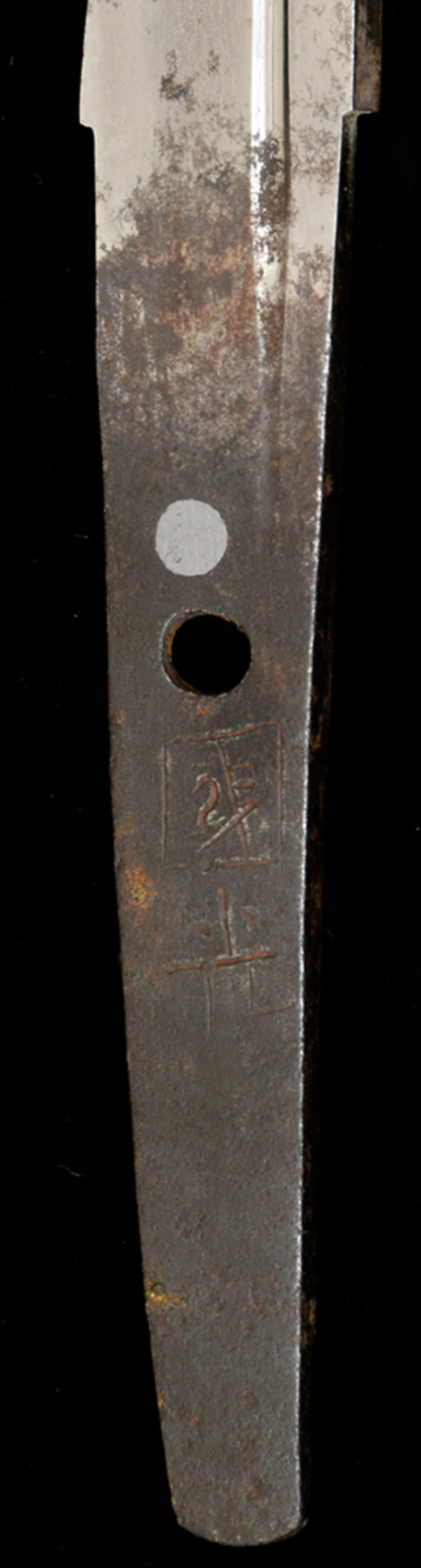
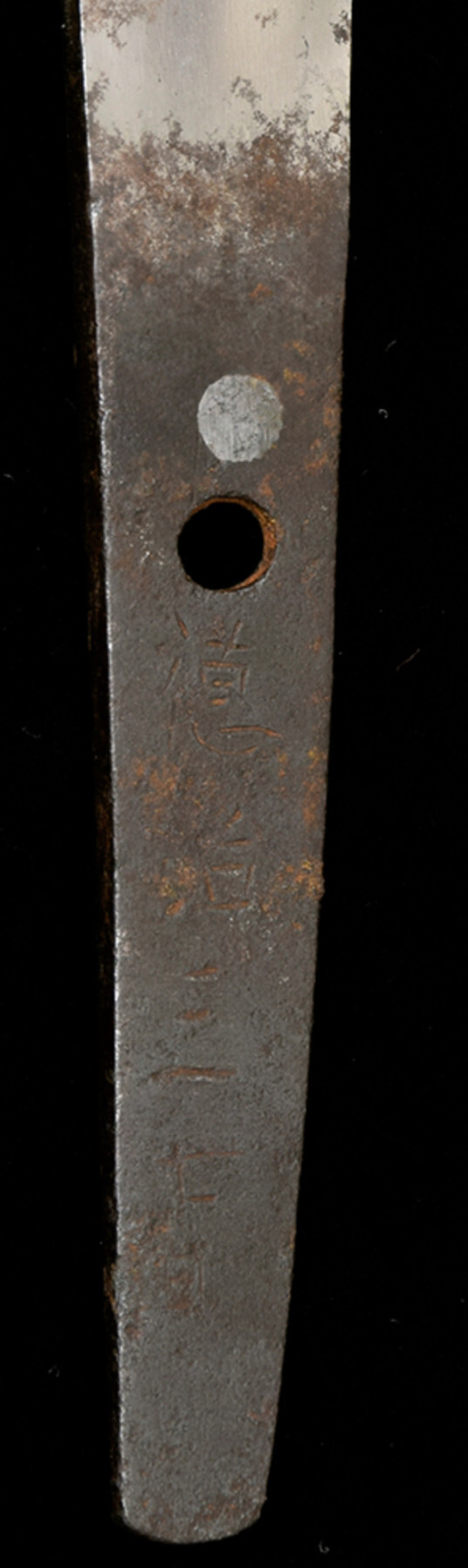
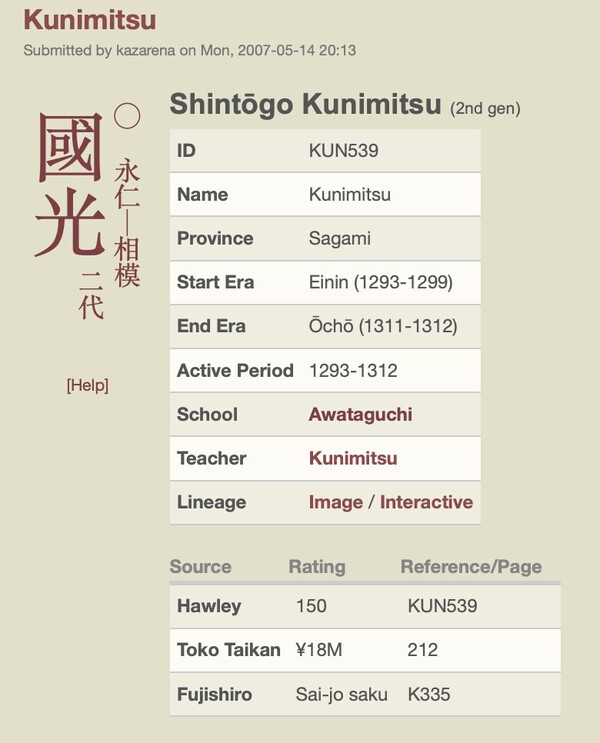
Some very useful points of reference. According the the Nihonto Club Kunimitsu was active 1293-1312. It's interesting that Tanobe gives a longer active life for Shintogo on the basis of the quality of a particular blade ie the 1320 tanto. From the Koto Meizukushi Taizan. Shintogo is said to have been born in 1250 and according to this reference dies in his 63rd year, ie 1313. Question is, which source is the most reliable. Dating works from this period are notoriously difficult with many contradictions even within the old texts. Given photos are even less useful for observing certain features compared to oshigata, this tanto dated 1324 shows many of the signature Shintogo features, such as extensive chikei, fine kinsuji and yakikomi. Signed Shintogo Kunihiro. https://emuseum.nich.go.jp/detail?langId=en&webView=&content_base_id=100486&content_part_id=0&content_pict_id=0 The 1318 Kunihiro signed tanto also has yakikomi. Beyond that the poor quality B&W image gives up little to be able to pass judgement on the jiba. What doesn't make sense is why Kunihiro would be signing in his own right if his father was still alive and working.


-
Yet it has Horyu papers, instead of just calling it gimei and collecting the fees. I guess it will need to be judged on its jiba after a polish. I'm also curious what Tanobe says about it.
-
Another worthy contribution by the forum troll. You're on a roll......keep it up.
-
So to summarise. As Ray suggested this appears to be an apprentice blade made daimei or more likely daimei-daisaku. The more I learn the more this makes sense. I would argue the smith is Norishige at the age of 18 working as an apprentice under Shintogo Kunimitsu. What evidence do I have to support this hypothesis? 1) Its universally accepted now that Norishige initially apprenticed under Shintogo Kunimitsu. 2) He had a long career starting 1308 (exactly the date this blade was made) and in this year he would have been 18. 3) His early Mei was large using a thin chisel, with the 2nd kanji slightly at an oblique angle. And from what I can tell it's quite an angular style too. 4) He dated many of his blades which was unusual for the time. Those that exist from up to 2 years either side of 1308 and also dated were carved by different hands that used a stylised writing style for the date, suggesting he was one of several apprentices in the Shintogo workshop. 5) The fact that the 1306 and 1308 blades are almost identical in sugata, length, identical koshi-bi etc would make sense if a Shintogo wanted to evaluate his students capabilities, by minimising the variables. Apprentice pieces follow this practice even today. 6) If it is an apprentice piece it likely took a lot more time to make thus explaining why there is no reference to a specific month in the date. 7) Norishige continued the Shintogo tradition of carving usual features into his Mei (like the horizontal half-moon on 'shige') throughout his career with only small changes in style. 8. The format of the date is consistent for Norishige who uses phrases like "on this lucky day...." 9) Daimei and Daimei-Daisaku is accepted for Shintogo Kunimitsu towards the end of his life. And in 1308 he only had 4 more years to live. 10) Norishige continued to make tanto in this archetypical Shintogo style for many years after his Master's death. 11) Unlikely to be Yukimitsu or Masamune as their Mei is too different. Kunihiro is a certainly a realistic possibility, but was he old enough if Tanobe says the sons were too young in the preceding Kagen era ( 1303-5) and Shintogo's oldest son Kunishige died in 1303. Here is an example of a dated (1324?) Juyo Bunkazai Kunihiro tanto, but without the adjective kanji Norishige uses. Just "on the 1st month, 3rd day......" Does anyone take exception to any or all of this hypothesising?

-
Thanks. I'm trying to figure out if the last 2 kanji on my tanto could correspond to 吉日 or if the penultimate character could be for something else. I don't see the any reference to a month. I clearly see the 日, but the 吉 is less obvious. What I can decipher is 徳治 (Tokuji) and 三 (san) for 1308 (Tokuji 3). The penultimate character is a mystery and doesn't seem to be related to the preceding 三 but connected to the 日. Why is this important? Norishige dated his blades in an unusual way for the period eg “on a lucky day of the 11th month of 1319”as translated from the tanto I posted above. If not lucky, what other descriptors could match the character and used in a similar way to 'lucky day'? The closest I can get that makes sense is "sē" and "bì" せ日meaning date, or on a day of Tokuji 3.......
-
Which kanji translate to lucky day? Kanji in red or yellow box?

-
Norishige certainly changed chisel size, preferring large Mei using a fine chisel early on (see his 1314 blade and signed ko-Hoki inspired work), switching to a thicker one later in his career. 1319 dated Tanto using a thin (?) chisel and what I assume appears to be a regular way to carve the date kanji. Application of a thick chisel and reference to his signature, later matsukawa hada forging style, are often referred to in the same text eg https://www.touken.or.jp/Portals/0/pdf/english/tobi_translation/794_NBTHK_March_2023.pdf Extract from Soshuden Museum essay on Norishige's periods of activity and associations in the early part of his career: "It is possible to determine Norishige’s exact period of creativity because nowadays we have quite a lot of works with his authentic signature and date of manufacture. The period when the master actively worked can be established as the interval between the Enkyō era (延慶, 1308–1311) and the Kareki era (嘉暦, 1326–1329). In accordance with his dated works and information about his life, it is possible to conclude that only the earliest works Norishige created in his youth can be attributed to the Enkyō era. These dates are of great importance when we determine Norishige’s teacher or teachers. The Kiami-bon Mei-zukushi manuscript (喜阿弥本銘尽, 1381) records that Norishige was Shintōgo Kōshin’s disciple (新藤五光心). We should recall that Kōshin was the Buddhist name of Shintōgo Kunimitsu. Consequently, it is most likely that Norishige began to learn smithing from this grand master. Modern researchers are unanimous on this matter and consider him the middle one in age among Shintōgo’s three disciples: Yukimitsu, Norishige, and Masamune. As an additional argument, it is often noted that Norishige’s tantō sugata is very close to Shintōgo’s. Moreover, Norishige’s tantō sugata did not undergo any serious changes with time. Therefore, we can conclude that Shintōgo immensely influenced Norishige’s smithing style. Nevertheless, we must remember that Shintōgo was likely to have passed away in 1312. At that time, Norishige apparently was still at a young age. He still needed both mentors and new ideas to develop his skills. Thus, the Kotō Meizukushi Taizen contains very important information that Norishige - Was Yukimitsu’s disciple during the Ōchō era (応長, 1311–1312) and the Shōwa era (正和, 1312–1317); - Studied under Gō Yoshihiro, beginning in the Gen’ō era (元応, 1319–1321), continuing through to Genkyō (元亨, 1321–1324); and - Was Masamune’s disciple during the Shōchū era (正中, 1324–1326)."

-
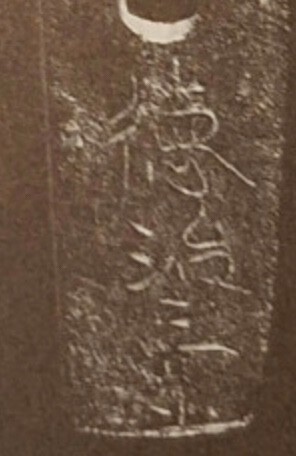
Date comparisons



-
1306 1308 2nd 1308 tanto. 1309 Juyo (1970) Juyo Bunkazai Juyo (2009) Different hands carved these 3 Mei IMO, based on the style of 'mitsu' Mei. The 1306 and 2nd 1308 tanto have the stylised date carving as noted by Tanobe. The 1309 could be a 4th hand or perhaps the same author who carved the 2nd 1308 tanto mei.


-
Thanks to Jussi's comprehensive list I now know the sister Kunimitsu tanto dated 1306, discussed by Tanobe in the Token Bijutsu #29 and exhibited at the NBTHK last year, passed Juyo #19 in 1970 (private collection).
-
It's unfortunate Darcy was not so forward thinking or his heirs so generous. A whole canon of invaluable research and some of the best images of nihonto have been lost to the community, both now and for future generations. But it's fantastic that @Rivkin @Hoshiand now @Jussi Ekholm are so generous with their time and knowledge, by publishing their Treaties and accumulated data. And not forgetting @Rayhan for the Token Bijutsu as well as other reference materials. Truly commendable. Special shoutout to @Brano for his generosity in sharing his amazing collection with the lucky few in May. It's only by having these unique opportunities to observe and study exceptional blades in hand can we further our knowledge and understanding beyond what is read and seen in photos. A humbling experience especially for someone so new to nihonto.
-
Looks like it's had a hard life. Hardly any hamachi remaining. I would agree with Kirill, looks like late Muromachi Bizen to me too and a worthy first sword if priced accordingly.
-
Fantastic resource. Even my pdf reader was impressed Puts in perspective how prolific some smiths were. Thanks for all the effort putting this reference together.

-

Council
Lewis B replied to Pritajeni1's topic in Sword Shows, Events, Community News and Legislation Issues
I wonder if the NBTHK have responded yet. -
Council
Lewis B replied to Pritajeni1's topic in Sword Shows, Events, Community News and Legislation Issues
This is internet gold....golden eel. -
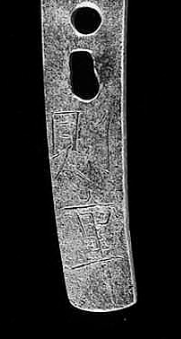
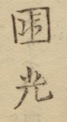
Another Norishige signed tanto with large, finely chiselled Mei, characteristic of his early work and exagerated slant to the 2nd shige kanji. From the Compton collection. Kunihiro, when he signed Kunimitsu, has a different style 'mitsu' than his father, again with a slight tilt. And Kunihiro signing as an independent smith in his own name with sloping kuni stroke.


-
Thanks for compiling that Jussi. The middle one, 3rd row is a real outlier. Both the kuni and mitsu kanji are atypical. Get well soon.
-
Council
Lewis B replied to Pritajeni1's topic in Sword Shows, Events, Community News and Legislation Issues
Sorry RR, but John is absolutely correct. The spelling mistakes and assertions on the "Certificate" are laughable. -
For NBTHK members about $1700 (pass) and $160 (fail)
-
Thanks Hoshi. This was always going to be a pre-requisite for it to pass Shinsa. But I think I can see enough of the jihada with its characteristic Shintogo school chikei to move forward. The blade really needs some experienced eyes on it after a window has been opened. There's only so much photos can tell you.
-
The red kanji on the report says "There is room for research in the inscription". In other words come back when you can convince us in a way that makes sense why the Mei is atypical. I think I am progressing in the right direction. Is it possible no one thought daimai-daisaku was a plausible explanation, especially given the date? This is why I was looking at old threads for 2018/19 Shinsa results to see if the panel were particularly cautious those years. I believe I'm correct in saying that when Tanobe sensei left, the NBTHK lost a bit of its mojo. I'm pretty sure a Horyu result can have a variety of different recommendations.
-
For posterity here are the very rarely seen Horyu papers issued by the NBTHK

-
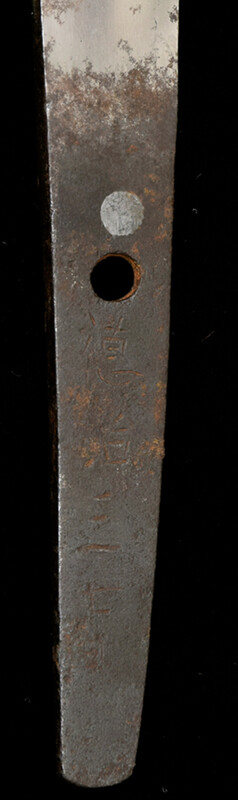
Hello Hoshi. I appreciate the encouragement. Certainly much to learn and exciting to be the custodian of this blade which appears to have so much potential. It made me work for it, haunting me for months and that is part of the satisfaction and a desire for a better understanding for this period ie the dawn of Soshuden. Here are the images you requested of the omote and ubu sides

-
Norishige signing daimei seems like the strongest candidate so far. Many examples of large, lightly chiseled Mei and he even tilts the 2nd character as in this example from a tanto, to follow the shape of the nakago, something Yukimitsu didn't do. And the date of 1308 puts him working as an apprentice under Shintogo Kunimitsu at this time, when he was 18.


-
It's good that certain egregious activities are being discussed. Removing Mei just to pass Shinsa is a crime against history. https://markussesko.com/2016/06/26/the-pitfalls-of-removing-signatures/