Joseph P.
-
Posts
97 -
Joined
-
Last visited
Content Type
Profiles
Forums
Events
Store
Downloads
Gallery
Everything posted by Joseph P.
-
Hello Hank, This sword appears to be a genuine Japanese sword. The blade is much older than WWII. I can see the leather cover on the Saya, typical of swords that served during WWII. A traditionally made antique Japanese sword that was refitted for the war. Someone will be able to translate the mei (signature).
-
Hello Kristie, I see many bayonets of all types. From early socket type to more modern lug-mounted type. A nice collection. Some of them may be Japanese. Just at a glance I can tell you a few of them are British. Keep in mind, this is a Japanese sword forum. Looks to be some knives and swords there as well. The katana with the metal handle is known as a Type 95. We would need closer photos to determine whether it's a reproduction or not.
-
 Hello and welcome to the forum, Most of the swords will require closer photos, but I can tell you the Blade 05 appears to be a Type 32 Cavalry Saber.
 -
Here is a video about this sword in case anyone is interested.
-
Hello Collin, It looks like an authentic Type 98 gunto to me as well. I think ChatGPT made a few mistakes with the date though. I believe it is actually dated May 1942. I see the kanji for Jyuu (10) and then the kanji for Nana (7). That means Showa 17. The kanji for the month seems to be a 5 (Go), but It is a bit sloppy.
-
Here is my attempt. Keep in mind I am still learning. I am unsure of the first kanji, even though I should know it. (?) Nobumitsu Saku
-
The signature says it was made in Showa 18 (1943), in the month of July. The side with only two characters is the name of the smith. Someone else will be able to translate this for you.
-
It is possible the signature may read "Endo Ichimonji".
-
Here is my attempt:
-
Art of the Samurai
Joseph P. replied to MassiveMoonHeh's topic in General Nihonto Related Discussion
Downloaded it, look forward to reading it. Thank you Brett! -
Well you know, not really. https://photos.app.goo.gl/5kgsGduA5w17fy3W8 Unfortunately the mouth is quite worn, especially at the top. There was a leather strap with a button to keep it secure, but it tore off at some point. It doesn't feel too bad with all the fittings on when it's in there, but definitely not secure.


-
Look for help with a sword on auction
Joseph P. replied to slowtriathlete's topic in Auctions and Online Sales or Sellers
Hello Brian, Here is my opinion. It is a decent blade on it's own, with no major flaws and seems honest. It is a genuine antique Japanese sword. Is it worth the asking price? Not really imho, especially when you include the cost of shipping/fees. The paper with Japanese writing that is displayed in the photo is a registration certificate, it is required to possess a weapon in Japan. They are not authentication papers (NBTHK) on their own though. You can find NBTHK papered swords within the $1,500-$2,500USD range, so it would be more worth it to buy a blade for around the same price that comes with papers. For that reason, it's hard for me to recommend this blade at this price for someone new to the hobby. Just to compare: https://rva-katana.com/collections/antique-swords?filter.v.price.gte=&filter.v.price.lte=&sort_by=price-ascending -
Hello Gerry, I have seen a few of these wrapped saya recently. I don't think any of them were in type 98 fittings though. Hopefully someone can provide some more information.
-
Reproduction? I have not seen a Yasurime like this
Joseph P. replied to Jon D's topic in Fake Japanese Swords
Yes, this is likely a chinese fake. The kanji look bad, the yasurime looks bad as you pointed out. The nakago is not finished properly, does not have any patina either. The number one telltale sign for me though, is the presence of the typical chinese "damascus" running throughout the tang. -
Hey Forest, I am not fluent in Japanese (yet). I have been studying for several months. I learned Hiragana and Katakana in one or two months give or take, it was really fast and easy. Basically I practiced writing the entire Hiragana/Katakana alphabet over and over again, and used what I wrote as a chart to study. If you watch Japanese TV shows or read manga, any Japanese interest really, you can practice writing words in hiragana and katakana using the chart as a reference (like katana, wakizashi, anime characters, Japanese actors, etc). You will memorize the characters pretty quickly. Kanji is where it gets challenging, it may be easier to learn the spoken language than to learn kanji. As for the spoken language, I have learned some but not really a whole lot. It's actually less difficult than it seems. It can take years to properly learn spoken Japanese and kanji, in my opinion. Usable Japanese though? Not really that difficult to learn.
-
I would classify it as a late war sword, having been made in the last year of the war. It is decent quality and looks to be in good shape. The mounts are called Rinji Seishiki, but they've been known by many different names over the years (such as Type 3 or 44). Someone may be able to chime in with more information on this particular smith. The blade is stamped which indicates this sword was not produced in a traditional manner, or it involved some sort of non-traditional component. This is typical for many gunto, early and late war. Edit: After searching, this may be the guy we are looking for but I am not 100% sure on this.
-
Hello Chansen, From what I can tell, Nobumitsu (信光) seems to be accurate. It is also signed "Showa 20", or 1945. First month (January).
-
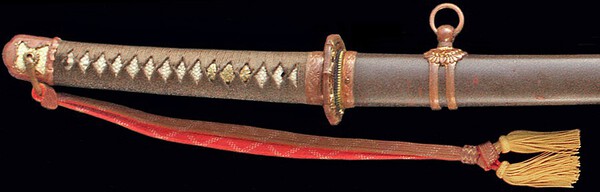
Bruce posted this above: "Wartime sword that likely had a damaged tsuka (handle). Someone along the way crafted a new wooden handle, but kept the Army kabutogane (end cap)." So the wood handle is not original, but whoever made it kept the kabutogane (the brass end cap) and put it on the new handle. The flower was a personal touch by whoever made it, no Japanese tradition or anything associated with it. This is more what it would have looked like originally. A Type 98 Gunto.
-
Hello Jon, Welcome to the forum. I believe the sword is dated "August, 1943". The shorter signature with only two characters should be the name of the smith. Please wait for this to be confirmed and for further translation, as I am still learning.
-
It's a nice tsuba Chris. Brings to mind something else more prevalent in the firearm community, called "blood pitting". Blood contains salt (?) which if left unchecked, can lead to rapid rust and decay. It is possible the tsuba had been grabbed by a bloody hand, or maybe laid on the ground for a while after a battle and was picked up and simply wiped off. Of course this is all just speculation.
-
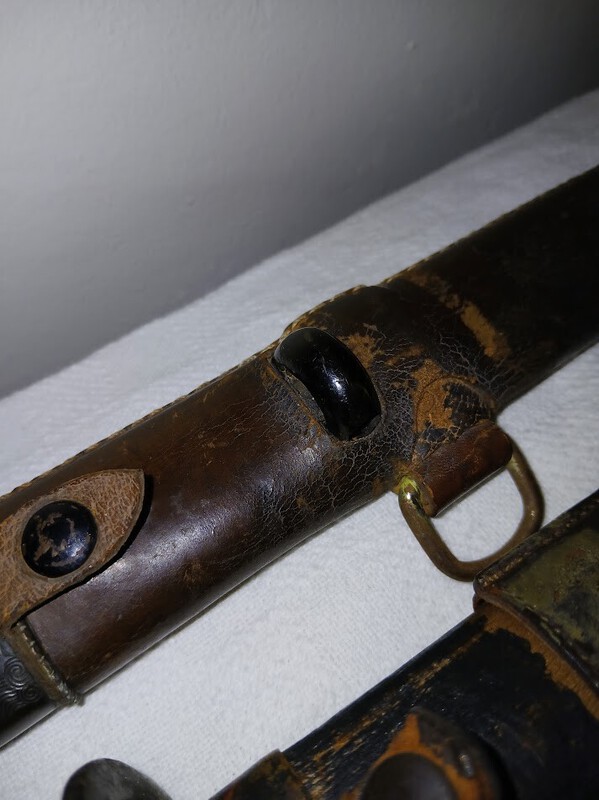
Here are mine. I have a few more photos in my Google Album, be warned though the photos aren't that good. Also the one with most of the cover missing (third one down) is canvas. https://photos.app.goo.gl/wzz8yGffcZ1FUp4V9 It's not uncommon to find a cover with the soldier's name or a patriotic slogan written on it. One with a kurikata and hanger. Variations of the scabbard "drag".
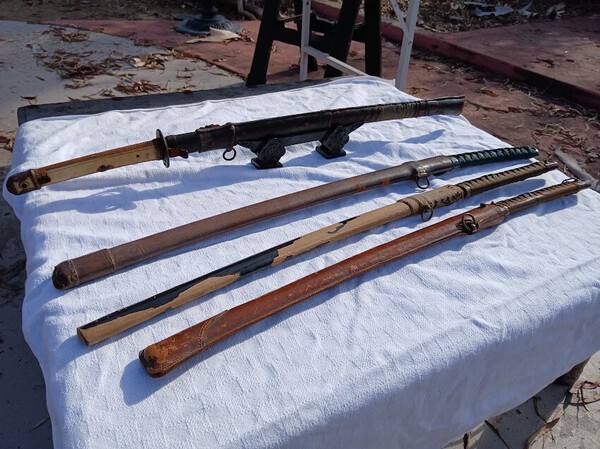
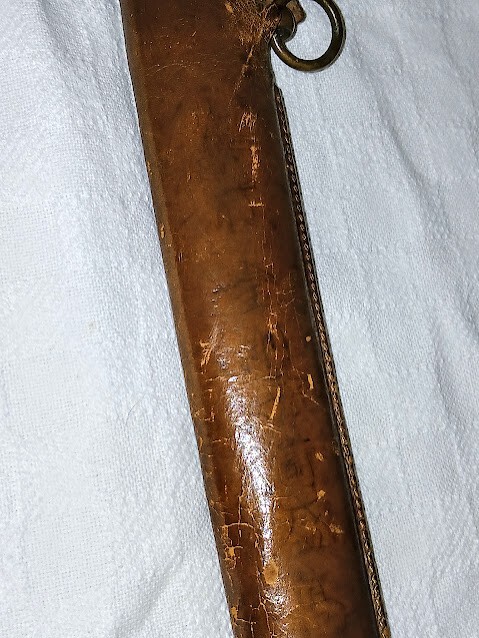
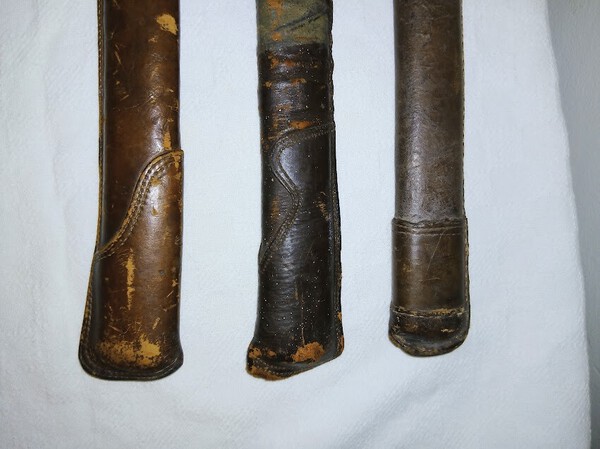

-
Hello Olga, First off, welcome to the forum. This probably should have been posted in the "Nihonto" section, but the admins will move it when they get to it. Having more pictures is necessary, but from the single photo provided it appears to be a genuine Japanese sword. It is reminiscent of a World War 2 era sword, these may be non-standard fittings (Gunzoku), as the menuki under the handle wrap appears to be from an army gunto. Though usually the saya will not have sageo for World war 2 era swords. Please wait for the experts to chime in as they will be able to provide a translation and more information. Also please post a few more photos if possible, especially of the blade itself.
-
Thank you all for the assistance. Very helpful for learning some of these kanji.
-
Thanks so much Bruce. I made an attempt at translating the date but I was off, getting better though. I am studying kanji right now and I had trouble with what I assume is the 4 or 44. After you provided the correct translation, the month portion made more sense to me.