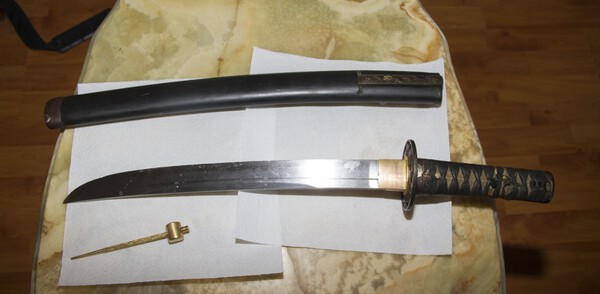
Hello, I’m new on this forum, and I would like to apologise in advance for my bad english !
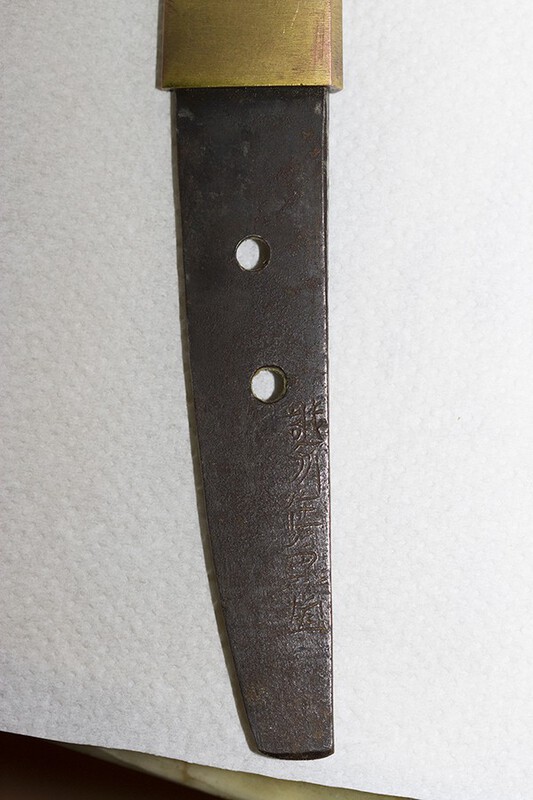
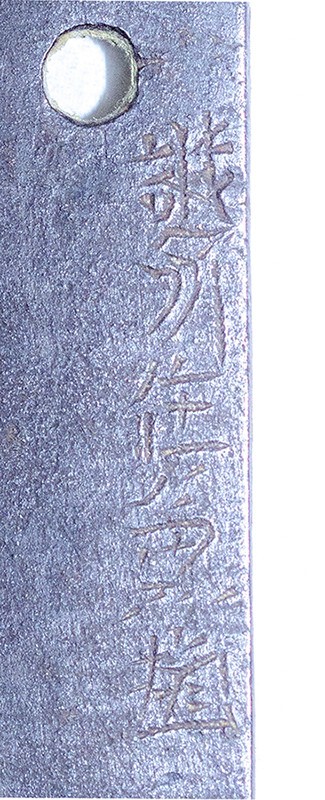
I received one week ago, a ko wakizashi and I would like to ask some help to decrypt the mei :
The nakago is 36 cm length and is a hira-zukuri style (don’t know if it could help?)
As you can see, I modified the contrast and the chromy of one of my pictures (the blue one) to be easier for you to decrypt the mei.
I tried to identify by myself, and I’m not sure about it, but I think it could be « Esshu-ju kanenori » or « Echizen kuni kanenori », but by searching on http://nihontoclub.com/view/smiths/meisearch, I only find two swordsmith who could match with the mei :
- Kanenori from the province of Echizen, tensho period (1573 – 1592) used to sign 越州住兼法
- Another Kanenori from the province of Echizen, Shinto period (1596-1781) used to sign 越前國包法
So my questions are :
-Did I’m wrong with the translations ?
-Does the kanji 兼and 包 are the same and have no difference on this website ?
- Could it be possible that the second and the third kanji are 前國 instead of 州住 ?
-Could it be a gimei ?
Thanks a lot in advance !
(more pictures available)