


estcrh
-
Posts
2,003 -
Joined
-
Last visited
-
Days Won
8
Content Type
Profiles
Forums
Events
Store
Downloads
Gallery
Everything posted by estcrh
-
This Week's Edo Period Corner
estcrh replied to Bugyotsuji's topic in General Nihonto Related Discussion
Ian, I can not think of what that would be.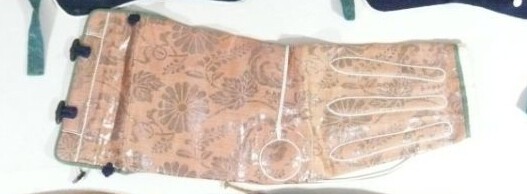

-
This Week's Edo Period Corner
estcrh replied to Bugyotsuji's topic in General Nihonto Related Discussion
This is probably a bukuro of the type mentioned in the translation of this book, http://www.rhinohide.cx/tousando/yoriaku/index.html I do not know what size it is but you can judge from the Kyahan that it is next to, looks to be around 12-18 inches long. Kate-bukuro (provision bag) There are several kinds, as the koshi-oke, koshi-dzuto, men-oke, kouri, etc. For ordinary officers, the kind called koshi-dzuto is recommended; it is made of kan-yori (twisted paper strings) in the style of fine basketwork, and measures about 1 foot by 9.5 inches. It is carried at the right side of the waist. Besides this it is advisable to carry another bag (which is called uchi-gaye), in which are 3 or 4 gou of raw rice (about 1lb). In cold weather baked rice is recommended because it gives warmth -
This Week's Edo Period Corner
estcrh replied to Bugyotsuji's topic in General Nihonto Related Discussion
Moriyama san, I have seen pictures from the site but not the original site, very interesting, thanks. Here is a better picture of the unusual item I mentioned, someone must have seen one of these before. -
Hachiwari with nihonto style tsuka.
estcrh replied to estcrh's topic in General Nihonto Related Discussion
Piers, I have tried to find a meaning to the words but . If it was sharpened it was a long time ago by someone who knew what they were doing as it has a very sharp point but no edge, a very heavy truncheon that can stab at the same time, the hook attaches nicely to a belt and the tsuka makes it look like a sword if thats all someone could see.Here is the other side. -
This Week's Edo Period Corner
estcrh replied to Bugyotsuji's topic in General Nihonto Related Discussion
Ian, from my observations clothing from around the Edo period or older is really hard to find and there are not many examples online to see, its funny how the better cloth seems to fall apart while the rougher lower quality cloth still holds up, with brocade being the least able to withstand harsh treatment. Did anyone notice this other auction, there is an item that is very rare to find now but at one time must have been quite common. http://cgi.ebay.com/ws/eBayISAPI.dll?Vi ... 2245wt_797 -
This Week's Edo Period Corner
estcrh replied to Bugyotsuji's topic in General Nihonto Related Discussion
Moriyama san, thank you for the correct name, and while searching with the name you provided I found this site with interesting information, I wish I spoke Japanese. http://members3.jcom.home.ne.jp/pehota0 ... mohiki.htm -
This Week's Edo Period Corner
estcrh replied to Bugyotsuji's topic in General Nihonto Related Discussion
Henk, have you seen this site? http://www.rhinohide.cx/tousando/yoriaku/index.html Shitagi (shirt) There are several different styles of shitagi, but do not get any fancy ones - the style recommended is just about the same as an ordinary kimono with very narrow sleeves, a little shorter in length and narrower in width, with a few buttons at the breast, and a thick tape or cord around the waist. It should be put on as though it were a kimono, the left hand being first put into its sleeve, and then the right, the breast being buttoned and the waist cord finally tied at the back. -
This Week's Edo Period Corner
estcrh replied to Bugyotsuji's topic in General Nihonto Related Discussion
Henk, you might be right about the European influence, I believe the shirt is actually a gusoku shita or shitagi for under armor wear. All of the ones I have seen have a collar which buttons, narrow arms and an attached belt. -
This Week's Edo Period Corner
estcrh replied to Bugyotsuji's topic in General Nihonto Related Discussion
Henk, your right on both, one is hakama with built in kyahan and not kote, and the other is not a haori, any idea what is really is? -
This Week's Edo Period Corner
estcrh replied to Bugyotsuji's topic in General Nihonto Related Discussion
Just some trivia, these 2 auctions are over now, the seller has years of experience, anyone see whats wrong with these 2 listings? http://cgi.ebay.com/ws/eBayISAPI.dll?Vi ... 2245wt_797 http://cgi.ebay.com/ws/eBayISAPI.dll?Vi ... 2245wt_797 -
"Nearly flawless blade, some scratches and grain patterns visible, with lots of activity"....not exactly "no flaws" but would anyone consider this to be an adequate description of easily spotted flaws, especially if the seller has some experience?
-
I posted a picture of this on the Edo period corner but I have taken some more detailed pictures. This hachiwari has an unusual shape in that it has very little curve and the point is quite sharp. Someone went to a lot of trouble fitting a tsuka and related parts to this weapon.
-
Matus, there is a great post here by forum member ERazer titled "Books from the 19th & Early 20th Centuries" and supposedly they are all in the Public Domain and can be printed off or converted to disc. viewtopic.php?f=9&t=7983&start=0&st=0&sk=t&sd=a
-
Here is a good place to start, a visual sword glossary to help with the proper names for the different parts of the sword. Also look around the site as it has a lot of good information and the owner of the site is a member here. http://home.earthlink.net/~steinrl/glossary.htm
-
Andrew Graham-Dixon's I, Samurai.
estcrh replied to Ford Hallam's topic in General Nihonto Related Discussion
A very interesting concept, I havnt heard it described like that, any examples of the "earthenware" look? -
Andrew Graham-Dixon's I, Samurai.
estcrh replied to Ford Hallam's topic in General Nihonto Related Discussion
And yet when it come to nihonto perfection is often seen as the ultimate goal and anything less is viewed as abject failure not to be tolerated. -
For those who do not know this sellers personal philosophy.in regards to the swords he sells:
-
This Week's Edo Period Corner
estcrh replied to Bugyotsuji's topic in General Nihonto Related Discussion
Ron, I am sure you are already aware of mink oil, I have used it for many years on all my leather shoes and clothing. I have some very dry ww2 Japanese sword belts and I have some mink oil I was planning to use on one as an test piece, I will let you know how it works. http://en.wikipedia.org/wiki/Mink_oil -
Identify defenders of a castle?
estcrh replied to Bugyotsuji's topic in General Nihonto Related Discussion
That would be like showing Winston Churchill fighting in full armor. -
Identify defenders of a castle?
estcrh replied to Bugyotsuji's topic in General Nihonto Related Discussion
If you look at the armor that is depicted it is a very old style of armor, which would indicate (if the artist was showing an historical fight) that this conflict was close to the introduction of firearms, before armor use changed to the newer style of plate armors. -
Acquiring a Tanegashima (Japanese matchlock)
estcrh replied to estcrh's topic in Tanegashima / Teppo / Hinawajū
Piers I was wondering how that was referenced, I had no idea that there were any records like that being kept. It also shows the firearms were still being produced quite late in the Edo period. Thanks! -
Clive, if you happen to read this, the makura-yari you mention, is it the one pictured in your book?
-
Acquiring a Tanegashima (Japanese matchlock)
estcrh replied to estcrh's topic in Tanegashima / Teppo / Hinawajū
Piers, I am still removing the under barrel rust , its a very slow job, but once it is done I will post pictures of the final product. I had wondered about how one would go about finding a date on a Tanegashima with only a signature. Many thanks for your efforts and like Ron, I also ran up against the online translators road block. I was going to ask for further clarification but you finished the job already. What was the final verdict on the translation of the name, and as for the date mentioned 1801, how does that come about? -
Thanks Piers, Jūroku Uragiku, crest of the noble Hirohata family.
-
Ian, thats another not often seen but formally common item. I have two matching small hitsu with covers and the framework cage with pitched roofs (rain protection?). One cage needs some tlc but I will post pictures next time I can clear enough space to find them.The leather cover on one of the hitsu's was so tight it took a lot of careful work to remove it and when I finally got the hitsu open this was inside.

