Rentokill
-
Posts
5 -
Joined
-
Last visited
Rentokill's Achievements




-
Inherited Gunto Katana in bad shape - what to do with it?
Rentokill replied to Rentokill's topic in Military Swords of Japan
Well YOU seem to be a rather knowledgeable fellow, looking at your website over here... Yes I should be patient. I just checked the handle, there IS something stuck halfway back in there. but I cannot tell what it is, it's simply too far in. Would you KNOW someone you'd consider to be an expert on this matter? -
Inherited Gunto Katana in bad shape - what to do with it?
Rentokill replied to Rentokill's topic in Military Swords of Japan
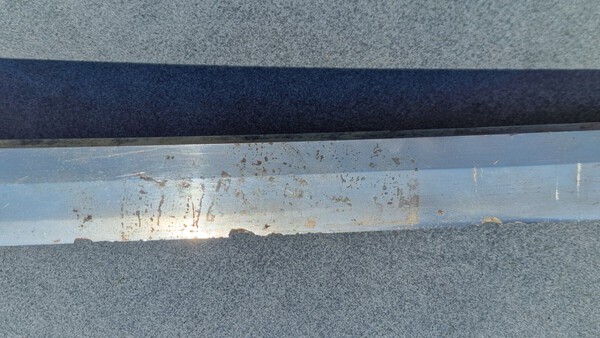
Hey Grey, well I would like to give it a try myself - as the item apparently is not fit for sale, and I am not willing to pay 3000 Euros for a professional polish (an offer I saw yesterday, and which I am sure is fair for a vintage blade), I really don't have many options. I wrote to half a dozen specialists yesterday (all here in Germany) but so far have not heard back from them. Why can't I remove the rust from the nakago? Because it's part of the patina? Yes I am quite sure the remaining piece of the nakago is still inside the handle, I don't know where else it would be? I doubt that I could get it out with a magnet, I just tried a neodymium magnet against the remaining piece of the nakago and the attraction wasn't very strong even under these rather good conditions. Unwrapping / unknotting the ito to be able to remove the pommel is not an option either, the leather is SO old, it has hardened to a semblance of plastic. Which brings me to a basic question - how much restoring is adequate, where do you cross the line to "this isn't the original sword anymore"? At which point would the original maker say "you dishonor my craftsmanship", or would he go, "Eh, that needs to be fixed, do what is necessary"? -
Inherited Gunto Katana in bad shape - what to do with it?
Rentokill replied to Rentokill's topic in Military Swords of Japan
Hey Grey, big thanks for your feedback. It seems nursing the sword back to a semblance of its old glory will be a bit of a journey, especially if attempted in a proper fashion. My problem is that I wouldn't even know where to start as most of the everyday methods of cleaning a "tool" simply are not applicable. How do I get off all of the dirt and what seems to be glue and wall-paint (?) on the blade? What is the proper oil for blade care, should I get the rust off the nakago, if so - how, should I try to retrieve the broken-off part (it may or may not have etchings telling me a bit more about the sword's history), etc etc. I have taken a look at the page you linked, that looks helpful, thank you very much. And the bit about a collector's group sounds like good advice, too. -
Inherited Gunto Katana in bad shape - what to do with it?
Rentokill replied to Rentokill's topic in Military Swords of Japan
Hey Brian, the break is pretty much in the middle of the handle, I pushed it together a bit so it actually doesnt look damaged but it is really only held together by the wrapping. Yes, I suppose taking a bit of care of it and repairing whatever I can would be in the best interest of the weapon, as opposed to being stripped for spare parts (I hear there is a market for single koshira or fuchi). But I will need to check out what Grey posted first, I would really like to go about it in as much of a proper fashion as possible. Starts with the blade, that thing is awfully spotty as well, the kissaki seems to have frickin wall-paint on it, and there is stuff that looks like glue on the blade as well... ugh. how do I get rid of all of this without ruining the blade? AI tells me to use camelia oil for the surface, not sure if THAT would be the right way or if I would be better off with some original Japanese oil... sounds like a longer project, but an interesting one. -
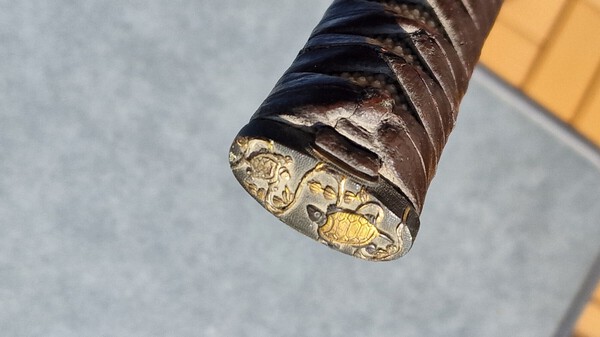
I inherited a Gunto katana from my father; unfortunately, upon closer inspection, it’s in much worse condition than was apparent during the years it hung on the wall. I’ve attached some photos; the biggest issue is the broken tsuka. The break was apparently caused by moisture seeping in through the upper menuki hole (the pins are unfortunately missing). The upper third of the tang is still embedded in the handle, which is also broken. I realize that this essentially renders the sword "dead", which is very unfortunate since, as is clearly visible at the break, it was clearly folded/forged and not factory-cast. Is there anything that can even be done with an object like this? I actually wanted to hang it on the wall myself, but it’s truly painful to look at now that I know it’s do heavily damaged. I would be very grateful for an expert opinion.