Nazar
-
Posts
285 -
Joined
-
Last visited
-
Days Won
4
Nazar's Achievements






-
One may notice interesting geometrical shadows in some photos. As I mentioned In Walking thread in Izakaya I had to remove part of the shutter in my camera. So that's how the remnants of shutters look like. There is no chance I will buy a new camera any time soon, so at the moment I am slightly limited in my photography. Jumping a little forward, I already addressed the issues of the bent saya metall shell and blade. The idea wasn't to make things "like new". Those bends and dents are part of the history of this sword. Yet they are unacceptable as they are, so I had to do something about them. Here are the results. I still have to repair the wooden core of saya though. Also, later on, I could do some further adjustment to the blade. I'll post on how I straightened the blade and saya metal shell later, as at the moment I have some other things to do .


-
Marcin, as I already mentioned, it's a great project for me. I am enjoying it immensely. It would be too dull to get a sword and just hang it on the wall.
-
It's not too hard to notice that this sword, traveling through years and hands, lost some parts: - the sarute; - the mekugi nut; - Saya haikan (torn off). And while absence of sarute is not of big importance, the absence of mekugi nut and haikan may tell some stories. So, why is haikan absent? My theory is based on what I could see: at some stage the sword and saya were bent. And this happened while blade was in saya. Then someone tried to unbend the assembly and eject the sword. Or rather remove saya of the sword. The point of force application was haikan and thus it was torn off. Here is a picture of saya. It's more clearly visible with saya in hands, but even in photos double bending is recognizable. Let's add a straight object to make the picture more clear. Dents on the metal housing of saya are quite prominent too. And here is the sword. As one may see, the point where the blade is bent corresponds to the bend on the saya. So I believe that my theory of the blade being bent along with saya is correct.


-
Bruce, I am far from being native speaker, so it happens that I could choose an incorrect word. I mentioned the pattern is identical in one of the following sentences but forgot to edit the previous one.
-
But before I proceed to the issues, I would like to post some info on tsuka. When I was going through Scogg monograph on Type 95 swords, I read that the ito of Variation 3 is symmetrical. And my understanding of this statement was literal. Like one side of tsuka is mirroring another except for menuki. So when this sword got my attention I was slightly confused, because what I saw was not a symmetry but rather similarity of both sides of the tsuka (except for menuki). However, a quick check confirmed that this is a standard pattern for NCO swords with Suya Shōten stamps and serial numbers around 50K. I am not sure if this information is of importance, but decided to post it anyway in case someone needs it. Here is what I mean. As you may see from the photos below, the pattern of ito is identical for both sides. Same is with ito knots.

-
The person, who stamped the ferrule of this sword, deserved a salary raise. It might not be the perfect example of a Type 95 sword, but I like it immensely. I like how tsuka is worn to bare aluminum, I like those scabbards with remnants of paint and bare metal that blackened with time. I even like the blade with all that spots. The patina on brass and copper parts (except for habaki) is great too. Dunno how to express this feeling I have about this sword: it looks like a complete picture to me. Yet, there are some things in this sword that I would like to address so it would be my project for some time.


-
First and foremost, I have to thank two members of this board. I want to thank Sam @Scogg for his monogram on Type 95 swords, that saved me so much trouble and helped pass by some fake NCO swords. And I want to thank @Marcin, who generously agreed to resell me his freshli bought NCO sword. Without Marcin my chances to get Type 95 were indistinguishable from zero. As it was discussed in another topic on NCO swords, they are rare in Europe and they are even rarer here in Ukraine. What I've seen locally were mostly 100% fakes. The only real NCO sword I have seen was refurbished, which means tsuka and saya repainted which in my opinion is unacceptable. Here is the sword itself. It's Variation 3 with Suya Shōten, Tōkyō 1st Army Arsenal Supervisory Section and Kokura arsenal stamps on ferrule. The blade is stamped with Tōkyō 1st Army Arsenal Supervisory Section stamp and its serial number (54285) matches the number on the throat of saya. And as the tsuba of this NCO sword still has a slot for a leather knot I deem it was made somewhere between 1939 and 1941.


-
Like to introduce my new dirk and looking for info
Nazar replied to chandlang's topic in Military Swords of Japan
Tsuka wrapping is made of celluloid, not the samegawa, therefore this dirk is of late production. It looks like someone tampered with the blade. Nakago jiri looks like someone used a hammer on it. I have seen dirk blade with unfinished fuller before, but this one looks like it was barely started before the task was abandoned. -
Thank you Florian! It's kinda hard to catch in photos. Did my best though.


-
Thank you, Jean!
-
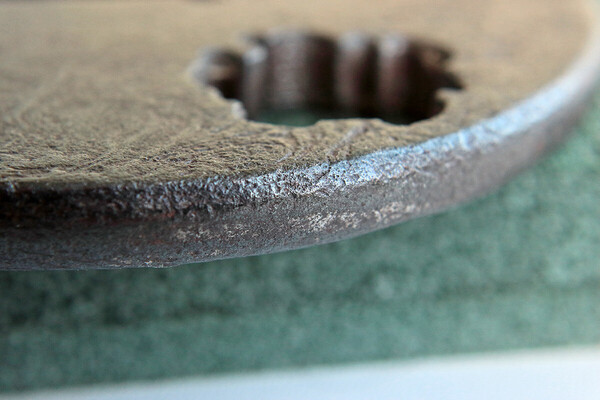
Some additional photos.


-
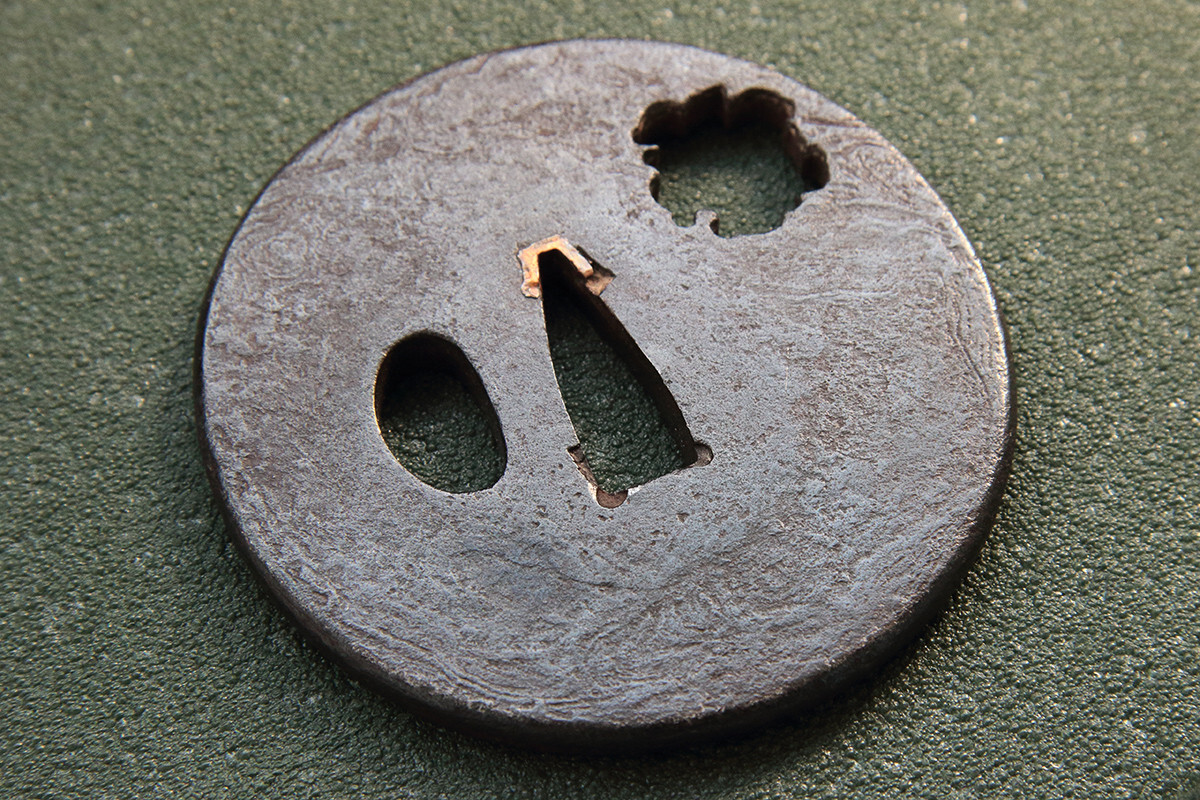
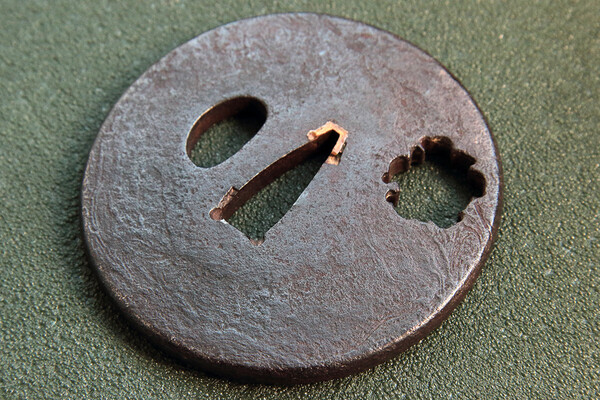
Tsuba arrived. It's quite massive and heavy. I have no scales at hand to weigh it, but dimensions are as follows: 79x76.5x6mm. What else could I say? It's beautiful.


-
Hi Jean, The seller stated dimensions as 76х78х5mm and 180gr of weight. Alas, as I mentioned, another person bought that tsuba. According to the listing, it happened like 10 minutes after I bought Tetsujin tsuba.
-
Glen, thank you for your answer and clarification of that pattern! I was curious about it. I have to confess that the sarcastic part of me called it "shamisen and cats" because two of those shells seem to have ears:-) Yes, I noticed those lines but was kind of cautiously optimistic and therefore was waiting till I got it in my hands. At the moment the tsuba is on its way to me. And again, thank you for clarifying the pattern! Maybe I had to buy that rudder and shell tsuba too, however, I am happy with what I have. As the song says, two out of three ain't bad. Also I was very cautious about all these tsuba because the seller who put them for sale was earlier noticed selling well, tsuba like objects...
-
So, I won that tsuba with a red cushion. Only one person made a minimal bid, so my final bid was like EUR 54. Will post photos of tsuba here as soon as it arrives. As for the photos of that coated tsuba with blue cushion, I saved a couple of photos from a local auction to analyze it later. The photos are of low quality, but I believe the coating is clearly visible. Here they are: