Gerry
-
Posts
259 -
Joined
-
Last visited
Content Type
Profiles
Forums
Events
Store
Downloads
Gallery
Everything posted by Gerry
-
Unfortunately, this is a Chinese reproduction sword. It's evident from the supposed mei.
-
Damn you'd have to be a crazy huge Himura Kenshin fan to dump 1.25M yen on this. I wonder how the smith compensates for the curve that appears during the yaki ire process? https://www.samuraishokai.jp/sword/25142.html
-
Just came across this odd looking nakago on a nagamichi katana. Does anyone have any idea why they would weld on an extra piece of nakago to original one? It's like the opposite of a suriage nakago.
-
I've never seen a gunto with a leather covered saya with fittings: https://www.jauce.com/auction/e1192352718?allow=1 It seems like the leather shrank over the year, and split from the kojiri at the tip.
-
He usually has those suspicious Hon'ami papers with the blades. Every once in a while he'll have legit looking NTHK papers. He sold a realistic looking signed fukuoka ichimonji blade last year with NTHK papers for only 1.3M yen.
-
And he has excellent feedback, but suspiciously, many of the feedback for his swords have the exact same text. Here are some pictures of the other swords he's recently sold... A masamune: https://auctions-yahoo-co-jp.translate.goog/jp/auction/m1190204643?_x_tr_sl=ja&_x_tr_tl=en&_x_tr_hl=ja&_x_tr_pto=wapp&_x_tr_hist=true A bizen nagamitsu: https://auctions-yahoo-co-jp.translate.goog/jp/auction/p1188449281?_x_tr_sl=ja&_x_tr_tl=en&_x_tr_hl=ja&_x_tr_pto=wapp&_x_tr_hist=true A sanjo munechika: https://auctions-yahoo-co-jp.translate.goog/jp/auction/t1187516715?_x_tr_sl=ja&_x_tr_tl=en&_x_tr_hl=ja&_x_tr_pto=wapp&_x_tr_hist=true
-
The swords being listed by this seller are rather perplexing. He's able to consistently list a large number of swords that are either "masamunes" or "sanjo munechikas", etc. The thing is, the swords are actually rather nice, with lots of koto looking activity in the hamon, and sometimes even having koto jitetsu. But many of the swords are extremely healthy with ubu nakago, long nadasa, thick kasane and prominent hamachi, so it leads me to believe that they're shinshinto copies. But they're really good quality shinshinto blades. And he's able to get some pretty good prices. Does anyone here think that these blades are indeed koto? Or if not, how the hell is he able to get his hands on so many high quality shinshinto blades? Here's his current live listing, a "Rai Kunimitsu": https://www.jauce.com/auction/f1191102591
-
It's crazy that he paid 1.4M yen for this sword, and with the Jauce fees on top of that. I wouldn't think he'll recoup his $11K back on eBay. It'll be interesting to see how much it goes for. He already relisted it this morning.
-
Mandarin Mansion - experience to share?
Gerry replied to omgPirates's topic in Auctions and Online Sales or Sellers
If there was ever a case of humble bragging... Just kidding! Sounds like an impressive collection though, and in Singapore too, where owning swords isn't very well looked upon by the government. -
Sure, Lex. The seller didn't take good pictures ,but here are a few where you can kinda make out the jigane.
-
Ah, thank you for sharing, Jussi!
-
I know of ko, sue, and chu Mihara attributions, but can anyone read the attribution of this NBTHK origami?
-
Here's another odd hamon...a chicken pox gunome?
-
Nah, I have no intention of purchasing this sword...just thought I'd share this unusual looking hamon. And for what it's worth, the sword is actually in Japan with a torokusho, so it's not a Chinese fake.
-
I came across this sword with a peculiar hamon. Does anyone know what this type of hamon is called? It kind of looks like a reverse saka choj.
-
Sure, I used Nosyudo in Gifu.
-
E-Bay - Price evaluation and markets in general ?
Gerry replied to drbvac's topic in General Nihonto Related Discussion
For what it's worth, katana prices (I don't pay attention to tanto or wakizashi prices) at Aoi Art and other online dealers who have a Western clientele have been trending up in the last year. This is probably due to the increase in international demand caused by the weaker Yen. A TH katana with koshirae from a regular smith listed on Aoi 2 or more years ago went for somewhere between 700,000 to 950,000 yen, whereas they're being listed for about 1,200,000 yen recently. I was still even able to buy a few TH katana in shirasaya as recently as in early 2024 for 600,000 yen each. However, prices on Yahoo Japan have been fairly consistent because they mostly cater to their domestic collectors. -
Aoi Art is definitely pairing up koshirae with blades to make them more appealing to Western collectors. In fact, I had previously purchased a daisho from them with a gorgeous set of Edo period mounts, only to find out that the blades in them were not original to the koshirae, and didn't fit exactly. In the case of daishos, they find blades to make the daisho koshirae more appealing. I was in their shop recently deciding on whether to purchase a particular katana in shirasaya, and discussed options about having an antique koshirae for it. They walked me through the process of finding suitable koshirae parts, and the hardest step in the process was finding a suitable existing saya. I ultimately decided to send the sword off to have a custom koshirae made in Gifu.
-
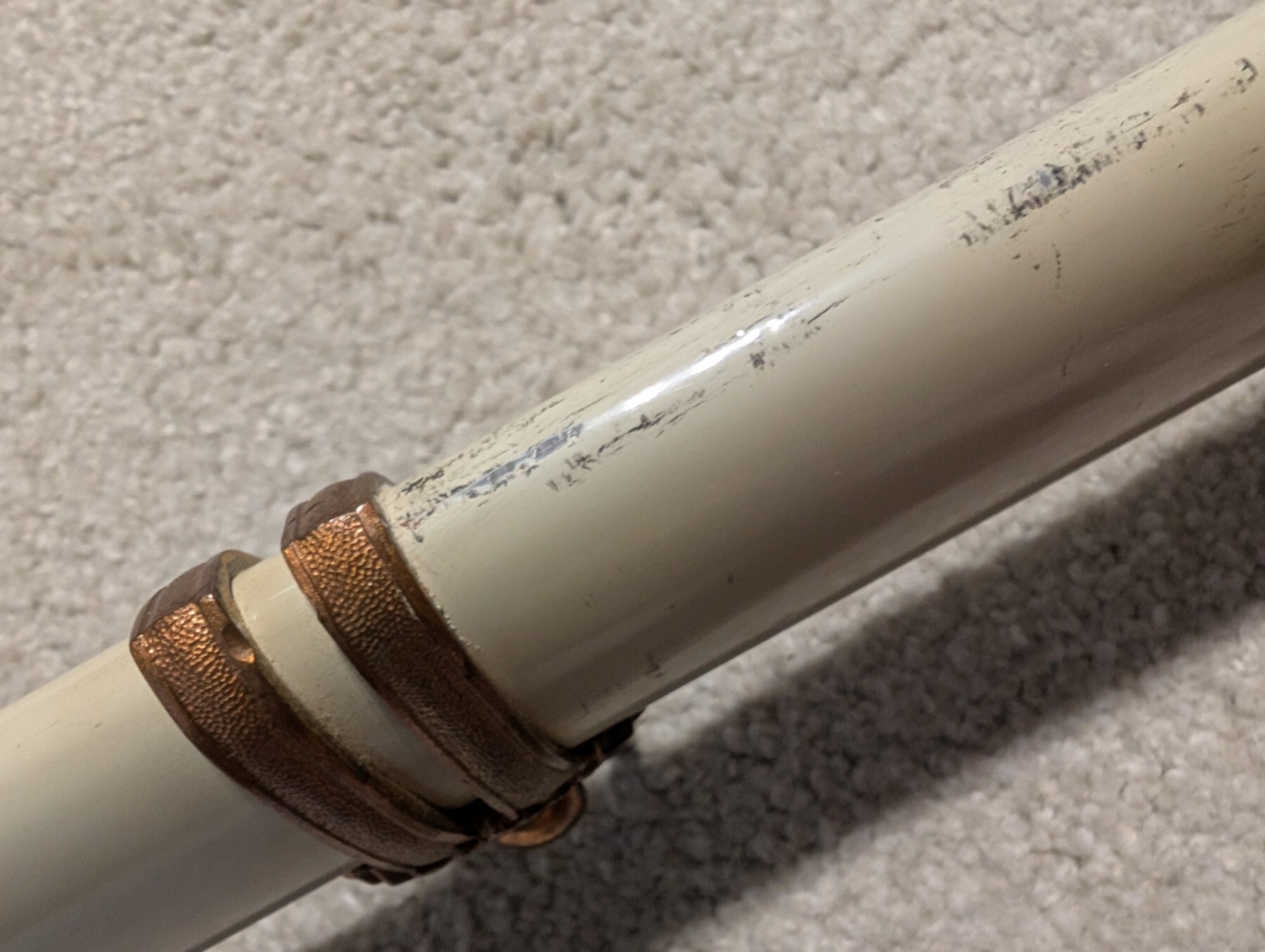
Interestingly enough, the same on the tsuka on mine is also painted white on the exposed areas. It would be quite remarkable if this color of gunto was indeed for troops sent to the Aleutian islands. There's movie footage of these troops that I've soon on TV, so let me try to find it again and verify if they had white gunto.
-
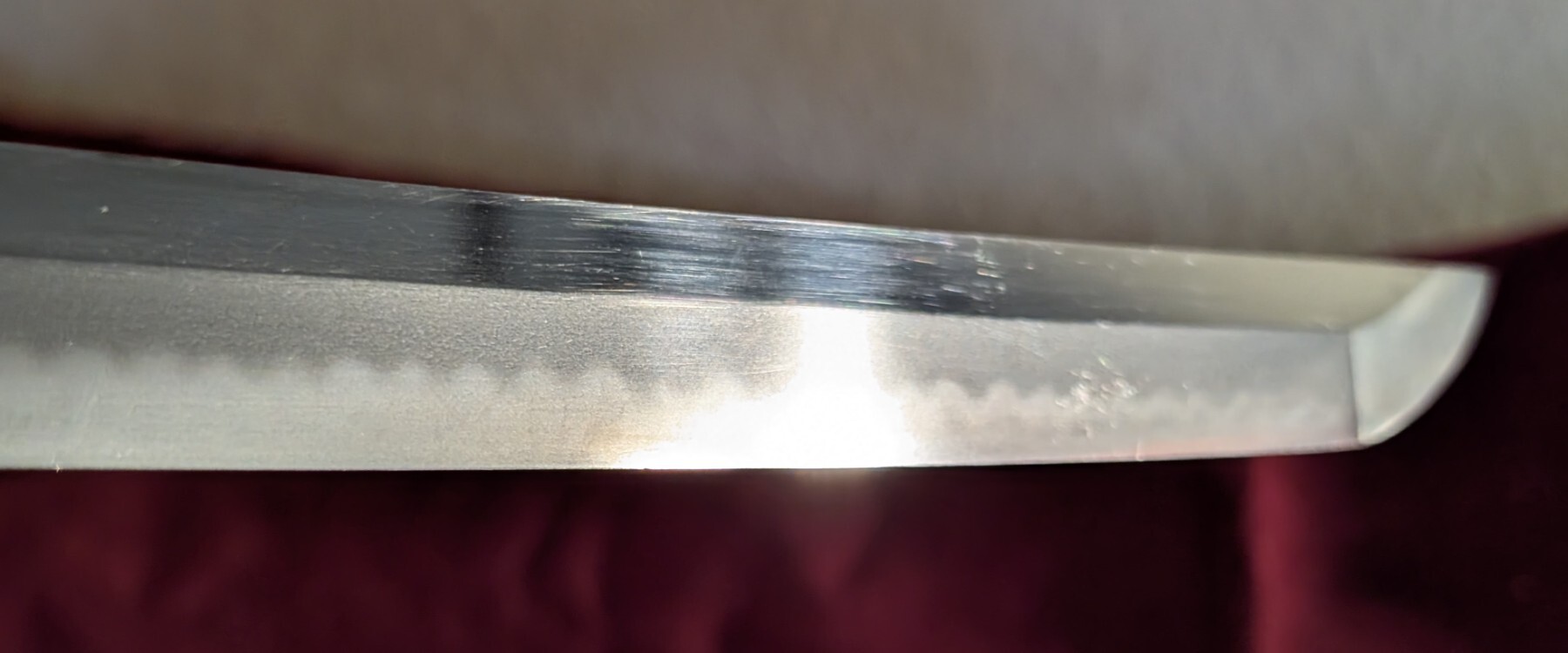
Thanks, and with regards to the copper fittings, if you look at the last photo above showing the ashi, you can see that the left clasp has s small chip, exposing the internal color of the metal, which is also copper colored.
-
Hi Bruce, Thanks! I appreciate you sharing the photo of the NCO swords, and these do have a similar cream colored paint on the saya as the one on my sword. One thing I also wanted to note are the slender proportions of the blade; the width at the yokote is only 0.75" (1.90cm), and the width at the hamachi is 1.125" (2.86cm). It almost has the proportions of a koto sword.

-
The mon on the hilt is unfortunately missing.


-
I've owned this custom shingunto for the better part of 20 years, and thought I'd share photos of it with this forum since I don't see gunto with white says very often. The sword has a graceful 25" inch nagasa blade that is ubu and unsigned, with a very well controlled nioi deki gunome hamon, and is very well balanced in weight distribution. The pierced tsuba is also very large and heavy. It seems that the white paint is original to the saya, since some areas of wear exposing the steel underneath don't show any other colored undercoats. The metal fittings are also heavy and copper colored, with an oval ashi ring. It's a pity that the nakago isn't signed, since I've always wondered who the smith was for this rather lovely blade.


-
Wow, I was pretty surprised that this Masanori katana with the dragon horimono on Aoi went for only 1.3M yen. It sold a few months back on Aoi too, but WITHOUT the koshirae, for 2.0M yen. https://sword-auction.com/en/product/27081/as24102-katana-yamato-daijo-fujiwara-masanorinbthk-tokubetsu-hozon-token-2/
-
- 2
-

-
Ah, that's a good observation. I always read so much about Ka's "Kamakura jigane", but I don't see it at all from the photos of this blade.