The Myoan Collection
-
Posts
25 -
Joined
-
Last visited
The Myoan Collection's Achievements






-
A modest Tsuba of Sayagata Manji.
The Myoan Collection replied to The Myoan Collection's topic in Tosogu
This is the very chap. Well spotted. Definitely looking much happier now after it’s bath and some quite lengthy attention with a porcupine quill and Egyptian cotton. -
For your appreciation today is a piece which I have recently restored. It had a fair amount of rust particularly in the recess. Now looking much more healthy. Interesting that this example is not cut all the way through like most of the examples of this style I can find online. I wonder why? it strikes me as very logical that this symbol was a demonstration of serene and skilful craftsmanship. I suppose the wearer was demonstrating to his audience a similar aspiration of equanimity. Your comments And observations would be most welcome. The extent of my notes concerning its description….. Iron, oval-shaped tsuba with openwork in “sayagata” pattern (interlocking buddhist “manji” symbols). Bushū Itō school. ? Sayagata is a pattern of interlocking manji. The Manji symbol is a testament to the Buddhist ideal of interconnectedness. It signifies the interdependence of all phenomena, emphasizing that each individual being is intricately linked to the vast web of existence. This interconnectedness fosters compassion, empathy, and a sense of responsibility towards all beings. The Manji serves as a reminder of our shared humanity and the interconnectedness of our actions, highlighting the importance of cultivating kindness and mindfulness in our interactions with others. I can’t think of better words at the moment to encourage us to all reflect on ways of living in these difficult times…..

-
A pair of dragons chase each other through the sea.
The Myoan Collection replied to The Myoan Collection's topic in Tosogu
A male and a female! What great symbolism. Thanks for the education guys🙏 -
For today I present you this piece. Two dragons chase each other through the sea. One has already lost its tail to the aggressions of the other. There are traces of gold inlay here and there including some quite charming gold tenzogan. As with my other dragon piece I have no illusions that this is a masterpiece but it was the second tsuba to come into my possession so it forms part of a growing awareness of the form and the mark making of the craft. Does anyone have any particular insights as to the narrative of the two dragons or any other observations with regard to place or date for this. Thanks guys.


-
Thank you so much Ford and others for your insights. I'm glad to say I didn't pay very much for this piece, $250, The most I have ever paid for a Tsuba, and I'm not in any way disappointed by Ford's assessment. As a novice collector it's extremely interesting to begin to educate myself as to the depth of this art form. I had no illusions that this was a masterpiece. It's amazing the way more and more examples keep coming out. The previous owner of this piece would have been fascinated by this discussion. This piece and most of the others in my collection come from a single previous collection that was assembled here in Cape Town in the 1950s. The previous collector would have been in his early 30s at the time and a novice in the subject. Lovely to now assemble this research and pair it with the pieces so that the next custodian will be able to further the research and not have to repeat it. Thank you everyone for your engagement and interest. I will slowly over the coming days and months share the rest of my collection for your enjoyment and scrutiny.
-
An Owari (尾張) tsuba with double diamonds
The Myoan Collection replied to The Myoan Collection's topic in Tosogu
Excellent. Very useful advice. Thank you so much David 🙏 -
Aaaaaah, very interesting. Thank you so much Brian🙏🙏
-
Hello Brian and others Am I interpreting things correctly that this is the Smith?

-
Thank you Dale and Malcolm. I'm pretty blown away by the quantity and quality of information here. Definitely very satisfied to know soooo much more about my piece. So we will go early Edo right?
-
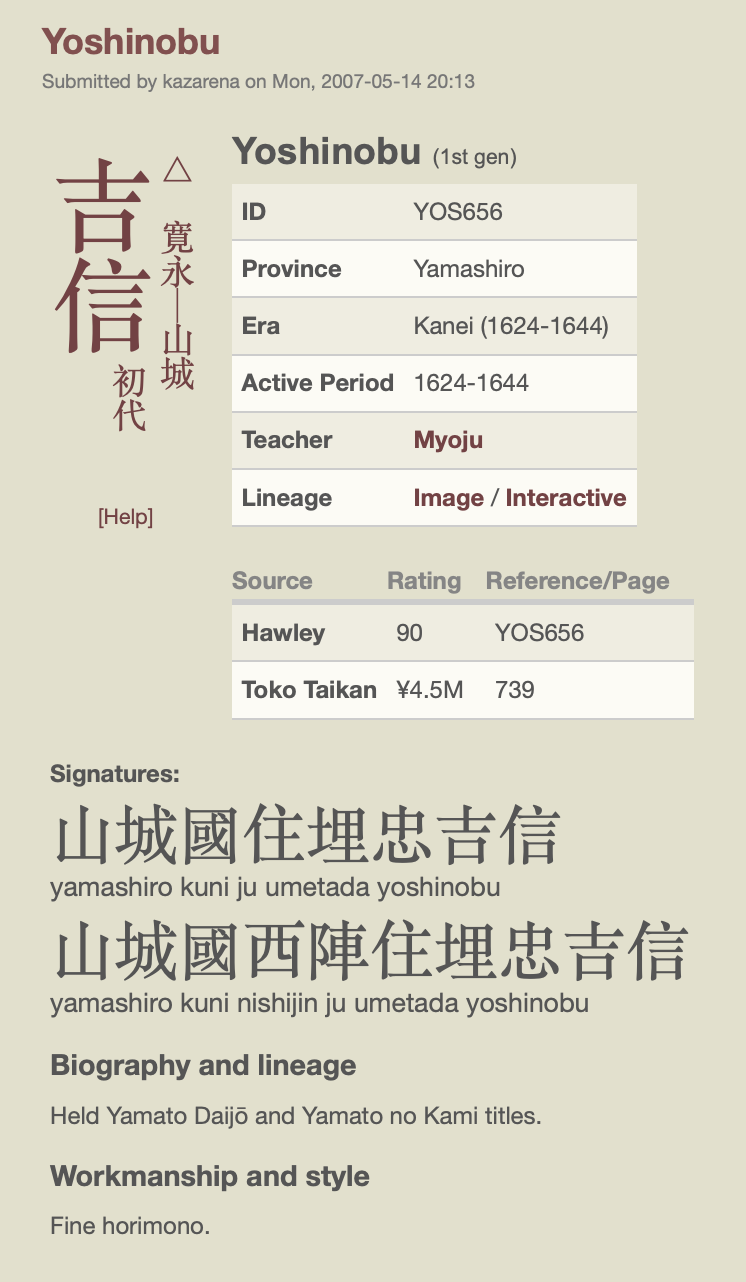
Is this the Man ? Yoshinobu Submitted by kazarena on Mon, 2007-05-14 20:13 吉信 初代 [Help] △ 寛永︱ 山城 Yoshinobu (1st gen) ID YOS656 Province Yamashiro Era Kanei (1624-1644) Active Period 1624-1644 Teacher Myoju Lineage Image / Interactive Source Rating Reference/Page Hawley 90 YOS656 Toko Taikan ¥4.5M 739 Signatures: 山城國住埋忠吉信 yamashiro kuni ju umetada yoshinobu 山城國西陣住埋忠吉信 yamashiro kuni nishijin ju umetada yoshinobu Biography and lineage Held Yamato Daijō and Yamato no Kami titles. Workmanship and style Fine horimono. https://nihontoclub.com/smiths/YOS656
-
I see dates in your text. Let me read that first.
-
Thank you Mal. The Kinai document is absolutely fantastic. So great to have a positive identification. I even found another piece by the same two men. Would you have an idea of a date for my piece?

-
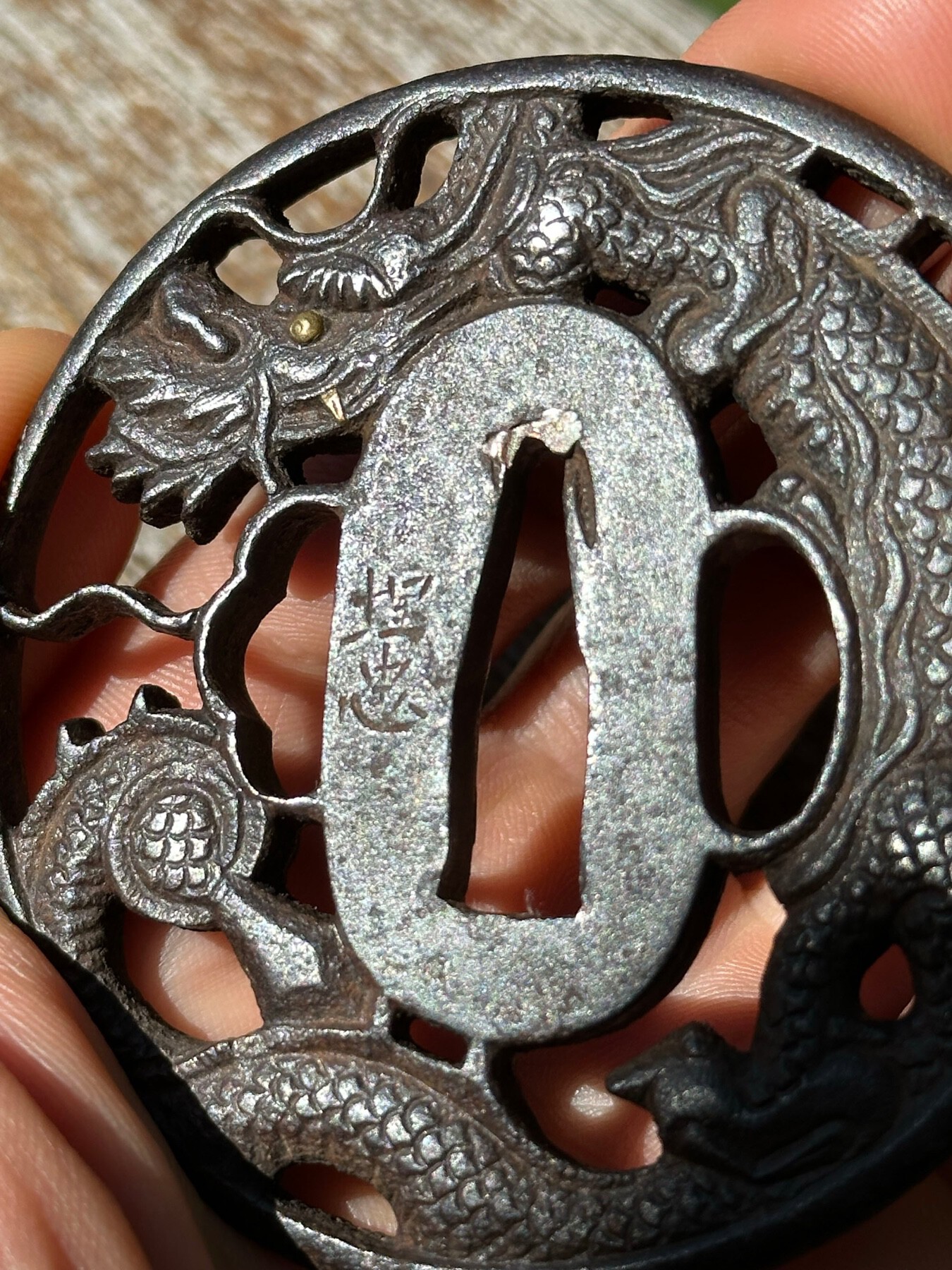
Thank you very much for your reply Jean. Here are some better photographs. Thank you for your interpretation.

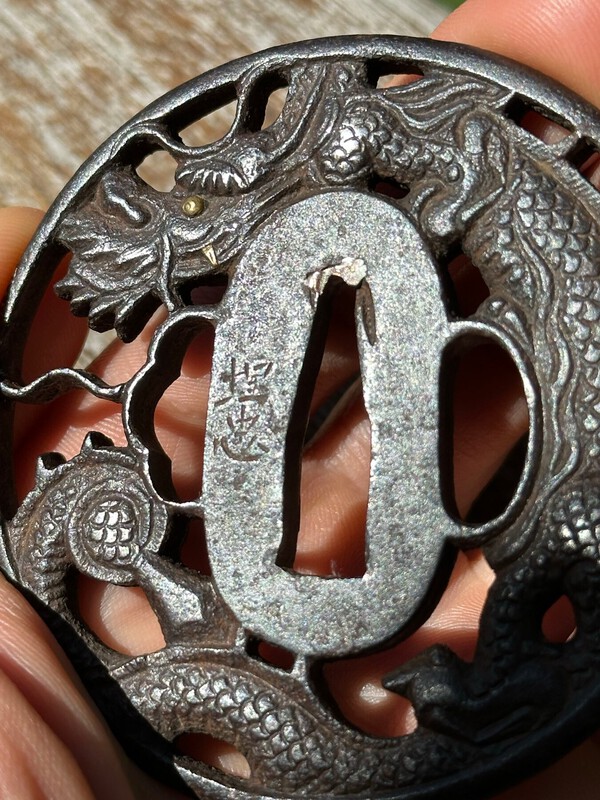
-
Hello everyone. I've done some very rudimentary research on this piece as I am still new to the field. Would anyone be able to pin down a slightly more accurate appraisal? Signed: Echizen ju Kinai Date: 18th century Mei: Echizen Ju Kinai A description very similar piece., . The design of RYU, a stylised dragon, is depicted, the head to tail around the SEPPA DAI, shown flying across the clouds and holding a flaming TAMA, a Japanese jewel. TECHNIQUE Pierced in YO SUKASHI, positive silhouette, with KEBORI light hairline incised surface details, which would indicate his style as well, the eyes of the dragon inlaid in gold. SIGNATURE / SCHOOL 越前住記内作 ECHIZEN JU KINAI SAKU KINAI school. PERIOD / ORIGIN Middle EDO period. 18th century. Japan. To see the body of a dragon in its entirety was thought to expose oneself to certain death, the punishment for looking upon too much divinity: the eating off the tree of knowledge. This idea is also said to be the reason why formerly the Japanese emperor, who through his forbears was said to be descended from a dragon, was always hidden by a bamboo curtain from those he received in audience. Possibly a branch of the Miōchin (Group IV), this family was founded by Ishikawa Kinai, who moved from Kiōto to Echizen province and died in 1680. The succeeding masters, however, bore the surname of Takahashi. All sign only Kinai, with differences in the characters used and in the manner of writing them. The Kinai made guards only, of hard and well forged iron usually coated with the black magnetic oxide. They confined themselves to pierced relief showing extraordinary cleanness both of design and execution. Any considerable heightening of gold is found as a rule only in later work. Dragons in the round appear first in guards by the third master, fishes, birds, etc., in those of the fifth; while designs of autumn flowers and the like come still later. Thanks very much everyone.


-
Thank you so much David!