.png.2adb07d434adbd4c808846789e68d947.png)
AlexiG
-
Posts
76 -
Joined
-
Last visited
About AlexiG

AlexiG's Achievements






-
.thumb.png.85f3fd036d09507865860724219753c4.png) Price update: $10 100. Can't figure out how to edit the original post. Best, Alexi
Price update: $10 100. Can't figure out how to edit the original post. Best, Alexi -
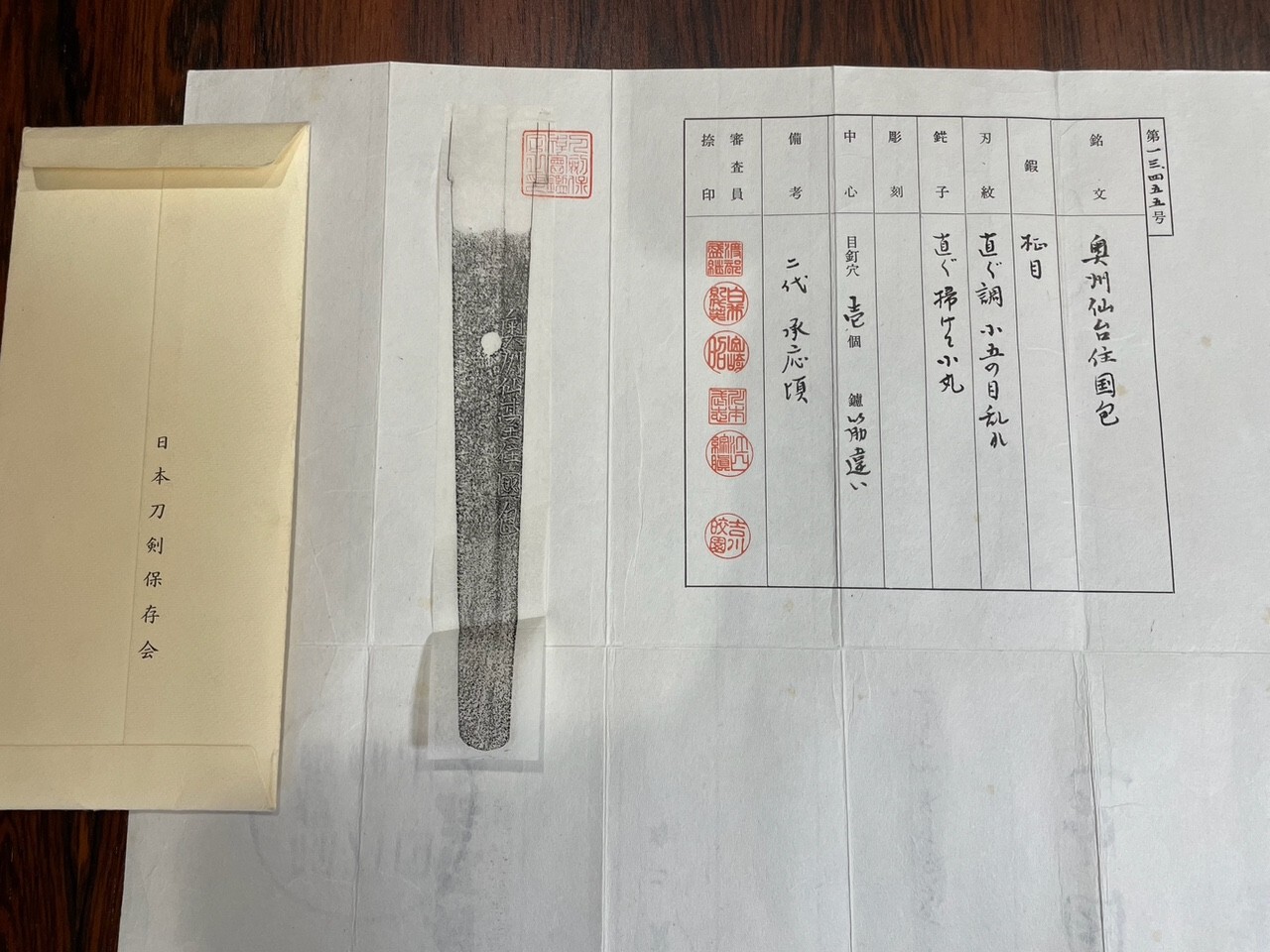
Type : Katana Ubu Mei : 奥州仙台住國包 O-shu Sendai resident Kunikane Papered : NTHK Japan Era/Age : Shinto Shirasaya, Koshirae or Bare Blade? :Shirasaya Nagasa/Blade Length : 2 shaku 3 sun 3 bu (70.59cm or 27.8 in) Sori : 1.1cm (0.43in) Hamon Type : notare Jigane : masame Other Hataraki Visible : ara nie, small ashi, some hint of sungashi Flaws : no Sword Location : Bay Area CA, USA Will ship to : Worldwide Payment Methods Accepted : Certified check, Money Order, Bank Transfer, PayPal (+3.5%) Price and Currency : $10 500 (USD) Returns Policy: 14 days after receipt for US buyers. No international returns. Other Info and Full Description : This sword is attributed to the second generation Kunikane by NTHK in Japan. The Kunikane clan operated in Sendai and were well renowned for producing high quality masame swords supplying the daimyo Date Msamune and his retainers. The Kunikane clan spans at least 13 generations making swords from early 17th c till last 19th c. Second gen Kunikane (Yamashiro no Kami) learned from his father with whom he worked closely and is considered the second most valuable in the Kunikane line according to Hawley who rated the 2nd gen Kunikane at 70. The sword is in excellent polish and the masame hada is very dense. This sword has a significant heft when held and it always surprises me when I handle it with other swords in my collection. It comes with a single piece gold habaki, shirasaya, and a bag. PM me with any questions. If you are near the Bay Area in CA, you can inspect it in person.



-
Hi Luca, It seems your experience is similar to John's, i.e. give time and space and good things can happen. Thanks for sharing. Best, Alexi
-
Hi John, thanks for the info. Seems like what I am experiencing is par for the course. I got a papered sword from the Kunikane clan (the 3rd Kanetsugu) with amazing masame hada, so I am quite excited about the sword. I am in no rush, but would like to know that folks have not forgotten about this project @JCKang John, do you feel your calls made a difference for the timeline? I am not inclined to start calling unless it will have a positive timeline impact. Given the feedback I will hurry up and wait Maybe the tariff thing will resolve itself by the time this sword gets shipped.....I can dream, can't I Best, Alexi
-
Hi all, I purchased a blade from Isao Machi (Nihontou.jp) in mid-February this year, long before the tariff nightmare began. The blade was supposed to get a new habaki and saya in Japan, which was supposed to take couple of months. In May I reached out to see how things were going, and I got a reply indicating that there seemed to be no progress. In August I reached out to again and have not gotten a reply. I just sent another polite email to inquire how things were going. If I don't get a reply within the next week, I am tempted to contact my credit card and start a dispute. This experience has been quite different compared to the other two Japanese online sellers that I have dealt with before. Given that Mr. Isao may be experiencing headaches of his own (the website was re-done and updated few months back), I'd rather not "jump-the-gun" so I am curious what advice folks here have. Best, Alexi
-
She has a tanto from Shibata Ka that is within the same price range. The tanto has been there for a lot longer. I wonder if the non-uniform (in terms of thickness and clarity) nioiguchi puts it in this lower price range. Still quite interesting. Best, Alexi
-
Which would you get? Mei or Mumei
AlexiG replied to RichardY's topic in General Nihonto Related Discussion
One has to wonder why a Kamakura or Nanbokucho sword attributed to a well-known school will be priced the same as a late-Muromachi sword from a "generic" school. Is the den Kunizane sword tired, or is there something special about the Sukesada sword that has not been discussed yet? Alexi -
ID Help Please (Type 98, Shin Gunto, Officer's Sword?)
AlexiG replied to EryrWen's topic in Military Swords of Japan
Hi EryrWen, it is helpful if the pictures of the nakago are posted with blade-tip up. Easier to read. I am taking a stab in the dark but it seems you have a seki stamp on the nakago. Meaning the sword was inspected before issued to military. You can read more here. The smith's name is Yoshimitchi (吉道) best I can tell. Picture of nakago below. There is a gendaito smith with that name, given name (小島 幸七, Kanetoki Koushichi I think). I am sure others will chime in if I have gotten it wrong. There is a date of manufacture on your sword as well (on the other side of the nakago) but folks may need a better picture to read it. Best, Alexi -
Thank you! Very helpful. Alexi
-
Hi Oli, The nihontocraft pages are great. I visit them often when I drool over a blade that they have for sale. I keep reading and re-reading the Masahide article. I think this is a small piece of the "Practical theory of swords" book. Would love to read the rest one day Alexi
-
Hi BaZZa, I mistyped in my reply. The search I did was for Hakudo. Did not find direct references for testing Gassan blades though. If you do, please link here.
-
Great suggestion! Quick search for Nakayama Kakudo and Gassan did not get me any leads but did find references to Hakudo testing various swords on ohmura-study.net Another way I can look at it is that Gassan Sadayoshi (Sadakazu's adopted father) was trained by Suishinshi Masahide who was a great proponed of the practicality of swords. So maybe that rubbed off to Sadakazu, Sadakatsu and the later generations I still wish someone will translate the two Suishinshi Masahide books in English: Practical theory of swords and Secret teachings of swordsmiths. Alexi
-
I was looking for this type of data so many thanks to @Jussi Ekholm for collating it. I was reading an interview recently in the book "The new generation of Japanese swordsmiths". The interview was with Shibata Mitsuo an influential sword trader who learned his craft from Fujishiro. He mentioned the introduction of the white kicho papers in 1948 and how that led to record sword prices at the time (20 000 yen). Now we all laugh and ignore at the white papers but at the time they seem to have been the coolest thing in town. Of course many/most of the good swords got re-papered, meaning more shinsa fees, more expenses by the collectors, etc). Maybe juyo is like that (less extreme of course). It was the cool kid in town at one point (Darcy points this out as well), now those with the means ($$$) go to tokuju and the value of Juyo is open to debate. Those with the knowledge don't need papers. The rest of us try to figure it.... Alexi
-
Hi Oli, I know of these and similar blades. My question is a) besides the masame hada, how close are those to Yamato tradition sugata, specifically the "high shinogi" attribute. Hoke Saburo Nobufusa smiths (8th, 9th Gen) make/made Yamato-school blades. Those are often described as with "high-shinogi" by folks and are tested by various martial artists to be very durable and being able to make difficult cuts without damage. It seems that within certain aspects, Nobufusa lineage smiths are trying to be true to the Yamato/Hosho tradition. Similarly, I have read accounts of advanced iaido and kendo practitioners who used Yoshindo Yoashihara blades because of their durability and great balance. There are also accounts of Yoshindo testing his blades on helmets and such to demonstrate their robustness. There is the whole set of tests in the Mito domain and smiths like Kusamura Norikatsu making blades that can pass the tests, blades that often happen to also be very beautiful. My question is does that hold true for Gassan Sadakazu and Gassan Sadakatsu? Or did they make pretty swords in masame because that is what the officers in the Imperial court wanted? I would like to think that given the status of Gassan Sadakazu, he maintained the practical aspect of the sword in his art but not having handled any examples, and not having read accounts of such observations I would like to check with the community here. thanks, Alexi
-
I am trying to learn a bit more about the shinshinto/gendaito Gassan sword characteristics. Would their swords be considered with high shinogi, eg Yamato tradition like? I have not seen anyone refer to them as such, but since some folks here may have handled many Gassan works I wanted to ask. I am specifically interested in the Sadakatsu (son of Sadakazu) made swords, but any feedback is helpful. Another potentially divisive question. Are there written accounts of 19-20th century Gassan sword durability or anecdotes of their performance, good or bad? Given the heights of recognition of the skills of Sadakazu and his descendants, one would expect that the beauty of their swords is more than skin-deep so what is the evidence that their swords maintained the balance and robustness needed for practical use. For example, what would happen if one applied the Mito region sword testing tests to a Gassan sword? Thanks for any information, Alexi