drac2k
-
Posts
77 -
Joined
-
Last visited
Content Type
Profiles
Forums
Events
Store
Downloads
Gallery
Everything posted by drac2k
-
Thanks to everyone for the information! Were the Shikomi-Zue created as a result of the Haito Edict and the Satsuma Rebellion and since this is a true form of that blade type, we can date the sword post 1876/1877? The reason why I thought the sword might be older due to the forging flaws is because it appeared to me to have been the type exposed after repeated polishing, just a guess from a very green novice.
-
I just picked up this sword cane and based on this site I believe it to be a Shikomi-Zue. From my reading here, the blades were usually(not always), not the best; this one measures 23.5" long and has pitting and exposed forging flaws that make me think that it may be an older blade. I am very impressed by the nice fit of the blade in the scabbard. I tried to gently force the pin out, but it was not moving and I didn't want to take a chance of injuring the handle. Based on the limited information and pictures that I have provided, I would appreciate any comments offered.
-
WW2 Japanese Last Ditch(or in the Ditch), NCO Sword?
drac2k replied to drac2k's topic in Military Swords of Japan
Thanks for your imput Bruce. I am leaning towards Chris's thoughts that is might be an older blade. I think that the flaws may have come out due to repeated polishes. I wish that I could capture the temper line on camera -
WW2 Japanese Last Ditch(or in the Ditch), NCO Sword?
drac2k replied to drac2k's topic in Military Swords of Japan
Thank you both for your informative comments! Tensho, your sword handle looks like the twin to mine. Is it in fact a last ditch NCO sword? -
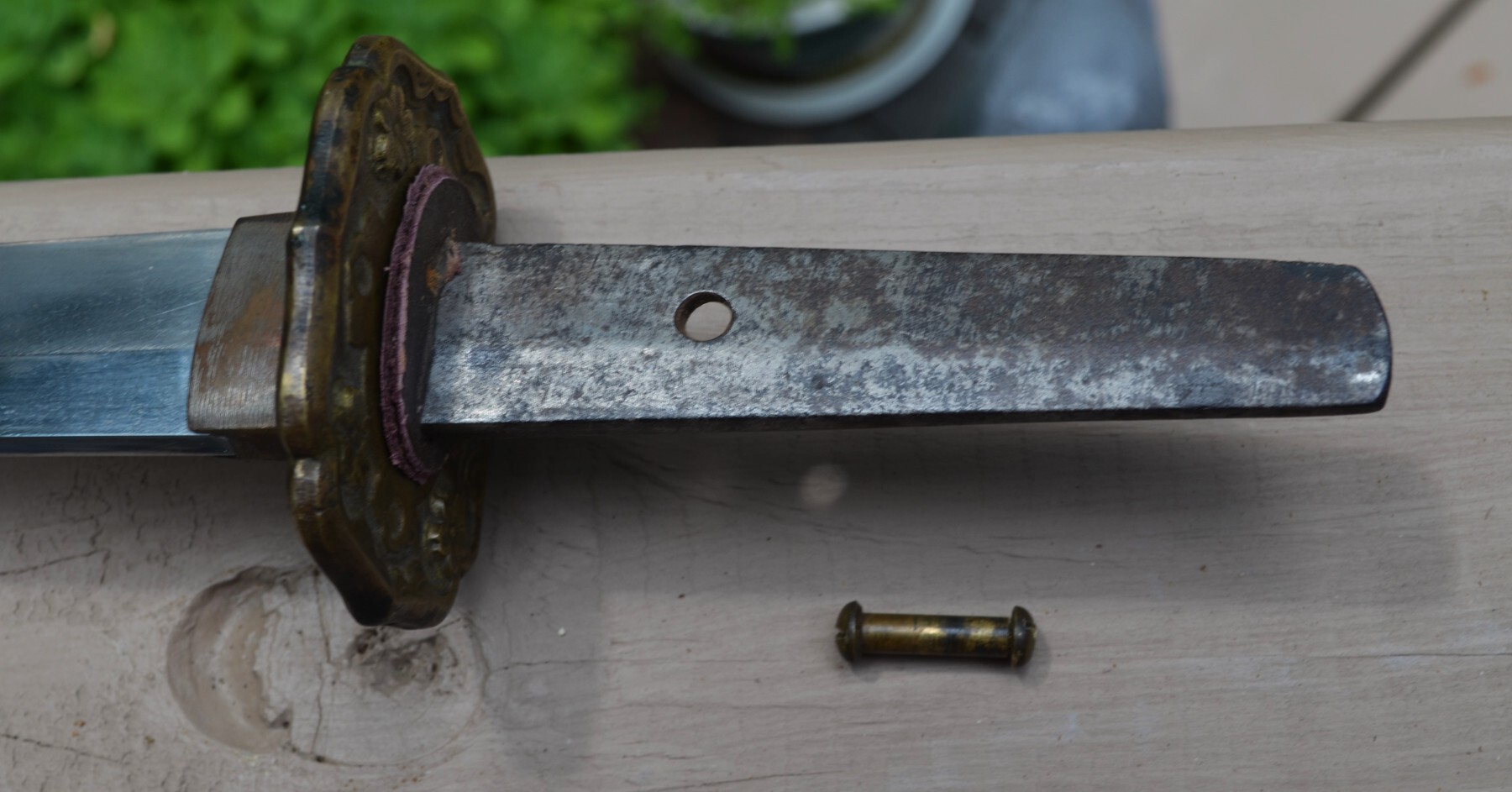
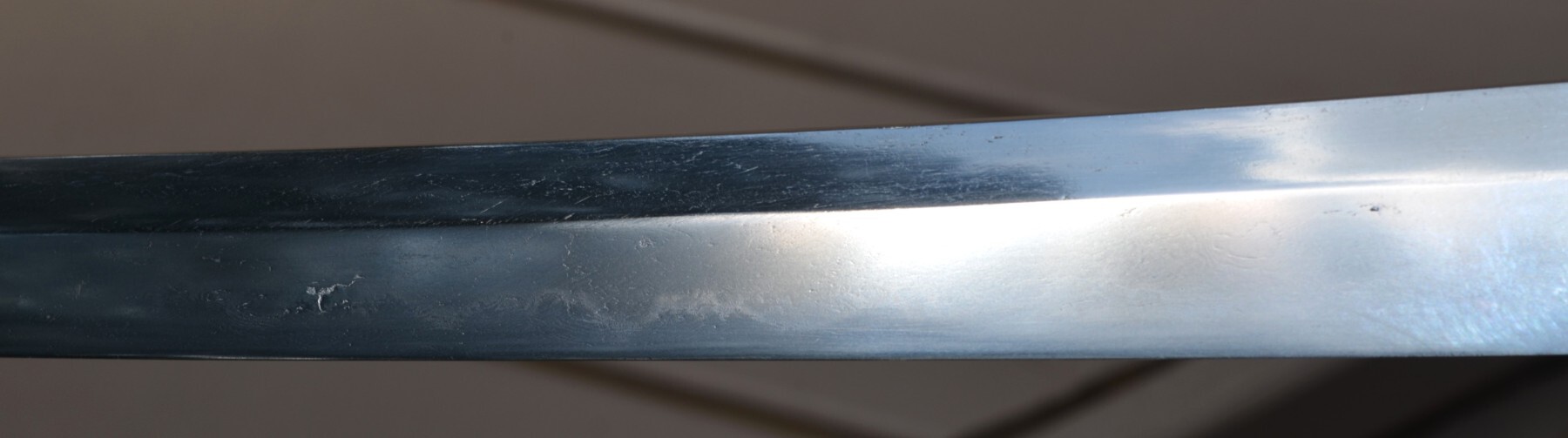
I recently picked up this sword for a very modest price, mainly because I wasn't sure about what it exactly was. Actually, it's a wakizashi because it is only 21" long. The blade is in good general condition with an apparent hamon, however it has several small horizontal forging flaws that normally would make this a non-starter for a serious collector. The unsigned tang looks like the hole was punched rather than drilled, so I'm unsure whether this blade pas been polished so many times that the flaws eventually appeared or that this blade was put aside for a last-ditch effort because of the poor result. The tsuba looks to be standard issue, buttressed by metal and leather washers. My concern is the handle; I never seen a cruder one on any blade. I put the wooden dowel pin in, however prior to that it was held in place by a type 95 NCO screw that I have shown, which was a real bear to remove! Should I scrap the handle and find a better one or is this truly the handle that came with the sword and not some G.I.'s work?

.jpg.15aceba0c93f20895d2d15be2d39bccd.jpg)
.jpg.50056d538466af4c518357b8df2b3576.jpg)
.jpg.9cee3f01b7f9c2d22a10328c2f58ba02.jpg)
-
A Request for Translation ,but Please Don't Cry
drac2k replied to drac2k's topic in Translation Assistance
Thanks to all.Some really great suggestions. Darkening the handle will be the next step, especially since the partial black scabbard that I have is too long, needs to be cut down, and has missing lacquer; I can either repaint it or sand it down and stain it the same color as the handle that I will darken. Beautiful examples of your handle work DoTanuki yokai; were those removable?If not that was the limitation that I was faced with. -
A Request for Translation ,but Please Don't Cry
drac2k replied to drac2k's topic in Translation Assistance
Thanks; several lessons were learned, lol. -
A Request for Translation ,but Please Don't Cry
drac2k replied to drac2k's topic in Translation Assistance
Yes, the handle didn't come out like I expected it and I can see that the incorporation of the tsuba was like putting DC-10 wings on a paper glider. I like your idea for a handle. The blade was not rehardened, but as noted the knifemaker commented on how hard the steel was to reshape. -
A Request for Translation ,but Please Don't Cry
drac2k replied to drac2k's topic in Translation Assistance
I knew that some people would differ from my choices and I respect that. The handle is a bit bulky and long, however, it was necessary to maintain the tang length and to have it removable. The blade configuration is what I am happiest about and if I find another broken blade without a temper line, unsigned, I'll use the same configuration, with changes to the guard and handle and sharpening to make a workable knife. -
A Request for Translation ,but Please Don't Cry
drac2k replied to drac2k's topic in Translation Assistance
Well, I finally picked up my modified knife from the show and here it is; probably more people will disagree with what I did, but I will try to illustrate my line of thinking. My 3 priorities were to keep the temper line, not to shorten the tang or make it inaccessible, and to keep it a weapon in the tradition it was originally constructed for as opposed to a workable knife. I used an old tsuba that I had that someone had over-polished (sanded), which was worthless. The wooden handle is pinned and glued together but can be easily removed by taking out the dow; the tang has not been shortened. The blade hasn't been sharpened so as to insure that the temper line remains intact. On a side note, the knife maker commented that the metal was extremely hard, very tight-grained, and without any flaws in the areas where he removed the metal. He was impressed by the quality of the blade..jpg.db130aa2a27645158759a53a752b6e32.jpg)
.jpg.c5b18ddaeb1e194825e6360bb268cb69.jpg)
.jpg.69b2de6f316141f04b80ee8c650b4811.jpg)
.jpg.c2fa8aa79b2a885a98eb56faef0aa7f1.jpg)
.jpg.9354ba85eb79180fe0c83cac3708cd7b.jpg)
.jpg.199c8d0e5d7b7031c9008a3ed4a5cdf1.jpg)
.jpg.93c347a0049afc3bc16acd89317c7c2a.jpg)
.jpg.70a345ec1842e275a6aa01de9301d00e.jpg)
.jpg.438bef0e32232b5820ba3ae02dde8add.jpg)
.jpg.4db8fae5028993adefdf9c613bccc710.jpg)
.jpg.34b65ca5b38253164111fa29fcc99e3b.jpg)
-
A Request for Translation ,but Please Don't Cry
drac2k replied to drac2k's topic in Translation Assistance
Wow, the pressure is on; I hope that I don't disappoint too many people. -
A Request for Translation ,but Please Don't Cry
drac2k replied to drac2k's topic in Translation Assistance
I dare not say more, as I don't want to give it away before I post the pictures prior to receiving it in April. -
A Request for Translation ,but Please Don't Cry
drac2k replied to drac2k's topic in Translation Assistance
Now that is funny! The answer is watching too many hours of Netflix! Hint, I reconfigured the item as a weapon as it was originally meant to be and not to be used as an everyday knife. -
A Request for Translation ,but Please Don't Cry
drac2k replied to drac2k's topic in Translation Assistance
I think many will find the modifications interesting; I operated within the confines of keeping the full tang length, not adding any holes and keeping as much of the temper line as possible. I dare not say more without giving it away before I can unveil it, however I do think it would made a great stabbing weapon for a serial killer, but not in the shape one might imagine. -
A Request for Translation ,but Please Don't Cry
drac2k replied to drac2k's topic in Translation Assistance
Update; the blade is with the knifemaker and it will be picked up and posted by the end of April. -
Thanks to you both!
-
I was wondering if I could further impose and get a translation. The entire blade, including the tang is 32.5";the tang alone measures 6.5". Thanks
.jpg.150fa60a802fda7601f84234c30ae690.jpg)
.jpg.8ba2b498a1a0b427675e0207417e771b.jpg)
.jpg.2a5912af3cdf9684f82c6d17447e35b6.jpg)
.jpg.8428f3acc80b3292144be8b84a6339b0.jpg)
.jpg.13d734dce491d04e593ff94e482614e5.jpg)
.jpg.7a90e972a988b8eed5ee394d53aaf6b1.jpg)
.jpg.53f0cd53b675e1af18846be2697271df.jpg)
.jpg.10664df18682bc7c1b8154b740f24db0.jpg)
.jpg.f210b3c04f365575b3d72031acce2f25.jpg)
.jpg.dbb4667f2223dc19465cf3efb2fcef17.jpg)
.jpg.ecfa68b25a51b6ca1c6303d6fe70165a.jpg)
-
A Request for Translation ,but Please Don't Cry
drac2k replied to drac2k's topic in Translation Assistance
Thanks John; yes it was disappointing. I have decided to go with one of David's variations, probably the last illustration for the blade. I've been messing around with a couple of ideas for a guard under the habaki in a more Western style, while keeping a traditional handle. -
A Request for Translation ,but Please Don't Cry
drac2k replied to drac2k's topic in Translation Assistance
I Just wanted to update everyone on the knife project; unfortunately I got the flu, and I had to give up my 2 tables at the show. I will try to reattempt in January -
Thanks to all! The blade measures approx. 28.25" from the tip to the bottom of the habaki and it is a stout blade, heavier than most of my other swords. I also think that it has a nice feel and look to it.
-
Thank you very much !
-
I am requesting this translation for my personal request .If some of you pick up some crude sandpaper streaks on the blade, I swear I didn't do it! I know I could make the blade look better, but the one thing that every serious Japanese sword collector has told me and this forum has reinforced is if you don't know what you are doing "LEAVE IT ALONE!" Fixing it makes it worse. Eventually I'll post something on this forum that doesn't have a problem. Thanks
.jpg.d1ab53fcb0dfd310b7f7d66b64c4421e.jpg)
.jpg.a73359c8bb930692f0a37901d4fc23df.jpg)
.jpg.a6e2687f937e149c86013b28a31f49a4.jpg)
.jpg.3646900e2631c64f87582bfb8bfb8545.jpg)
.jpg.0713ae5af6f0180645c1aed165a06020.jpg)
.jpg.b9c7ae5fdd70b57d6e7ed8dde78929e0.jpg)
.jpg.a154bbfd329ac5243339188a83fa4d56.jpg)
.jpg.3d92e295266f46dbd2dd4d3777c94cc6.jpg)
.jpg.f55b543401aecc4c63c30e22605e0138.jpg)
.jpg.4a4dd5d140b58fc1fd3040cdda797915.jpg)
.jpg.64e78211ec96655aaf346e127555e0f9.jpg)
-
A Request for Translation ,but Please Don't Cry
drac2k replied to drac2k's topic in Translation Assistance
Thanks guys for all of your support and great ideas! I think most of you understand what I'm trying to do and several people have summarized it perfectly. Rokujuro's idea of a seax got me thinking and I like the last picture of David R's diagram. The blade length is 20 cm. I will carry it to a local gun show November 25th and discuss it with the knife maker and advise the forum of my progress after that. -
A Request for Translation ,but Please Don't Cry
drac2k replied to drac2k's topic in Translation Assistance
Last point first; the idea of a seax is a great one and certainly worthy of consideration. I would love to keep the Yakiba. I have been going back and forth about keeping its original length, as opposed to shorting it. I think that shortening the tang wouldn't be out of the tradition of Japanese sword makers of which I have several examples of the Nakago being cut ,i.e. a katana made into a wakizashi .
.jpg.a721e15f9d68227c4193b03fa541ba41.jpg)
.jpg.68ff947fe449d687334357675efd17d4.jpg)
.jpg.2d5727ed7660c2ff4042cda14f780584.jpg)
.jpg.4e21f54f048b8a3e5f953904e9320d1c.jpg)
.jpg.95e926e1d5ac1f367d9a8dc1c1c1e6ee.jpg)
.jpg.6fb32cca8430f5d8d385e709087c8637.jpg)
.jpg.a0d662c1e0c76dda44bda3b0de463e61.jpg)
.jpg.828936a18afdc5d2c30b2fe129440055.jpg)
.jpg.127f47980830b6f96e7c70e3c492227a.jpg)