neo1022
-
Posts
17 -
Joined
-
Last visited
neo1022's Achievements






-
Hey Baby Joe, You provided exactly what I needed! This was the final bit of confirmation I needed to finish the paper I'm working on! I do have one additional question/favor to ask: the first image you uploaded (the genealogical chart) contradicts the detailed narrative description. Specifically, the active periods are all displaced by one era: 1st Gen = Kan’ei (narrative) → Kanbun (chart) 2nd Gen = Kanbun → Tenna 3rd Gen = Genroku → Kyōhō The prose is clearly the more well-substantiated account, especially since the dated blades and title award dates correspond perfectly to the dates in the narrative but not those in the chart (those dates appear to have zero independent support). Could you send a full scan of the page containing the genealogical chart? I'm hoping there's some contextual information explaining the discrepancy between the chart and the detailed narrative (i.e., the chart is received tradition, etc). Much appreciated all around! Thanks again! Kevin
-
Hi All, I am researching the Owari Sadahiro (定廣) lineage and am hoping that an NMB member with access to Owari Tōkōfu (尾張刀工譜) might be willing to provide clear photographs or scans of the relevant entries. From what I can tell (based on condensed -- and somehat confused -- secondary citations), the lineage is recorded as consisting of the following: Shodai, reportedly a Mino-born smith working in Owari around the Kan’ei era, using the mei 尾州住人定廣作 (Bishū jūnin Sadahiro saku) Nidai, reportedly Tanabe Den’emon (田辺伝右衛門), who received the title Ōmi no Kami in Kanbun 5 (1665) and used 近江守藤原定廣 (Ōmi no Kami Fujiwara Sadahiro) Possibly a Sandai as well, working under Ōmi no Daijo title... If possible, I would greatly appreciate images of the complete Sadahiro entries. Images showing the page numbers and section heading would also be very helpful for accurate citation. This is for a research project. I am trying to clarify the chronology of the smith or smiths and the evidentiary basis for distinguishing the shodai from the titled nidai or sandai - most sword publications from the 1730s on - including Kokon Kaji Bikō and Sesko -- treat this Sadahiro as a single smith working in Kyōhō, but Owari Tōkōfu (and a few dated blades) indicates a much earlier two- or three-gen lineage... So far, I've been working off secondary sources (which I don't trust), and would really like to examine the primary data. Many thanks for any assistance! Kevin
-
 Looks Peruvian to me…
 -
Here's a photo of the nakago inscriptions:
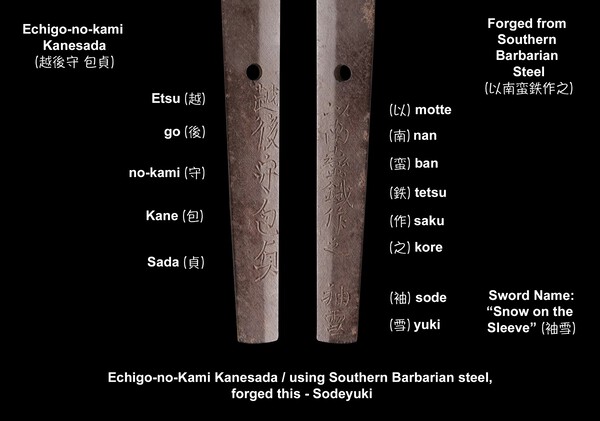
-
Yes, I’ve read the Sesko article you mention, and agree that it’s likely a poetic allusion to a keen cutter (“slices as cleanly as snow skips from a silk sleeve”). The “snow on bamboo leaf” he cites is almost certainly a variant.
-
Hi, I’m doing some research on a TH katana with the name sodeyuki (袖雪 “snow [on the] sleeve”) inscribed on the ura side of the nakago (and transcribed on the kanteisho as well). I suspect it’s the name of the sword. I’m aware of the tachi in the Chidō Museum with a kinzōgan mei reading 「袖ノ雪」 (Sode no Yuki), and I’m curious whether anyone knows of other examples bearing this name. A quick Google search yielded a Japanese Wikipedia page that references the following: 「袖雪号」と切りつけられた、水心子正次の刀 [A sword by Suishinshi Masatsugu (水心子正次) engraved with the phrase “Sodeyuki-gō” (袖雪号)]. 「袖の雪」と切りつけられている、豊後守正全の脇指 [A wakizashi by Bungo no Kami Masazane (豊後守正全) engraved with the phrase “Sode no Yuki” (袖の雪).] Both are sourced to: Fukunaga Zuiken "Nihonto Encyclopedia" Volume 3, Oyamakaku Publishing, November 20, 1993, page 163. If anyone has a copy of this work, I’d really appreciate a photo of the page(s) that discuss 袖雪 / 袖の雪. Also, if anyone else has thoughts/information related to this sword name / poetic allusion, I’d be interested… Thanks!
-
I stumbled across an Oku family genealogy in the write-up for a special exhibition on Satsuma swords (薩摩刀特別展) held at the Kagoshima Prefectural Museum of Art (cited below). The document reproduces and discusses a family genealogy (keifu) compiled by Motohira himself, originally maintained within the Oku household. The genealogy was said to have been authored or copied by the second-generation Motohira, later lost in a wartime fire, but preserved through a surviving manuscript copy owned by Sakamoto Morinari (坂元盛愛氏), a curator and specialist of the museum. Seems like the most significant contribution is a well-documented keifu-based death date for Motoyasu. Below are some key data points from the genealogical summary, with a focus on birth and death dates (supplemented with consensus dates from other sources): MOTOHIRA(元平) Birth (accepted in wider literature): Enkyō 1, 10th month (1744). Nihonto-museum states October 31, 1744, but no source citation). Autumn 1774 aligns with the age-at-death (83) Death (in genealogy PDF):「元平、七月十三日 歿、八十三歳」 — “Motohira died on the 13th day of the 7th month, age 83.” (The article does not give the year, but other sources claim Bunsei 9, which would yield a death date of September 8, 1826 (Japan used a lunisolar calendar before 1873, so Gregorian conversions use historical astronomical tables; the Bunsei-9 table (see here: https://eco.mtk.nao.ac.jp/koyomi/yoko/edo.html.en) provides date-by-date correspondences. MOTOTAKE(元武) Birth (inferred): Age 69 at death in 1810 = c. 1741/1742* (likely incorrect, as this would make him an older brother of Motohira). Nihonto-museum cites 1748, without references. Death (in genealogy PDF):「文化七 午 秋 元武、十月二十四日 歿、六十九歳」 — “In Bunka 7 (1810), year of the horse, autumn: Mototake died on the 24th day of the 10th month, aged 69” (= November 20, 1810). Nihonto-museum cites 1816 (which would be Bunka 13)—this date is presented in multiple dealer descriptions and, I believe, by Sesko. Curious to know the primary source… MOTOYASU, SHODAI(元安) Estimated Death Date: after 1821 (based on latest dated sword described in article); Nihonto-museum states that there is a signed sword dated Bunsei 4 (1821)… Estimated Birth Date: Online sources provide a birth date of ~1758 (14 years after Motohira?), but no supporting sources are cited. Seems like an awfully large age gap Vital dates in genealogy PDF: None included. His active period is based on a few dated collaboration inscriptions cited in the catalog: 1) 寛政九 己巳 春 奥大和守平朝臣元平 (弟)元安造之/(同年)寛政九 巳 秋(初代)」 — “Kansei 9 (1797), spring: ‘Oku Yamato-no-Kami Taira no Ason Motohira; (his) younger brother Motoyasu made [it].’ (Same year, autumn, shodai).” 2) 「寛政十 午 秋 弟元安以相鎚鍛之 奥大和守平朝臣元平」 — “Kansei 10 (1798), autumn: ‘Together with my younger brother Motoyasu we forged this under the hammer.’ 3) 「寛政十一 未 十二月二十六日(初代) 奥大和守平朝臣元平 奥弟元武元安造之」 — “Kansei 11 (1799), 12th month, 26th day (shodai): ‘…made by younger brothers Mototake and Motoyasu.’” = 1799/1800 (12th lunar month straddles into early 1800; precise Gregorian day depends on intercalations). 4) 「(文化五 戊辰 八月吉日)作之 奥大和守平朝臣元平 輿弟元武元安造之(初代)」 — “Bunka 5 (1808), 8th month, auspicious day: ‘…made together with younger brothers Mototake and Motoyasu (shodai)." [Note that this inscription tells us there’s something wrong with Mototake's birth date (as calculated based on the death date in the geneaology); if he were born in 1744, he would have been Motohira’s OLDER brother... Other sources cite 1748, but I don't know the source of that date... MOTOYASU, NIDAI(元安) Birth (calculated from death date in PDF): Kansei 5 (1793) Death (in genealogy PDF, from tombstone): Meiji 7-08-06 (September 16, 1874) Tombstone Transcription:(正面)「鹿児嶋縣士族 奥平元安」/(右側面)「明治七年戌八月六日」/(左側面)「行年八十二歳」 (Front: ‘Kagoshima-ken Shizoku Oku Taira Motoyasu’ / Right: ‘Meiji 7, 8th month, 6th day (1874-08-06)’ / Left: ‘Age at death: 82.”) The author concludes: born Kansei 5 (1793), died Meiji 7-08-06 (1874), age 82 (= September 16, 1874). SOURCE: Yamashita, Hiroyuki. 1988. “Oku-shi Keifu to Nidai Motoyasu [The Genealogy of the Oku Family and the Second-Generation Motoyasu].” Reimeikan Research Reports (Reimeikan Chōsa Kenkyū Hōkoku) 2: 25-42. Kagoshima Prefectural Historical Center Reimeikan. 山下廣幸「奥氏系譜と二代元安」『黎明館調査研究報告』第2集、鹿児島県歴史資料センター黎明館、1988年、pp.25–42。 https://www.pref.kagoshima.jp/ab23/reimeikan/siroyu/documents/6757_20180421102454-1.pdf
-
Excellent suggestions. Do you know if Bill Miller is active here? Thanks!
-
Yes, I’ve been able to track down the original Japanese source for this claim, as well as an interesting genealogy for the Ijichi family line (I.e., the Masayoshi line) which, while not shedding light on swordsmithing, does establish them as key Shimazu retainers since the 1300s, as well as hinting at their deeper roots. Will share more once I’ve assimilated the info. Thanks!
-
Well, this is not what I hoped for with this thread…
-
While looking further into the question I posted above, I came across an Izumi City historical leaflet that describes the training of Uehara Masayoshi (shodai "Satsuma Masayoshi") as follows: “At first he studied swordsmithing in the Takada tradition (Ōita City). Next, he learned the Naminohira tradition (Kagoshima City) under either Yamato no Kami Yasuyuki or Yasuchika. Furthermore, in the first year of Kyōhō (1716), he 'entered the gate' of the famous Sōshū tradition swordsmith of Satsuma, Maruta Masafusa. He made all three traditions entirely his own.” 「はじめ高田伝(大分市)について刀鍛冶を習い、ついで波平伝(鹿児島市)を大和守安行または安周から学び、さらに享保元年(1716)には、薩摩の相州伝名刀匠丸田正房の門に入り、三伝ことごとく自分のものとした。」 This passage describes a three-stage apprenticeship beginning in the Takada-den of Bungo (Mino-influenced Kyūshū style), progressing to the Naminohira-den (Yamato-derived Satsuma style), and culminating with Satsuma Sōshū training under Maruta Masafusa (so, here's the synthesis of Mino, Yamato, and Sōshū influences!). The reference to early Takada-den training—which I haven’t seen anywhere else—suggests that the Bungo Takada school provided the shodai Masayoshi’s technical foundation prior to the Naminohira and Sōshū training that directly shaped his line’s late-Edo Satsuma work. On the Naminohira side, the sequence Maruta Izu no Kami Masafusa, 2nd gen ->Yamato no Kami Yasuyuki -> Yasukuni -> Yasuchika is standard; given Yasuchika’s period of activity (1704–1741), he looks to be the likelier Naminohira teacher for the shodai (the leaflet’s “Yasuyuki or Yasuchika” probably reflects chronology confusion). As for “entering the gate” of Maruta Masafusa, that can only refer to the 3rd-gen Maruta Sōzaemon Masafusa (1681–1716), not the Izu no Kami Masafusa (presumably 2nd-gen, 1658–1681) suggested in Sesko’s genealogy. I suspect common claim that ”Masayoshi” trained with Masachika applies to the nidai or perhaps sandai generations. The pathway appears to be from Maruta Sōzaemon Masafusa (1681–1716) -> Mondo no Shō Masakiyo (1664–1730) -> Masachika (dated blades 1735, 1743). I wonder if there’s any primary documentation supporting this link, which represents a second Masayoshi line connection to Maruta Sōzaemon Masafusa via Mondo no Shō Masakiyo and his son… This does seem to reconcile the confusing data I presented in my original post. I feel like I’ve either figured something out or fabricated a complete fiction. Problem is, I can’t tell which… Any insights, thoughts, or comments are welcome...
-
Good suggestion to contact Marcus directly. But I'm also an optimist -- perhaps a Satsuma guru is lurking on here...
-
Hi all, I’m trying to clarify the training of the shodai Masayoshi (正良)—founder of what Sesko refers to as the "Satsuma Masayoshi school." I’m interested in understanding how these lineage-specific influences shaped what we think of as the late-Edo Satsuma style as exemplified in the work of sandai Masayoshi/Masayuki and related smiths. Sesko’s genealogy lists the shodai Masayoshi as trained under Naminohira Yasuchika and Izu no Kami Masafusa. That pairing would explain a blend of local Naminohira / Yamato-leaning traits with the Mino / Sōshū infusion tracing to Masafusa and his father, Ujifusa. The Masafusa link seems very well supported, but I’m not able to find any non-Sesko support for the Yasuchika connection. If anyone has additional information on this, I’d appreciate it… I have also found many online sources that claim "[Satsuma] Masayoshi" was trained by Masachika (which I suppose would then also trace Satsuma’s Sōshū-leaning tendencies to Mondo no Shō Masakiyo). There is no way they’re referring to the sandai Masayoshi, since he would have been quite young (~8 yrs old) when Masakiyo died. Since Masachika is roughly contemporaneous with the both the shodai and nidai Masayoshi, might this be a later-generation apprenticeship (i.e., shodai Masayoshi trained under Naminohira Yasuchika and/or Izu no Kami Masafusa while nidai apprenticed under Masachika as well as his father)? In other words, an original lineage substrate of Naminohira / Yamato + Mino / Sōshū training, with subsequent Sōshū-den reinforcement via Masachika. I’m sure I’m missing something basic here, but I don’t have enough sources to sort this out (assuming they even exist…). Can anyone help clarify these questions for me, or suggest a solid reference? Many thanks!
-
Is machiokuri generally a deal-breaker for Juyo? Any sense of whether suriage or machiokuri is weighed more heavily (i.e., is an ubu with machiokuri more likely to pass than a suriage blade)? It seems some level of re-machi is necessary on most swords with anything but the most minor of suriage, but minor machiokuri can occur as a result of a changed tsuba, new tsuka, etc. Is that right? I've always associated the two quite closely, assuming suriage meant re-machi, but not vice versa.
-
Is Mike V still working in Pasadena? If so, could someone DM me his contact info? Much appreciated!