


Jacques
-
Posts
5,153 -
Joined
-
Days Won
7
Content Type
Profiles
Forums
Events
Store
Downloads
Gallery
Posts posted by Jacques
-
-
Just to be clear
An oshigata isn't just a drawing; it's a full-scale reproduction of a sword, and the nakago is “imprinted”
-
 1
1
-
-
Quote
there is no a replacement for getting to have the item in hand and spend hours studying it with a proper instructor,
That's what I did for many years
Quoteour knowledge and enjoyment can be improved with the many informational aids available to us.
Joy, yes. For knowledge, it depends on what you mean by that word. I don't think we have the same understanding of that word.
-
 1
1
-
-
5 hours ago, Jussi Ekholm said:
Video that Brano took of the sword is incredible. I have viewed the sword in its normal residing place and it is a wonderful sword.
The video shows the details very nicely. I think sometimes with high quality video I can see more details than with my own eyes.
However as for me the size and shape is the driving factor with swords, seeing them in person can create different effect than seeing oshigata, photos or videos.
You can't see the nioiguchi on the video, yet it's an essential factor in evaluating a sword.
Don't confuse oshigata with a drawing
-
Wrong, ju is at the right location after Osafune
-
1
-
-
Fully agreed with Reinhard
-
Quote
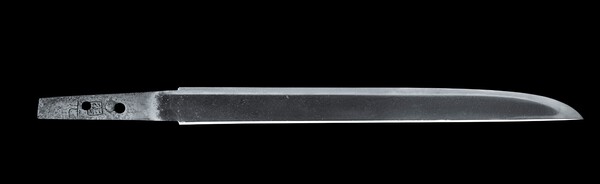
Length: 42.3 cm (this has to be total length)
Wonder
 Nagasa 25.2 cm
-
 1
1
-
-
Since Zenon Vandamme stopped poilishing, the only one who is fully trained is Massimo Rossi.
-
2
-
-
Quote
I think everyone here knows you VERY well too Jacques
Absolutely no, I can see when someone knows or don't know. You are far from being in this case. I have no reason to be modest. I know my limits, and you have a very long way to go before you reach them. Am I clear enough?
-
1
-
 2
2
-
-
45 minutes ago, Mushin said:
Jacques, where did you see a claim that these traits were exclusive to Shinto Kunimitsu? He said "commonly found," which is correct. Is this a language issue. or are you just being provocative? It's guess you are right: it's pointless to fight human stupidity...
I don't think Lewis wrote that in the sense that you mean (I'm starting to know him quite well). If that is indeed the case, it's completely pointless.
Now, you're right about one thing: I shouldn't have responded to you.
-
1
-
1
-
-
1 hour ago, CSM101 said:
Well, that depends on several factors ..
First the translation.
You didn't understand that it was a bit ironic; these characteristics are not exclusive to Shintogo Kunimitsu, far from it.
-
1
-
-
Quote
The tanto shown shares many of the characteristics commonly found for Shintogo. Mitsu-mune, sugata, uchizori, nakago shape.
Are you sure ?
-
1
-
-
Ippei Yasuyo is a big name of Satsuma. Unfortunately this sword is gimei.
-
Let's be clear, this is not a kikumon but an Eda kikumon 'not well made).
-
On 1/19/2026 at 8:31 PM, Lewis B said:
From Markus Sesko's swordsmiths reference it appears to be by one of these Fujiwara Kinmichi smiths. Most likely 2nd or 3rd generation as they carved chrysanthemum on the nakago.
KINMICHI (金道), 1st gen., Keichō (慶長, 1596-1615), Yamashiro – “Kinmichi” (金道), “Iga no Kami Kinmichi” (伊賀守金道), “Iga no Kami Fujiwara Kinmichi” (伊賀守藤原金道). He was the oldest son of the Seki-smith Kanemichi (兼道). He had accompanied his father in the second year of Bunroku (1593) with his three brothers Echigo no Kami Rai Kinmichi (越後守来金道), Tanba no Kami Yoshimichi (丹波守吉道), and Etchū no Kami Masatoshi (越中守正俊) to Kyōto where they settled in the Nishinotō´in (西洞院) neighborhood and where Kanemichi founded the Mishina school (三品). The name Kinmichi was in back then read Kanemichi but to avoid confusion, more and more the reading Kinmichi became common. He received the honorary title Iga no Kami on the 19th day of the second month Bunroku three (1594) and worked also for the Imperial Court from that time onwards. Shortly before the Battle of Sekigahara, Tokugawa Ieyasu ordered 1,000 tachi from him and due to the skillful management of all the workers he was granted with the honorary title Nihon-kaji-sōshō (日本鍛冶惣匠, lit. “master swordsmith of Japan”). With that title, he had a certain influence at court on the granting of honorary titles for other swordsmiths. The title and the advisory function at the imperial court were hereditary and held by successive Kinmichi generations until the bakumatsu era. The 1st gen. Kinmichi died on the eleventh day of the twelfth month Kan´ei six (寛永, 1629). His blades have a sakizori and his rather wide mihaba does not taper that much. The jigane looks hard and the jihada is a standing-out ko-itame with nagare and masame along the mune. Ji-nie and chikei occur. The hamon is a notare mixed with gunome and togariba or a ko-notare mixed with gunome. His works in the Mino tradition are somewhat different from his works in the other traditions, i.e. the hamon is in this case an ō-midare mixed with yahazu-midare or hako-midare with irregular nie. In addition, sunagashi and kinsuji appear and an influence of the Shizu school or of No-Sada can be seen. The bōshi is a Mishina-bōshi. wazamono, jō-saku
KINMICHI (金道), 2nd gen., Kan´ei (寛永, 1624-1644), Yamashiro – “Iga no Kami Fujiwara Kinmichi – Nihon-kaji-sōshō” (伊賀守藤原金道・日本鍛冶惣匠), real name Mishina Kanbei (三品勘兵衛), oldest son of the 1st gen. Kinmichi and the older brother of Izu no Kami Kinmichi (伊豆守金道), the 1st gen. received as mentioned the honorary title Nihon-kaji-sōshō but it was the 2nd gen. who signed that title for the first time, he also carved a chrysanthemum onto his tangs which looks like a stylized cartwheel, he died on the 21st day of the tenth month Enpō eight (延宝, 1680), itame mixed with masame, suguha, gunome-midare, often sunagashi, Mishina-bōshi, wazamono, chūjō-saku
KINMICHI (金道), 3rd gen., Jōkyō (貞享, 1684-1688), Yamashiro – “Iga no Kami Fujiwara Kinmichi” (伊賀守藤原金道), real name Mishina Kanbei (三品勘兵衛), he received the honorary title Iga no Kami on the 28th day of the first year of Jōkyō (1684) at the age of 30, the title Nihon-kaji-sōshō was granted to him in Kyōhō six (享保, 1721), he changed the characters for “sōshō” from (惣匠) to (宗匠), in the seventh year of Kyōhō (1722) he worked at the invitation of the bakufu in the Edo-bakufu residence Hama-goten (浜御殿), he and all of his successors carved a chrysanthemum on their tangs, because of an illness he was supported by
Mei reads IZUMI NO KAMI FUJIWARA KINMICHI
Gimei, kanji Rai 来 Is missing
-
From M Sesko Nihonto meikan translation
Aritsugu (有続), Genbun (元文, 1736-1741), Settsu – „Sesshū-jū Jinrikumaru Aritsugu“ (摂州住神力丸有続), „Jinrikimaru Aritsugu“ (神力丸有続), civilian name „Takayanagi Shōzaemon“ (高柳庄左衛門), son of Kaga no Kami Sadahiro (加賀守貞広), Settsu-Shimosaka group, he signed firstwith „Kunitsugu“ (国継), there exists a joint work under the name of „Kunitsugu“ with his father Sadahiro which is dated with the first year of Shōtoku (正徳, 1711) and gives the age of 27 years, notare-midare or an Ishidō-like midareba, wazamono
-
5
-
-
The length of swords has always followed the evolution of combat techniques (tachi versus katana) and the regulations issued by the shoguns. The vast majority of tachi were suriage so that they could be used as katana. Indeed, given the price of these weapons, it was better to shorten them than to make new ones.
-
4
-
-
Humm... NBTHK is not a government organization.
-
1
-
1
-
-
Regarding a possible restoration, keep in mind that a thickening file has not yet been invented and that polishing can permanently ruin this blade which already seems quite worn to me..
-
1
-
1
-
-
Because of the bohi, which shows that this sword is ubu, I think the wakizashi is Muromachi, as there were no shinogi zukuri wakizashi before this period.
ps take what Rivkin says with two grains of salt.
-
Obviously gimei, NBTHK oshigata (same sword the one Ray posted)

-
Old papers = no papers, whatever some people may say
-
1
-
-
Myoju was the son of Umetada Myōkin Shigetaka 埋忠明欽重降 who was the teacher of shodai Tadayoshi.
-
Quote
have I simply not read enough?
That's right.
-
Who is the polisher ?


New swords vs Koto swords; How much is anecdotal and how much is scientific
in General Nihonto Related Discussion
Posted
There is a misunderstanding regarding the difference in quality between Koto-period swords (particularly those from the Kamakura and Nanbokucho periods) and swords from other eras. Practicality is not the issue; a sword is a lethal weapon, and a kazu-uchi mono gets the job done. The difference lies in the artistic qualities of these swords.