


Kanenaga
-
Posts
302 -
Joined
-
Last visited
About Kanenaga

Kanenaga's Achievements






-
I think I am noticing a trend among some Japanese nihonto websites to no longer display the asking prices for some items. Is this perhaps an unintended consequence of NihontoWatch?
-
It's hard to tell from photos, but this could be a good sword in somewhat rough condition. Best to take good care of it until it can be evaluated in hand by a Japanese-trained polisher or someone comparable.
-
I came upon this auction by accident. Some tsuba, other kodogu, inro, etc. https://www.bonhams.com/auction/31871/fine-Japanese-and-korean-art/
-
- 1
-

-
Late, but as requested, here's that whole copper tsunagi. The "nagasa" is 13.5 inches, so o-tanto or ko-wakizashi.


-
I think Steve wrote muneami.
-
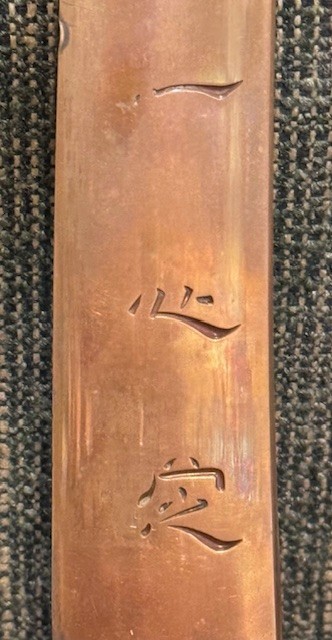
Apologies, Curran and everyone, I did not mean to mislead. It's the same copper tsunagi. I suspect it's a copper alloy because there is none of the usual copper oxidation. The color in the photos is pretty close to the real thing. The previous post was about kanji on the blade portion, and I got some very helpful info from Jan. This now is about the nakago portion, and thanks to SteveM for the translation, which seems to make sense even though it is not in the "standard" form of a mei on a sword. Regrettable that there's no Natsuo, Ikkin, Yasuchika, etc, Ian. I have no idea what the original blade was, or if there was one. The shape of the tsunagi (hira-zukuri with sori) suggests to me not earlier than Nanbokucho. I'll post a photo when I return from travel. Les
-
This is the nakago of a copper tsunagi in a wakizashi koshirae. It doesn't look to me like a normal mei. I'd appreciate some translation help.


-
Thank you, Jan.
-
Some assistance please. This is a tsunagi to a wakizashi koshirae. It's made of copper or some copper alloy, with these kanji engraved. Auspicious incantations, perhaps? Les

-
Can we know more about the Ko-Aoe Koretomo? I have a particular interest in this smith. Les
-
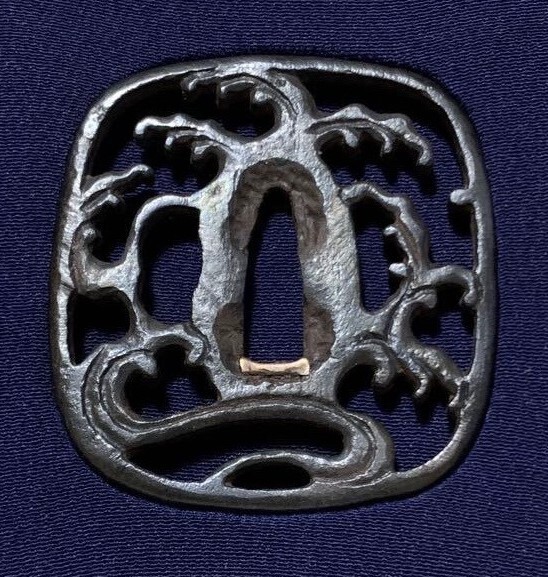
Rather than hijack another discussion, I borrowed this partial photo from another thread just for illustration. And please dismiss me if this has been discussed before. It's about the double cutouts around the nakago-ana in this tsuba, which create a "figure 8" shaped cavity. I see this from time to time, most often on Owari-sukashi tsuba but occasionally also on other iron sukashi tsuba, always on one side only. It's not clear to me that these chiselings alter the dimensions of the nakago opening itself. Does anyone know what these are for?
-
Shinogi-zukuri
-
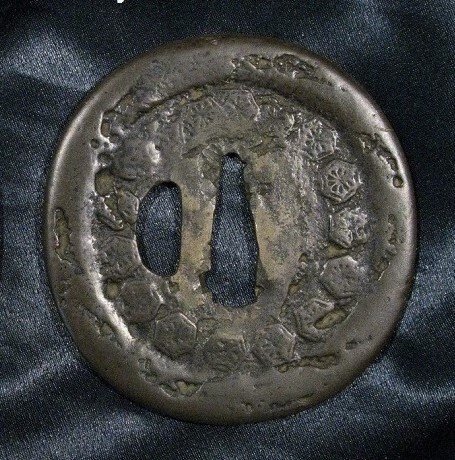
Here's another with features similar to my new one: thin plate with blurry hi-relief images, and the distinctive worm-eaten rim (borrowed from a website for educational purpose). Are we to think these were made by the same craftsmen who made Curran's? Seems unlikely, they are so different. Are these older or younger? Copyright Elliott Long
-
Yes, thanks Tim. You've helped educate this small focussed group of tsuba collectors.
-
... and the translation?

