R_P
-
Posts
311 -
Joined
-
Last visited
-
Days Won
5
Content Type
Profiles
Forums
Events
Store
Downloads
Gallery
Everything posted by R_P
-
Thoughts on this sword I just picked up
R_P replied to Eric187's topic in General Nihonto Related Discussion
Very well Colin, as you command, this will be my last post on the NMB. Colin you have sold crap to unsuspecting buyers. You will always have a market for that apparently so good on you. Keep going. Truly Alex i now understand that when dealing with you @Hokkeand people like @When Necessarythere is no getting around a victim mentality and there will always be pushback. So better to know my place and leave the advisory on the NMB to more educated minds. Thank you for always reminding me. To the new collectors on here, well apparently telling the truth will deter you from entering the hobby (it did not deter me but i guess @Matsunokihas decided you are all made of clay or something). So i guess you will not be detered by being sold low level items and having your expectations crushed but hey, at least it will be an item from Japan, maybe. Enjoy everyone, the nightmare is over. -
Thoughts on this sword I just picked up
R_P replied to Eric187's topic in General Nihonto Related Discussion
Yeah ok, attacking peoples assumed backgrounds seems to be the only way you get around and it has nothing to do with Nihonto, I have no idea why some people are on here. I would love to know where you think you know me from. If only I could express my opinion of your background freely but that would cause quite a stir I'm sure. -
Thoughts on this sword I just picked up
R_P replied to Eric187's topic in General Nihonto Related Discussion
With regards to the Ichimonji I have seen that one and it is not nice to look at personally, it just feels wrong. The Nagamitsu, yes the Horimono flows into the Ji but at least it is lower down and not mid sword. The good thing is it is a good example of what polished down Horimono looks like. -
Thoughts on this sword I just picked up
R_P replied to Eric187's topic in General Nihonto Related Discussion
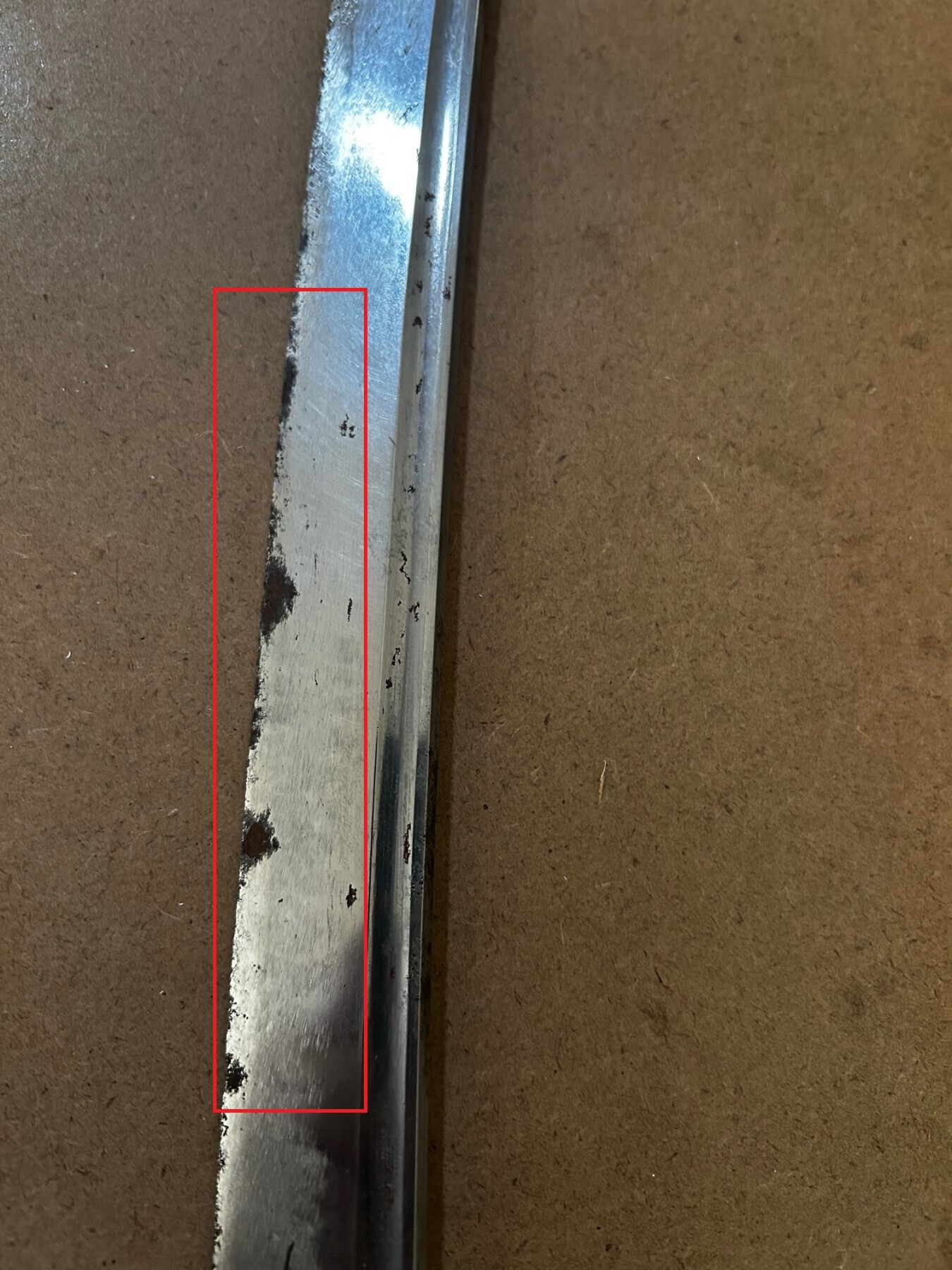
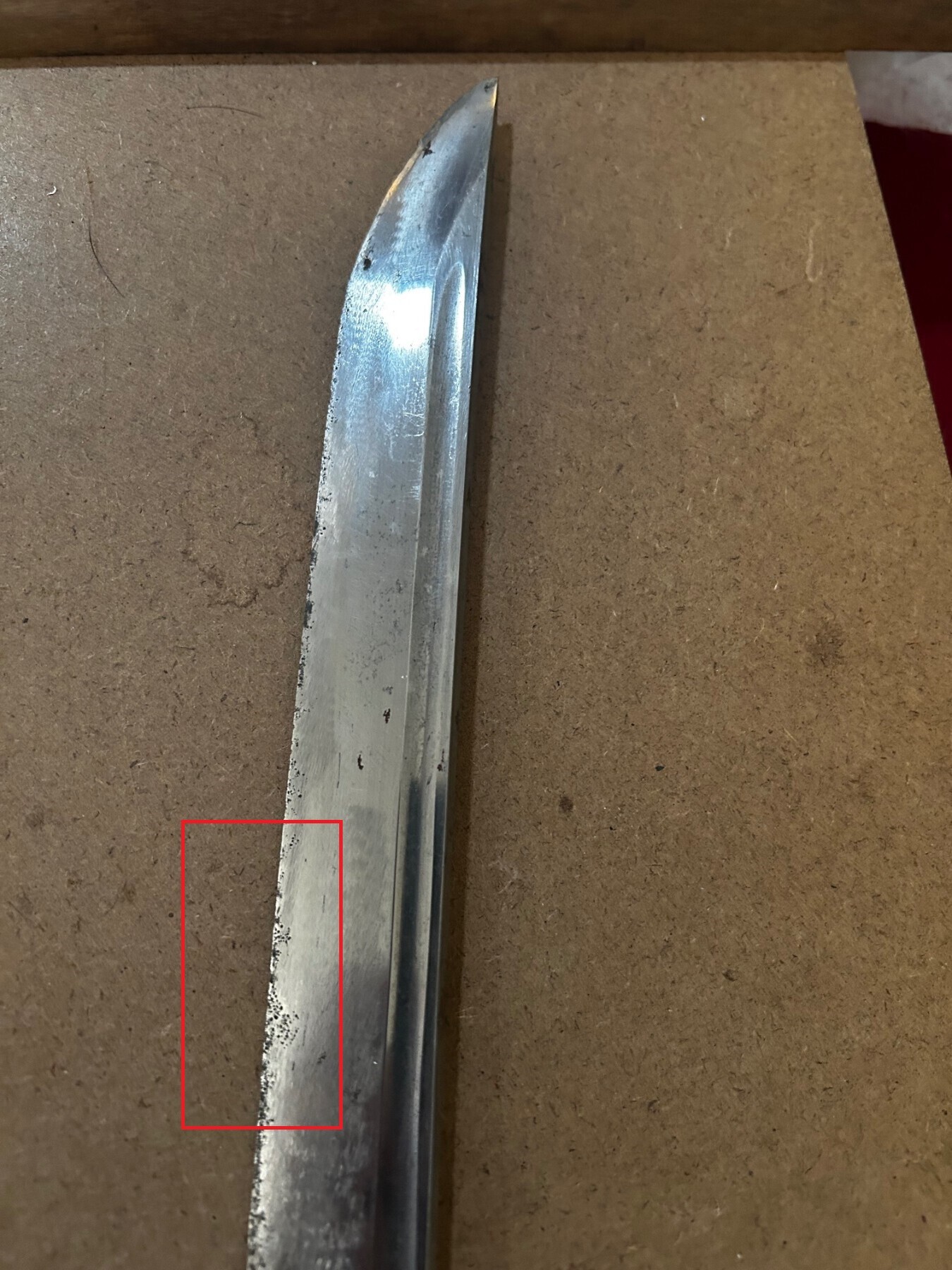
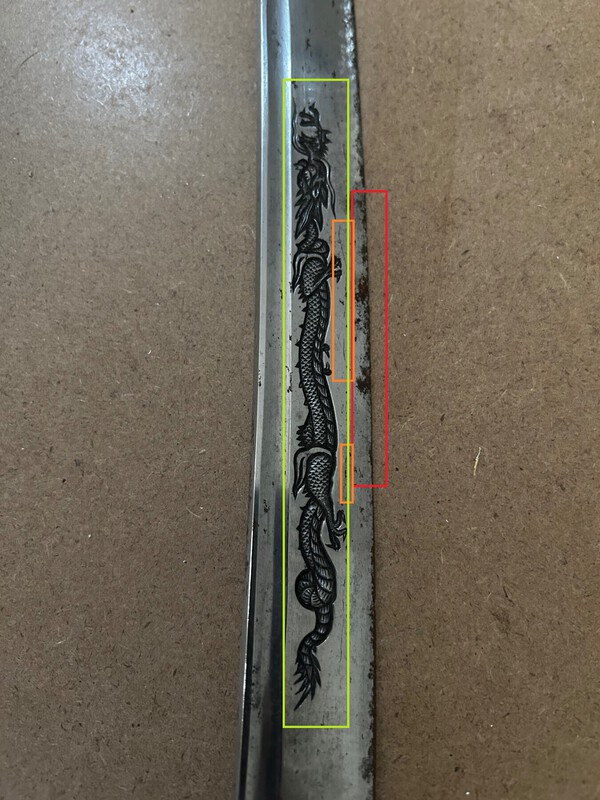
@Alex A So Alex I am also not one of your children so shouting at me, saying The END and go to your corner is not really going to work. What we should do is look at the nonsense you're sharing: "I said that because like a few others, think it deserves a bit more scrutiny than what we can give it here. And something you don't know, i presume. I know how much Eric paid for this sword, very little in fact and "IF" a polisher says its worth restoring and "IF" he can get it done for a reasonable price then i actually feel he could make a profit when its time to sell. Though many "IFS"!!!. At the price he paid most here would have bought it. Sure if he did NOTHING he could make a profit." @Eric187 Let me be clear that no matter what you paid for this sword it was a waste of every penny. If you value money and every minute it takes to make it then no matter what the price was, realise it was flushed down a drain and observe that feeling and ask yourself, knowing that it is not really a sword anymore would you really subject another collector, friend or enthusiast with this same feeling and tragedy? It's like conning someone. Alex is actively encouraging you to do just that and not just that he wants you to spend money in the sword to get to that point first. - "Nakago could be re-patinated, Shirasaya repaired/cleaned up" - "polisher says its worth restoring" Let us look at polishing, this will cost money, re-patination of the Nakago will cost money, Shirasaya will cost money, shipping, etc. So let us also look at the next statement: "Folks are always interested in horimono, even if not executed to an high standard. For many they add interest though its not for everyone." Yeah no, no, no, lol, no. Just a select few people maybe. @Eric187 let me tell you what your budget polisher will do, they will polish your sword and then: In these areas when polished the kizu will open up further Here the kizu will open but we can also see that the edge is damaged and will also need to be polished down to restore alignment Here we can see the edge is again in need of re-alignment. The orange is a line of masame hada that has opened up and will open further in polishing. Now the Ryu, the Ryu is in the Ji and when polished this will wear down the Horimono and damage it, I do not see why that would make it more acceptable? The position of the Horimono means it will meet with stone and there is no avoiding that. Edge alignment again As soon as this areas are polished they will open up pitting and it is in the Hamon There is pitting in the Hamon here This is a lot of work for a profit from an unsuspecting new owner. "This is nonsense, you are comparing this sword with Juyo swords" Well yes, I am using Juyo Oshigata as a benchmark why would I use a crappy example? I use Juyo Oshigata for most comparisons (personal though).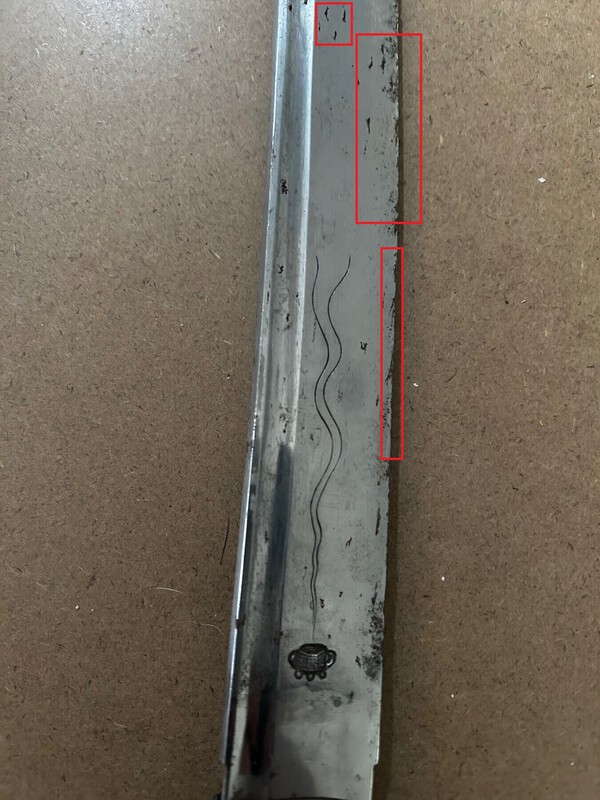



-
Thoughts on this sword I just picked up
R_P replied to Eric187's topic in General Nihonto Related Discussion
Ok so I take it that is a firm NO on paying for the polish then. I am always surprised when experienced collectors cannot just say, yep mistake, sorry. Anyway let us have a discussion on the actual sword since the OP is asking for opinions and saying "Its not your sword, or mine, its up to the owner." is a blank statement as he is literally asking. I will explain what i see as my reasons for the non quality of the sword and Bohi vs what you see, I would like to know what you see that makes this viable. When we look at the 48th Juyo Oshigata that Markus gave us permission to post here in the NMB we have many wonderful examples of how Bohi should be positioned and cut. In most instances (there are a few 2-3 maybe, that are not good representations of Bohi even in the 48th Juyo.) But, in most cases you see the Bohi cut uniformly hugging the Shinogi Ji and at the Kissaki side ending uniformly and symmetrically. There is no downward dipping. At the end of the Bohi (Nakago side) you see it gracefully leave the blades base and allows for the whole sugata to be complimented. On this sword here you will see that at the Kissaki side the ends of the Bohi are not symmetrical and they are not uniform in positioning, they sit above the Shinogi line and at the end they dip downward. These errors happen when Bohi are not cut well, cut by less trained artisan and done on cold hard steel much later in the swords life. There are areas in the Bohi that are good, but most of it shows divots and undulations that should not be there. The end of the Bohi is not leaving the sword in a uniform, elegant fashion, on one side you will see that there is a crack in the nakago at the end where is it was suriage, but the Bohi looks to unaffected by this Suriage leading me to believe it was added later. On the Ura side the end of the Bohi end is crudely cut into the sword and on the Omote it is well above the Suriage line so this must have been added crudely after. Another factor is the Kasane. You have asked for the Nagasa kasane and seen it is 0.65CM and omitted the Nakago kasane which looks considerably thicker (unless it is a camera trick?). If the nakago kasane is thicker compared to the Nagasa we can safely say that the sword has been polished way down to be something it is not. It also indicates that because the Bohi has not been affected in this process of change that it was added later and escaped most of the modifications. If the Nakago kasane ends up being considerable then the Shin Shinto theory will be more than plausible. I still think it is mid Edo. "As said, there are many good swords with questionable engraving." The engraving is part of the sword so then a bad engraving makes a bad sword, the two are not exclusive, this a singular object. "Think maybe folks past mistakes haunt them." Yep, I think mistakes like this sword should haunt all of us and I am sorry that @Eric187 has been another victim of a shitty dealer, there are good dealers out there who are not collectors or charlatans. -
Thoughts on this sword I just picked up
R_P replied to Eric187's topic in General Nihonto Related Discussion
Hallelujah! Keep it this way Dee, thank you. -
Thoughts on this sword I just picked up
R_P replied to Eric187's topic in General Nihonto Related Discussion
I think anyone who is brave enough to say the see Jigane and Hamon and potential after a polish on this sword should foot the bill for the polishing with full conviction and confidence, so @Alex A please pay for it so we can all marvel at the result? -
Thoughts on this sword I just picked up
R_P replied to Eric187's topic in General Nihonto Related Discussion
A missing boshi is a missing boshi and yes it makes it a bad sword but Heian Jidai makes it a historically significant item, so worthy of preservation for its historical context. -
Thoughts on this sword I just picked up
R_P replied to Eric187's topic in General Nihonto Related Discussion
I would like to see the pictures of that sword, and you say it is between Shinogi Ji and Ji but it is not smack in the middle of the Ji right? -
Thoughts on this sword I just picked up
R_P replied to Eric187's topic in General Nihonto Related Discussion
No no what is the style of the dragon in the middle of the Ji chasing a magic ball? -
Thoughts on this sword I just picked up
R_P replied to Eric187's topic in General Nihonto Related Discussion
@Alex A it would be better if we helped @Eric187 learn to look at a blade in hand rather than send it to a polisher to further advise him. I do not understand how a sword can be good if it has now got a bad Bohi or Horimono, perhaps the sword was once good, but with bad Horimono or bad Bohi it is no longer a good sword. -
Thoughts on this sword I just picked up
R_P replied to Eric187's topic in General Nihonto Related Discussion
Dude take a xxxxing laxative. -
Thoughts on this sword I just picked up
R_P replied to Eric187's topic in General Nihonto Related Discussion
Yes, this is true and the most obvious also, I am waiting for @Eric187 to answer a few questions before getting into this evaluation further: why you didn't consult someone before purchasing this? Could you tell us the Kasane at the thickest point along the Nakago please? There is Bohi that also looks Atobori and if you run your fingers (use a Kleenex or Fukusa cloth DO NOT USE YOUR BARE HANDS please) along the Bohi you will meet dips and divots and general lack of uniformity, can you check? You mention your Kasane is 6.5 MM so then what is the thickness where the mystical ball is and how deep is the inside edge carved into that area? And how much did you pay for this sword? I suppose I should ask where it was purchased from because if someone advised and actively marketed this to you they should be named publicly for doing you a disservice. If you can get your money back please do. @Alex A I think I have seen some Keicho executed far better than this and the Nakago looks ill formed when looking at the sword as a whole. We can settle the kissaki issue but asking for the dimensions. As for the comment on expert, I suggest you own the mistake you made here, one that irks me every time I see the new guy being asked to send his sword to a polisher, for what, in this case just say you didn't see the mess it was already in and own it. The bohi Alex....Let us study Bohi if we want to buy a sword with Bohi, you look at Hatakeda school and how they cut Bohi that looks sublime as if it was the absolute intention to have it there naturally, we can look at Aoe, Rai, Soshu smiths even in Muromachi, look at Kiyomaro, and especially look at Gassan (all of them do incredible Bohi and Horimono), look at Honjo Yoshitane and of course look at Umetada and his school of smiths. Do not assume just because there is bohi that it is original and done well.... where did this rule come in? Please show us. This is not a knowledge competition but it is annoying to see that @Eric187 is being advised to send this to a polisher... for what exactly. I think we could help by dissecting the sword and then saying why...there are other threads where that is being done without jumping to conclusions. You all hate taking advice or intention from me, well then take it from someone you all respect: "On the other hand, there are lots of swords that are polished but without deserving this costly treatment; the reason is only that the owner thought that every Japanese blade should be polished." -- Guido -
Thoughts on this sword I just picked up
R_P replied to Eric187's topic in General Nihonto Related Discussion
@Eric187 These comments above make you feel good, I know. And everyone wants to be told they have bought something special. I will do the opposite and tell you that I hope what you paid was the very lowest possible price and not more, I mean if you got this for 200 USD or less then be happy with it but anything over that and I must ask why you didn't consult someone before purchasing this? Firstly the shape of the blade is Edo period but has been shortened (not good for the period) and is Mumei (also not good for the period). The suriage on this blade was not done well and from the pictures it looks like someone cleaned the tang? Could you tell us the Kasane at the thickest point along the Nakago please? There is Bohi that also looks Atobori and if you run your fingers (use a Kleenex or Fukusa cloth DO NOT USE YOUR BARE HANDS please) along the Bohi you will meet dips and divots and general lack of uniformity, can you check? the Bohi dips downward and that would be an indicator of being added much later and not executed well. The Horimono, In general from the Gassan example that is placed in this post you can see how excellent Horimono should be done (not the Gassan best, their best are better than this example even). Note that the majority of Horimono go on the Shinogi-Ji, this is the thickest part of a Nihonto Daito (or Wakizashi). Tanto do not follow this rule. This is done for structural integrity (in old Koto, Kamakura swords you will see mei carved in the Shinogi Ji area of the Nakago, not in the full Nakago like in the Edo period and much less extensively and with a lighter touch, this is a matter of structural integrity). In your swords case the Horimono is half way up the sword and in the Ji mostly. Horimono are placed towards the lower part of the Nagasa because that is also the thicker part of the sword. Then there is the mystical ball....If you practice Iai or Kendo or read about Nihonto you will know that the 15CM or 150MM from the Yokote down on the Ura and Omote are the striking area on an offensive and you would not put a magical mystical ball in the Ji here and introduce a point of structural weakness.... I have never seen it. But, I am waiting to be shown by the NMB experts who praised this sword. Still waiting for the terminology for that type of Horimono also. You mention your Kasane is 6.5 MM so then what is the thickness where the mystical ball is and how deep is the inside edge carved into that area? After being advised to have the sword polished, what will be the depth then? This is not a sword, it is a wall hanger and I hope that is what you paid for it. Sorry to be blunt. -
Advice for new collectors from an old dog
R_P replied to R_P's topic in General Nihonto Related Discussion
Don't sell that monstrosity ok, keep it forever -
Thoughts on this sword I just picked up
R_P replied to Eric187's topic in General Nihonto Related Discussion
I cannot see the Yokote on this sword but if you draw an imaginary line down where the Yokote should be, can you tell me the distance from the ball to the Yokote? -
Thoughts on this sword I just picked up
R_P replied to Eric187's topic in General Nihonto Related Discussion
I am also very interested in the actual positioning of the Horimono, its new to me. At first I though this must be Mino Kanenori but the Hamon isn't an exact fit and his Horimono could not compare to the mystical ball in this example. -
Thoughts on this sword I just picked up
R_P replied to Eric187's topic in General Nihonto Related Discussion
With you on that, I am genuinely curious and looking for examples myself, there must be a terminology associated with this? -
Thoughts on this sword I just picked up
R_P replied to Eric187's topic in General Nihonto Related Discussion
Given the raised part then it must be a traditional Horimono effect, yes. I am wondering why in this area of the sword and by who? Which school is famous for this style of carving? -
Thoughts on this sword I just picked up
R_P replied to Eric187's topic in General Nihonto Related Discussion
This sacred "ball" seems interesting indeed, the NMB is about to teach me something yet again. So, would any of the experts who have already commented on this sword please enlighten me as to how often we see perfectly drilled or punched (looks drilled) holes that represent the mystic ball, in the Ji of the sword? I have to admit this is my first but then again experts like @Matsunoki or @Bruce Pennington or @ChrisW any examples you can share? I genuinely would like to learn about this Horimono technique and which Kaji usually executed such mastery in a critical area of a sword? Such a round circle no less, masterfully executed. Mino you say? Any examples from databases to be shared? @Eric187 could you let us know how much you paid for this sword? -
Advice for new collectors from an old dog
R_P replied to R_P's topic in General Nihonto Related Discussion
I am So glad the article by Guido was brought up - Some highlights from Guido's article: But what is art, and what kind of nihontō qualify as bijutsu tōken? Beauty, of course, lies in the eye of the beholder, and even "the experts" are not always in agreement. However, borderline cases are few and far between since certain standards and "laws" have been established and are universally acknowledged. The artistic features of the Japanese art sword can be recognized and studied since they can be shown and explained. This knowledge has nothing to do with spiritual studies, Zen Buddhism, iaidō training or sentiment; it is a question of mere study. The same methods applied to recognize architecture, paintings, sculptures and music according to their style can be used for swords, which can be dated and allotted in a school, province etc. The ultimate preparation available to the collector who would like to find art swords is at once the most elementary and the most sophisticated preparation of all. It is to learn the subject. No one knows instinctively what a good nihontō looks like, nor does anyone know intuitively the elements that constitutes it. The collector must absorb the basics in a gradual accretion of understanding. Likewise, good taste in nihontō is not an instantaneous revelation. It's usually a gradual development. Most collectors readily concede the improvement of their tastes over previous years. Good taste requires careful nurturing and tending for a mature blossoming. A natural good eye means a head start, an enviable beginning, but it is not enough. Just as a good voice without musical training will not enable one to sing like Pavarotti, so also a good eye will not assure a fine collection without some application and study. In order to appreciate the different types of beauty one should be equipped with as much knowledge as possible and a seeing eye regarding a good blade. Therefore it is useful to memorize the characteristics of the different "roads", schools and masters, so that when looking at a nihontō one knows where, when and by whom it might have been made. This is the only basis on which to achieve judgement about the differences in quality. The collector who boasts "I don't know anything about nihontō; I just buy what I like" makes a statement that is not very profound. Of course he buys what he likes. If he doesn't buy what he likes, what does he buy? If he doesn't buy what he likes, he had better not collect. The collector who doesn't know anything about nihontō will benefit by learning. If he should be blessed with innate good taste, he may develop expertness by listening and looking, like gifted students who earn degrees without cracking a book. For most of us, however, reading, discussing, examining, and studying are an essential though happy regimen for graduation to connoisseurship. The emotional response to a superb nihontō may be as intense for the collector who never learned any "technical" information as for the expert, just as the emotional response to music may be as great for the listener who can't hum a tune as for the trained musician. But the intellectual pleasure, if not the emotional response, of the musician is profoundly enhanced by his understanding of theme, harmony, and counterpoint. So also is the intellectual pleasure greater for the collector who understands sugata, hada, hamon, hataraki, school, smith. It also needs to be mentioned that the features found in a good blade become only obvious and recognizable when brought to light by a skillful polisher. The togishi needs to know how the blade was originally designed in order to bring out the characteristics the smith intended, since each style requires a slightly different technique. A poor polisher can change the character of a blade in a way that a good old kotō blade looks like an unimportant shinshintō, or a very good polisher might make a mediocre blade look almost like a good one. It takes a lot of knowledge and experience to judge this correctly. An unpolished sword shows none of the criteria that make a sword a good sword except the form, and even that only to a certain point. On the other hand, there are lots of swords that are polished but without deserving this costly treatment; the reason is only that the owner thought that every Japanese blade should be polished. There are people that study for hours a sword that has been polished expensively and which has its origin in a forge of the Japanese Empire during WW II, and which shows absolutely no artistic features. The same can be said about many blades from the Sengoku period which are highly esteemed by many Western collectors just because they are kotō. Many of them are mass-produced, too, and don't reveal anything which could be called worth being collected. And another big part of Western collections are blades produced by unimportant smiths, showing lots of forging faults, nondescript in form, hada and hamon, or just boring, because "weapons of Japanese origin" were collected instead of "art swords". All the swords of this lowest level are of course not to be classified accordingly, since the marks of schools, times, provinces or even masters can only be suspected. Certainly many of these blades show a kind of "quality"; it is even possible when looking at and examining the blade intensively that certain few details can be called beautiful or perfect, but nevertheless one should be advised against being occupied with blades of such a low level since bad swords spoil the eyes. Some collectors seem to have a positive propensity for choosing those types of swords that are best classed as non-nihontō. Whatever they are, they're not true nihontō. They are utterly devoid of any artistic feature. Our misguided friend exhibits his non-nihontō "treasures" with such obvious pride and pleasure that one is placed in a quandary between insipid pretense and brutal honesty. Perhaps the better course is to avoid outright condemnation and to attempt a patient explanation of the basic requirements of a good nihontō, and a gentle comparison of his selections with those preferred by recognized experts. If the explanations and demonstrations fail to register after a few efforts, and irritation and frustration begin to mount, it may be best to desist and to accept the situation. The collector loves his monstrosities faithfully despite confrontation with genuine examples and rational explanations. In such cases further insistence would appear to be a deliberate effort to undermine his pleasure. He's entitled to the protection of the maxim of the ancient hedonists: "If the pleasure is equal, pushpenny is as good as philosophy". Our collector of non-nihontō has one advantage: his swords usually cost substantially less than sophisticated choices. To summarize, if nihontō are worth the money they cost, they should be worth the time and effort they require to understand them. Learning nihontō, like learning any art form, is a gradual accumulation, a slow development of visual and critical acuity, a crystallization of standards, and finally complete rapport with the subject. There is no magic formula, and no secret shortcut: the road is tortuous The benefits of study may be perceived on three levels. At the basic level the collector learns the distinguishing characteristics of a nihontō: sugata; hamon and hada, and how to recognize them; types and classifications; origin, development, and decline. He begins to distinguish old from new, genuine from copy, crude from fine, commercial from art and other minutiae. He may make some poor choices, but he will learn to rectify his errors. Often dealers, and some collectors, too, advise neophytes in maxim form: "buy your experience". It's a variant of "learn by your mistakes". They mean by this that the toll for mistakes exacted by the purse makes the most unforgettable lesson of all. This advice is tinged with cynicism. It is true, of course, that experience is a great teacher and we must all learn from her, but there is no wisdom in buying first and discovering the mistake second. As the Chinese sages reasoned, the experience by which one learns need not be one's own. One can learn from the experiences of others and save oneself costly errors. The capsule advice of the numismatists "buy the book before the coin" is much sounder advice. The coin book distinguishes the genuine from the counterfeit and gives dates, identification marks, and values. The coin collector avoids mistakes at the small cost of the book and the time to study its pages. In the same way the cost of a good library on nihontō is in most cases much less than that of the purchase of one nihontō that was priced for fine quality, but was actually inferior. ________________________________________________________________________________________________________________________________________________________ After reading the article again (Attached the PDF here also) I think he sums it up very nicely. Collecting[1].pdf -
Thoughts on this sword I just picked up
R_P replied to Eric187's topic in General Nihonto Related Discussion
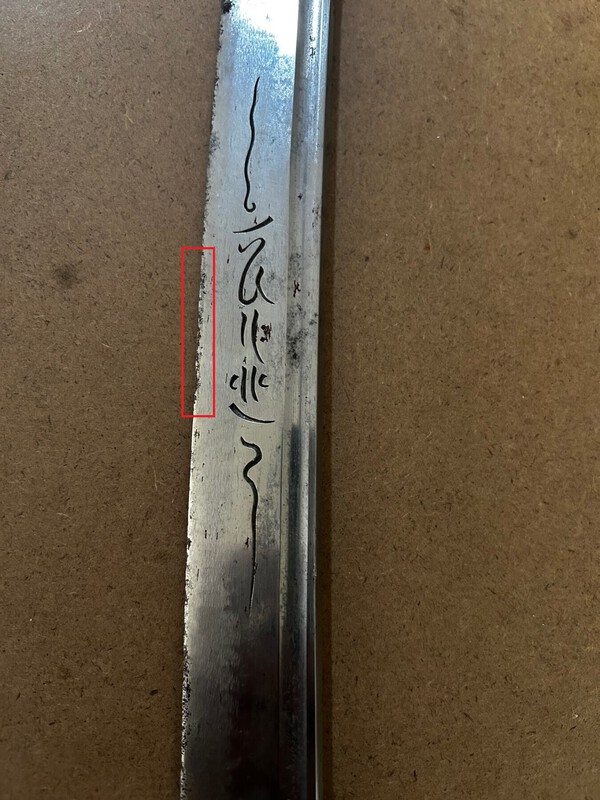
Hi @Eric187 Would it be possible to know what this area is? The blemishing makes it look fairly recent, hard to tell
-
Who is Jimmy Kimmel?
-
I would have thought these were right in your collecting wheelhouse? What happened to appreciating every sword?
-
No doubt #5 is a beautiful sword itself just the top areas condition is slightly degraded and visible in the images but that is down to personal preference. Aoe has little middle ground you generally see them in excellent condition or very bad condition.