Toryu2020 Posted December 10, 2024 Report Posted December 10, 2024 A kodai koshirae with at least the tsuba left… 3 Quote
Iekatsu Posted December 10, 2024 Report Posted December 10, 2024 Do you have more information about this piece? Quote
Toryu2020 Posted December 10, 2024 Report Posted December 10, 2024 Its from an old book so Pre-war Japanese - if I understand the listing this is from the Shosoin. -t 1 Quote
Iekatsu Posted December 21, 2024 Report Posted December 21, 2024 Just bumped into an example. Tachi Koshirae, Nanboku-chō period, housed in Kasuga Taisha Shrine. 3 Quote
GRC Posted December 22, 2024 Author Report Posted December 22, 2024 @Iekatsu Sadly, that example doesn't provide us with any reliable information as is... We'd need to know when that particular sword was donated to the shrine, because these things were typically donated by samurai after a particular battle, so the sword would likely have been fitted with whatever the "fittings of the day" would have been when the samurai took the blade into battle. I have no doubt the sword was made in the Nabokucho period (as stated in the description), but the fittings and the entire koshirae itself would have changed many times over through the years before it was donated at some point. I would stake my claim here and now, that this sword was likely donated during the Azuchi-momoyama period... right when these guruma style openwork tsuba were in their prime production period. 1 Quote
Iekatsu Posted December 23, 2024 Report Posted December 23, 2024 According to the shrine, the blade is Kamakura period, the Koshirae is Nanboku-chō period, and that the koshirae was likely made specifically for the donation. I presume it was donated at that time, but there is no mention of how/when it was donated. Stylistically it is not a Momoyama period Tachi Koshirae in my opinion, there are many extant examples that can be drawn from for comparison. There is another example donated to the same shrine (image below), that is quite similar stylistically, that was said to have been donated Ashikaga Yoshimitsu in the same period. It is not a smoking gun, but I think worthy of discussion. 1 Quote
Bugyotsuji Posted October 21 Report Posted October 21 Remember that this thread is focussed on the evolutions in iron tsuba, if I have understood it correctly. Beautiful elaborate sukashi work in copper brass, gold, silver and gilt was evident in armor fittings from very early on. The artistic techniques were certainly there for soft metals. Returning to iron, holes were drilled in the iron of kabuto plates and shapes were applied to the edges of iron haraidate-dai, upright holders for maedate. There were fashions for Kabuto bowls such as for the famous bulbous Akoda shape, indeed I sense fashions in Kiku chrysanthemum tsuba could have followed these as the triangular iron bowl plates curved outwards, following numbers such as 12, 16, 24, 32 or 62 etc. Kuruma ‘wheel’ tsuba (not Guruma, except inside compound words) also favoured set numbers of spokes, as did kiku chrysanthemum tsuba. There may have been corresponding fashion changes in armor outfits that included kabuto and tsuba on swords. But in iron? Did they have the files for fine work? Am I alone in seeing numbered spoke consistencies between kabuto plates and tsuba spokes? Here is a tsuba for age consideration. What do we think? An evolution from older yamagane tsuba? The hitsu ana are contemporary with the tsuba. 4 Quote
Bugyotsuji Posted October 21 Report Posted October 21 PS Since we use the name of Katchūshi (along with Tōshō) as one of the two foundations of tsuba evolution, fashions in the manufacture of armo(u)r, especially kabuto, which continued down through the ages alongside sword manufacturing, could well provide us with some useful reference materials. One BIG problem is that these two fields of study are like oil and water, ne’er the twain shall meet. It’s like the ancient word ‘mujun’ 矛盾 (blade and shield) meaning contradiction or paradox, is still expressing their anti-magnetic properties. Are you a blade being, or an armo(u)r being? Quote
Spartancrest Posted October 21 Report Posted October 21 (edited) Piers, do you have the dimensions of that kiku tsuba? It looks very similar to one in the Metropolitan Art Museum - especially the hitsu. One of mine - only one hitsu Edited October 21 by Spartancrest More images 2 Quote
Bugyotsuji Posted October 21 Report Posted October 21 Yes Dale, roughly 9.5 x 9.5 x 0.5 cm. The Metropolitan example has a smooth rim, more like a wheel. Here are a couple more: 2 Quote
ROKUJURO Posted October 21 Report Posted October 21 (edited) Piers, these are intersting and valuable ideas! But we shoukld not forget that our ancestor craftsmen were inventive and even ingenious. Grinding with stones is a neolithic technique as well as drilling, and all iron-working cultures found ways to use similar tools. Coming back to early iron TSUBA, we see that piercing/SUKASHI techniques were dominantly executed with chisels, and only the finishing was done by grinding and filing. If I remenber correctly, in his videos, Ford Hallam showed the use of small grinding stones in his work - not his invention, but learned from his master. Just remenber AKASAKA TSUBA with heavy chisel traces (not removed or ground level!) on the inner side of the MIMI! Files were used much earlier than metal saws in Japan, so we should not look at iron SUKASHI TSUBA with the notion of our present technologies. And there is another point we often forget: Working time was no issue in former eras. The goal was the finished item, and people were not paid on working hours but on the quality of the single workpiece. So "working slowly" is just a picture in our brains as we live in times where speed is dictated by machines. When a beaver is gnawing down a tree, he rarely looks at his watch - he works until the tree falls. Edited October 21 by ROKUJURO 1 1 Quote
ROKUJURO Posted October 21 Report Posted October 21 (edited) 3 hours ago, Bugyotsuji said: .....Here is a tsuba for age consideration. What do we think? An evolution from older yamagane tsuba? The hitsu ana are contemporary with the tsuba.... Difficult to say for me what was first - YAMAGANE or iron in this kind of TSUBA? But I don't remember the so-called SAOTOME TSUBA being made of copper. Referring to the HITSU, this TSUBA could have been made pre-EDO. I have seen these TSUBA made from small parts (= single spokes) that were fitted into the MIMI rather than cut out of a solid blank. Age of my below pictured TSUBA: No idea, I guess early to mid EDO. In any case, it must have been a lot of work! Compare this one with 64 petals (Diameter 94,5 mm)! Edited October 21 by ROKUJURO 1 2 Quote
DirkO Posted October 24 Report Posted October 24 Maybe an interesting point of view by Mitsuru Ito (rougly translated, probably some small faults in there) February 9, 2025 Nittoho Yamanashi Branch Regular Meeting About the Hitsu-ana Holes on Tsuba 1. No Hitsu Late Heian to Late Edo Period These are the originals, and old tsuba no hitsu are highly valued. 2. Square and Yamagata These are old, elegant shapes with a taste that are suited to thin kozuka and kogai, and originals are rare. Kamakura (?) to Early Muromachi Period Square and Low Suhama Shape 3. Square and low Suhama shape Kamakura?~Early Muromachi period This is also an old and elegant shape suited to thin Kozuka and Kogai, and there are few originals remaining. It is thought to have originated from the same period as 2. 4. Thin half-moon shape and low Suhama shape Kamakura? ~ mid-Muromachi period This is also an old, elegant shape with a taste that is suited to thin kozuka and kogai, and there are few originals remaining. It is thought to have originated from the same period as 2 and 3. During the time of Ashikaga Yoshimitsu. 5. Both hitsuana are thin and crescent-shaped. This shape is seen in Kyoto porcelain from the Northern and Southern Courts (Nambokucho) to the mid-early Muromachi period. It is also seen in older armor makers. It is also found in Kamakura, Owari, and Koshoami. 6. Both hitsuana are Suhama-gata. This style is seen in many tsuba from the Momoyama period. This style was seen in Hirata Hikozo, and continued to be made in Higo afterwards. 7. Thick crescent shape and high Suhama shape are the most common shapes from the late Muromachi period to the late Edo period. Slightly slender ones are from the Muromachi period. In the time of Goto Norimasa, there were also ones with large cabinets to accommodate larger poles. 1 3 Quote
ROKUJURO Posted October 24 Report Posted October 24 1 hour ago, DirkO said: 1. No Hitsu Late Heian to Late Edo Period..... This is very surprizing to me. Perhaps it should be "....Late HEIAN to Late KAMAKURA period..."? 1 Quote
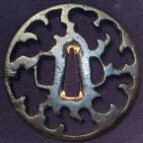
Curran Posted October 25 Report Posted October 25 I am late to this thread and will have to read it in more depth to see if I can add any value. For now, here is one I have owned for a while. Thought it has gotten some surprising interactions out of tsuba scholars smarter than me, I have never inquired too much. 4 Quote

Recommended Posts
Join the conversation
You can post now and register later. If you have an account, sign in now to post with your account.