Curran
-
Posts
4,595 -
Joined
-
Last visited
-
Days Won
23
Content Type
Profiles
Forums
Events
Store
Downloads
Gallery
Everything posted by Curran
-

Selling a small collection of Iron tsuba
Curran replied to Steve Waszak's topic in For Sale or Trade
HI Steve- Email sent. Curran -
As Jean said, my opinion is that most are Nata romanticized as kubikiri. As Reid said, cutting of a head isn't like cutting through SPAM. It is a lot harder than it looks. Sometimes you make a muck of it catching a bone wrong. Knackering a pig or cow can be done with a fairly modest knife. Personally, I would prefer a non forward curved blade. --- Wife was taught to use a small similar knife in florist and ikebana studies, usually reversed in a way that was more of a pulling action and required only slight forward hook with the blade slightly larger near the tip than from where the pulling action starts low on the blade.
-
Kamakura-bori style tsuba have little to do with the Kamakura period. The "wood carving style of the Kamakura period" tsubas do not => tsubas from Kamakura period. Careful with that. RKG's tsuba is actual Kamakura<->Nambokuchu.
-
So what's a weird deal-breaker for you?
Curran replied to Brian's topic in General Nihonto Related Discussion
Just for you: https://www.samuraishokai.jp/sword/22309.html Like the blade. Hate the koshirae. -
Very hard to get Ko-Mino papers these days. I'd dare say they are more rare than Ko-Goto. Nice.
-
Great reply by BaZZa, and great older thread by Steve W.
-
https://page.auctions.yahoo.co.jp/jp/auction/q1060519593 You'd have to knock out the kozuka plug. Love that kozuka.
-
Last comment: For Onin vs Heianjo, I relied heavily upon the Torigoye + Haynes Translation that is a brilliant bargain buy from the Northern California Sword Society. Google it and publications they have available. Peter Bleeds comment reminded me that I believe Torigoye or another scholar talked significantly about the "brass" (there being more than one type, so I am using a catch all word). My eye can see a shift in some of the stuff that is generally attributed around 1550 Late Muromachi, but for me it is something I personally find unreliable. I look more at other aspects.
-
I've never much worked metal in any fashion. This is really more of a question for Ford or Markus Chambers. What little I know is from my mother's years as a bench jeweler with a small lab in the house. That doesn't hold a candle to their many many years of experience. This is to say that I think my own opinions are largely derived from that which I have read in various books + just the basics of bench jeweler knowledge. I see in #1 that which I interpret as being constructed one way. In #3, I see it differently in a way which I interpret as how I have read Heianjo to be constructed. To my eyes, it has to do with the edges of the inlay and the way the iron around it is worked. If I go any deeper than that, I'm going to get tripped up in terminology that I will probably use incorrectly. Then Ford will tell me I am all wrong. Just in recent years have I gotten good at saying what is "Onin" vs "Heianjo" before I see the NBTHK papers. It is still an area where I take my own opinion with a pinch of salt (phrase I used recently in the Saotome thread). In terms of metal movement, I don't have the terminology. I only can
-
I tried to form my opinions before looking at what you wrote: [1] The first one, I would have said "Onin" partially because the mon (circle with 2 or 3 lines). Also the iron looks slightly better to me. The "brass" looks extensively hammered in and carved from there. In my head, "Onin" [2]The second one, honestly... I wasn't sure. It has some of the Onin worked feel to the inlay, but some pieces look pre-cut. That would have been a tough one for me, and I suspect a papering organization would just go to the more cautious Heinajo attribution? [3] I can see what I believe to be pre-cut to the "brass", pieced together and done up not too different from the way you do a stained glass window. Yet it has a large amount of inlay. In some ways, it looks like more work than the Onin tsuba. Still, I'd go Heianjo on it. I admit to thinking it a very pretty example. While the price difference between Onin and Heianjo can be fairly large, sometimes the Heianjo ones are just as pretty or prettier. I semi-admitted I had one that was published in three books. Two books said Onin, but one by a very respected authority said Heianjo.
-
I don't think the website is his. As happens with the grapevine, Mr. Haynes' opinions might get scaled up or blown out of proportion from time to time. I know I have been guilty of taking something Torigoye-san wrote and interpreting it in grander fashion than he intended. That is a mistake we younger students make. Remember to take things with a pinch of salt. Probably that saying is the same in Australia as here in SE part of USA.
-
Even with the exact same tsuba published in 2 or 3 different author's books, you will get different attributions between some of the later Onin and Heianjo. Personally I lean towards Momoyama Heianjo for yours, but it does fall into that overlap zone. As you said, the deciding factors are usually the feel of the iron, the thinness of the plate, and whatever you can observe of the way the inlay was done or cut.
-
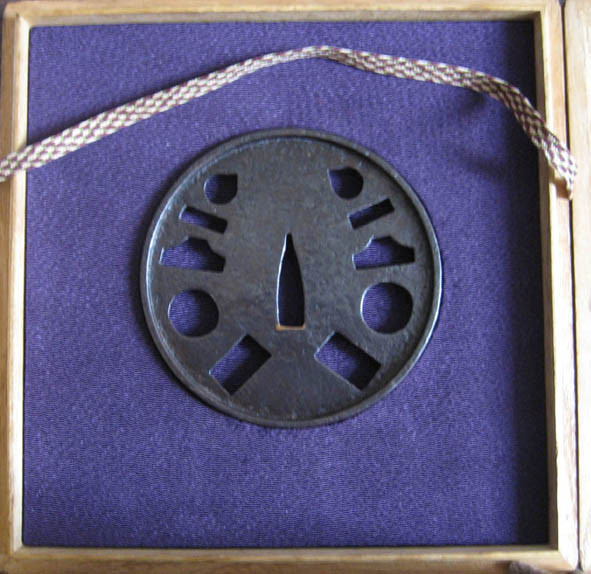
It is about 10.5cm round or so, and it is a bit concave. It is early, but not early early. Shinsa judge went on about the lead possibly being early or original, but I didn't understand. Tokubetsu Hozon. I was told to submit it to Juyo shinsa, but there are not Juyo Saotome... not even among the signed ones. It is one of the few non Higo or non Owari in my collection. Over time, I have found Saotome works more interesting.
-
Actually, the hitsu ana on mine tell you a lot about when it was made. And the way of the cutting heavily evidences it was original to the construction, not added later. I haven't looked at and won't comment on Shibuiswords, as the opinions behind it are at least partially Bob Haynes and should be given a LOT of respect. Even if I differ in opinion here and there, Mr. Haynes opinion is one to which I will always keep an open mind. He is one person I'll always hesitate to contradict.
-
All types.
-
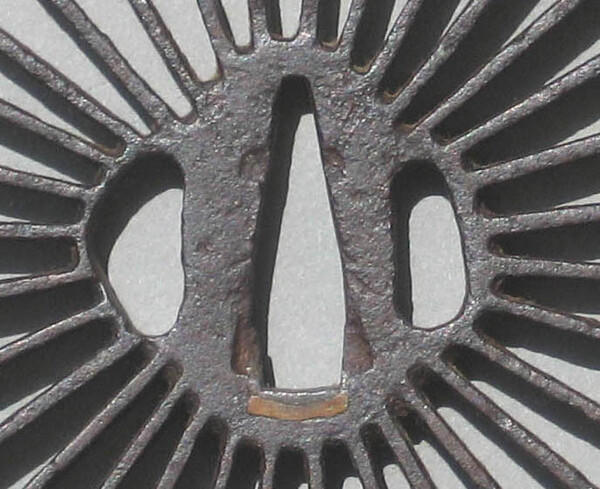
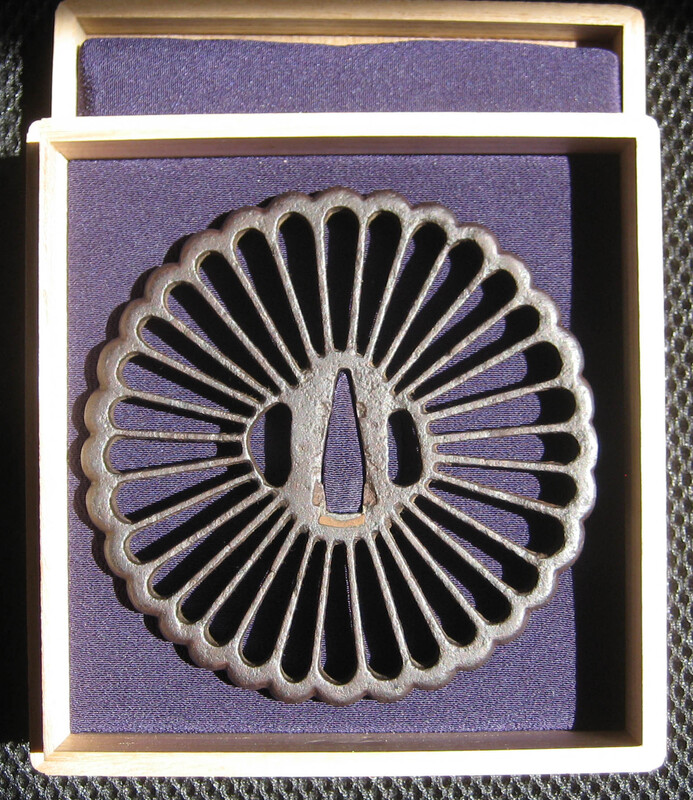
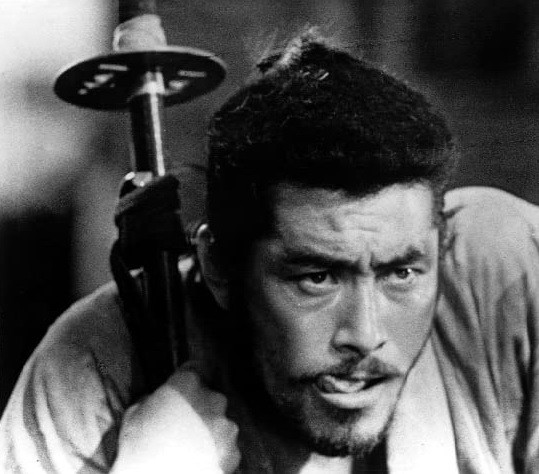
Think about when they were made, and the warfare of the period. Often the nakago ana is large. No kozuka and kogai ana. I've heard the theory before that they were going on large swords. Maybe what one would call 'horse killers'? Give one to the biggest guy in every platoon or group of a certain size, and tell him that his job is to fulcrum that long sword through every pair of horse legs that comes near him. The one Mifune-san was swinging in Seven Samurai has a Gorinto sukashi ko-tosho / ko-katchushi and the Saotome tsuba sometimes get lumped in the katchushi made tsuba category for relatively well known reasons.
-
What was the final reveal or solution?
-
Nice example of Saotome you have there Piers.
-
Tom nailed it. Then Mauro put the smackdown on a theme I didn't know. By the way, veeeerry nice Akasaka. Do you know the thickness of that one?
-
A most unique Koshirae / Interlocking Tsuba
Curran replied to Amenur's topic in Auctions and Online Sales or Sellers
Pic added
-
A most unique Koshirae / Interlocking Tsuba
Curran replied to Amenur's topic in Auctions and Online Sales or Sellers
Toppei style = late Edo. Ie. Influenced by western military things coming into the country. In your case, with Namban type Hirado style fittings. I have one of these locking mechanisms and really like them. They are fairly rare. Very cool. Thank you for posting that. I will save down the pictures for my own files. -
I enjoyed this thread. I can do without the tsuba, but do miss playing video games at the arcades.
-
You guys are making me feel uncomfortable. From my point of view: nice fat duck-tail type nakago, good broad geometry, clear nice Yamato jigane. I didn't think Hosho, but nice clearly in the Yamato camp to my eyes. Reasonable cost for such an example. The papers are nice, but the blade speaks well enough for itself. I've never owned a Yamato school tanto or ken before, and this would have been a good visual primer to own for a few years.
-
Good. This ken was tempting me too much. I try to stick to tosogu, but sometimes I tell myself some tanto and o-tanto aren't that much larger than a ko-goto kogai. My cerebrum trying to rationalize the temptation.
-
Tom, It was an interesting question. A ko-Tosho I have was mountet tachi style and has a lot of obvious wear on the tsuka side in the appropriate place for a tachi mounted iron tsuba that has been used a lot. Flipping it over, it does have some noticeable degree of wear in the area you are talking about, but not nearly as much as the tsuka side.