SteveM
-
Posts
4,283 -
Joined
-
Last visited
-
Days Won
96
Content Type
Profiles
Forums
Events
Store
Downloads
Gallery
Everything posted by SteveM
-
在銘祐定 時代天文之頃 Zaimei: Sukesada Jidai: c. Tenbu 長サ弐尺壱寸五分有之 Nagasa: 2 shaku 1 sun 5 bun 淑晃 Yoshiaki ? (multiple readings possible)
-
Here's another one https://www.seiyudo.com/ka-098121.htm
-
My guess is Chinese. Top of the fan: 拾捌羅漢図 A depiction of the 18 Arhats. https://en.wikipedia.org/wiki/Eighteen_Arhats
-
J: Someone tell me if there is a landmine there. B: There is a landmine there. J: *steps on landmine* BOOM! . . . . J: You so-called experts are so unhelpful.
-
On the reverse side, is the date. I'm tempted to say the year is Keiō - 慶應, based on the first kanji. It bears a striking resemblance to the grass-script version of Kei that we saw recently in another thread. Month is August.
-
武州住 正春 I think its very charming. Nothing to apologize for. A nice tsuba to have in the collection.
-
If you are an amateur like me, you will insert a few phrases into a search engine to see what results you can get. With an obscure smith, it takes a bit of luck to find a match, as the likelihood that a dealer has a papered item for sale, and has good photographs to compare with, is not high. One key may be the unique 州 kanji, which probably hints at when the sword was made as contemporary smiths may have used the same kanji. If you have a bit more experience and access to a good set of reference material, you will look at the sword itself and determine the era and style, and narrow it down to a particular region, time, school, or smith, being mindful of the signature, but trying as much as possible to let the sword tell you where it is from. Then the sword will confirm whether the signature is accurate or not. If you put up pictures of the sword, we should be able to reach a very quick conclusion on whether the sword was made in the 1300s or 1600s. Actually, if you have a good sword book, this is one of the things you can probably do yourself, unless the sword has been substantially altered.
-
伊賀茶盌 偉央 Iga chawan Isamu I think maybe this guy https://utougama.wixsite.com/isamu-umehara/works
-
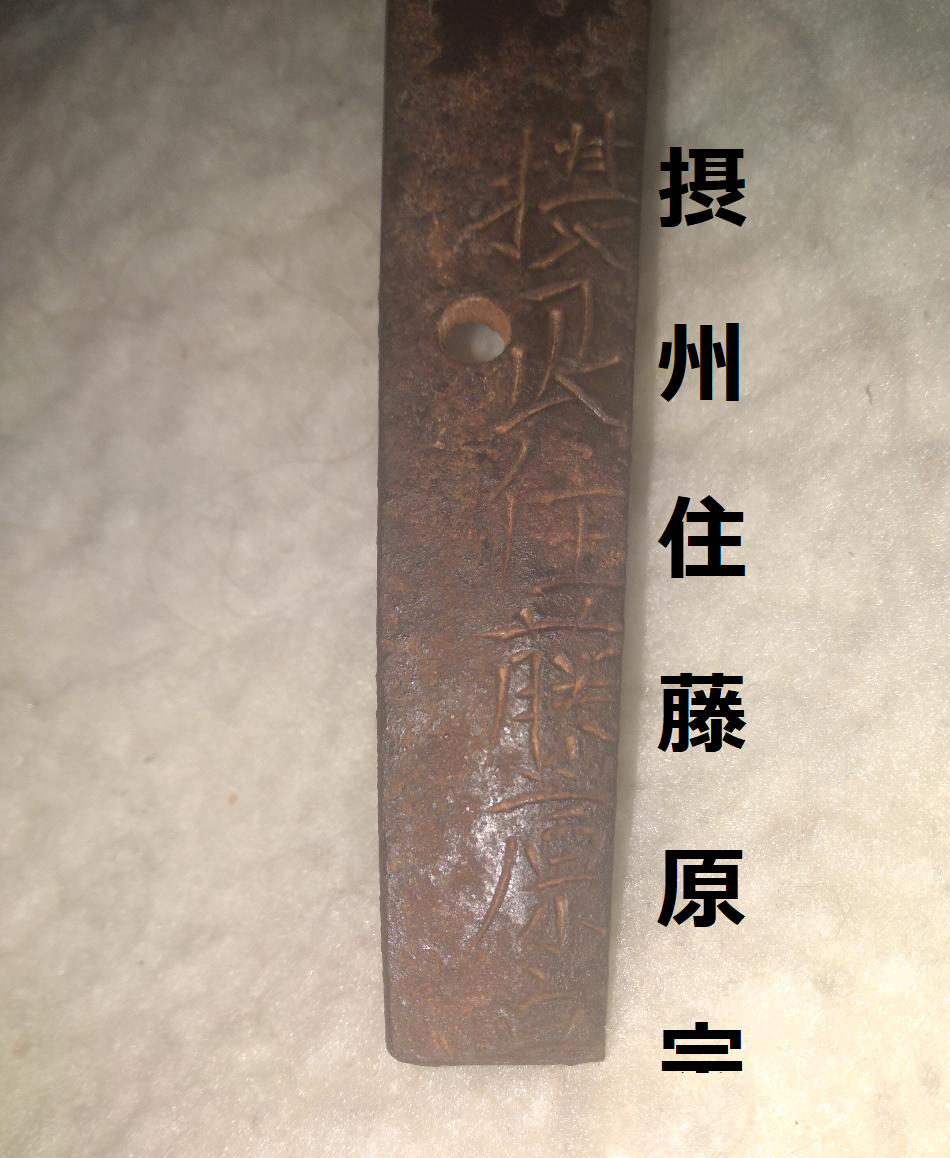
This is what you have on your sword. *Note the second kanji looks substantially different from the one I inserted, because the kanji on the sword is a seldom-used variant that doesn't exist in my font set on my computer. The last kanji which is partially visible is, I believe, the top part of 宗 (mune). It is not the top part of 高. There will have been a second kanji under the 宗, but that is entirely gone and we can only speculate on what it might have been. 澄 is my guess because there was a swordsmith named Munesumi (宗澄) from Sesshu who signed in that style.

-
I would also like to thank Thomas (and a big tip of the hat to Nick Komiya). This kanji remained stubbornly hidden from me no matter what I put into the search engine. Finding that old dictionary entry is like blowing the dust away from a hieroglyphic so that it is finally revealed. I tried to reproduce it again here so that the various bots and spiders can index it and reference this page should any future translators search for this kanji, but it wouldn't display correctly. I wonder why Thomas was able to post it. Something to do with unicode or truetype or jis... Anyway, I'll post as an image and a link. https://glyphwiki.org/wiki/u292e1 https://jigen.net/kanji/168673
-
Scroll...Think Japanese...Assistance would be Great
SteveM replied to Jon MB's topic in General Nihonto Related Discussion
Looks very interesting. I have no idea what it says. Well, I can pick out the word 三月 (March) and other bits and pieces (議, 道, and the odd hiragana here and there), but nothing that helps me figure out what it says in its entirety. Its almost as if the first section (on the right) is setting up the following sections, which are arranged more like a poem. Maybe a letter, or an explanation of a poem? -
Wim's reading and translation (and Bruce's verification) are correct. If you've checked out the Wikipedia entry for Hiroshi Nemoto, you've already got all the basic info. I would probably translate 佩刀 (haitō) as "sword" and leave it at that. Chūjō just means "lieutenant general" as above, so googling that phrase alone won't pull up anything useful.
-
1. 吉祥紋散透鐔 Kichijō-mon chirashi sukashi tsuba (auspicious designs in fretwork) 無銘 Mumei 古金工 Kokinkō 丸形山銅石目地小透 Maru-gata yamagane ishime-chi kosukashi 毛彫覆輪耳 Kebori fukurin mimi 2. 鉞と杵透鐔 無銘越前 Masakari to kine sukashi tsuba. Mumei, Echizen. (Axe and hammer designs in fretwork) 隅切角形 鉄磨地 Sumikirikado-gata Tetsumigaki-chi 地透覆輪耳 Chisukashi fukurin mimi Hard to decide what to translate and what to leave in the original Japanese. The tsuba (and sword) world tends to use the original terms as is.
-
I think it is Fujiwara, which, as Tom mentions is the usual way of signing. Its just that the photo is so close, the bottom part of the Fujiwara kanji (藤原) is emphasized to the point where it looks like a different kanji. 濃州関住二十三代藤原兼房作之
-
Yes - looks like Kanenami. WW2 smith. 兼波 The same smith as the one here http://bocho-kobidou.com/katana-03-093/
-
建依別山囗善貞(花押) Tateyoriwake Yama(?) Yoshisada + kaō Tateyoriwake is an unusual name, originating in Japanese mythology, and appearing on at least one other sword posted to this site http://www.militaria.co.za/nmb/topic/30320-help-translating-gendaito/ making me think it is a name used by a specific group or school of smiths. Yama-something Yoshisada would be the specific name of the swordsmith (or his art name). I can't make out the kanji after Yama.
-
Ancient Japanese Writing - Old Scroll #2
SteveM replied to Marino F's topic in Translation Assistance
1277, or every 60th year after that up to 1997 (1337, 1397, etc..). Or every preceding 60th year. So there are a lot of possibilities. I don't think that piece of paper is 700-800 years old. I would say your most likely candidates are something from the past 200 years - maybe 1937. Cloth and paper just doesn't hold up that well through the years unless it is very well protected from light and moisture, bugs, etc... -
Suzumushi 鈴虫 https://en.wikipedia.org/wiki/Meloimorpha_japonicus Very nice menuki, by the way.
-
Could be from a classic poem (by Shinran, 12th-13th c.) https://en.wikipedia.org/wiki/Shinran 箸鷹のみよりの羽風ふき立て おのれとはらう袖の白雪 No available translation, so again I'll give it a shot The hawk flapping its wings, blows the snow from my sleeve
-
Ancient Japanese Writing - Old Scroll #1
SteveM replied to Marino F's topic in Translation Assistance
You got a few right. Many, or most of these kanji are read together as compound words, so 日夕 go together to form one word; nisseki (day and night, or all night and day). Unfortunately most of the kanji following that opening word are far to reduced for me to make any sense of them. You got "40 years" right, as well as 57th. The small writing in the bottom left of the scroll would be a dedication and the name of the person who wrote the scroll. So it would be something like a scroll given to a teacher from the 57th reunion of a class. I'm wondering if it isn't addressed to a Tanaka-sensei (田中先生)? The rest is too abridged for me. Edit: Also note that it is not actually ancient writing. It is just a cursive form of calligraphy - its used even today in calligraphy and wherever there is a need for a stylistic cursive text. -
Ancient Japanese Writing - Old Scroll #2
SteveM replied to Marino F's topic in Translation Assistance
Left picture: 素志與白雲同悠 A classical Chinese poem from Rong Wang (5th century). I don't have a translation, but something like "A pure mind is calm, like the distant clouds" Under that is a date. March in the year of the cow, (in the sexegenary cycle of fire and cow - hinotoushi in Japanese). -
Hello Robert - this is where Wakayama lets me down. Sōsei (宗政) is listed as having been active "mid-Edo", but Wakayama doesn't list specific birth dates (or pronunciation for that matter, so I am guessing at Sōsei as it is consistent with other Yokoya artists's names). As I say I offer it with some hesitation as the artist seems to be obscure, and I have no other examples to go by. I am still on the fence as to the inscription on the right side. Robert Mormile's suggestion has made me search on a number of things trying to cast some light on the possibility of the date given (and referencing that date with the terse and often cryptic Wakayama entries). What I can say is: If the first kanji is 萬, the date must be either 萬治 Manji (1658 -1661) or 萬延 Man'en (1860 - 1861) To me the second kanji doesn't look like either 治 or 延, so I have some doubts already. The first kanji vaguely looks like 萬, but to me it looks even closer to the grass script version of 蔓, which is also pronounced "man", but it is a kanji that doesn't get much use except in specialized contexts. Anyway, you can see that by this time I've already got one foot in the weeds. Wakayama says Sōsei was an apprentice of Sōyo (宗與), however there were at least three generations of Sōyo, two at the beginning of Edo, and one at the end. So as a plausible date, Manji (万治) is compatible with an apprenticeship to the first Sōyo, but I take a step farther into the weeds here because I'm not convinced Sōsei is who I should be looking for in the first place, and, as I said before I don't like the looks of Manji, so I feel this is a dead-end. Man'en is so short of an era, that it ends in February of Man'en 2. Then the era name changes to Bunkyū. So an October date of Man'en 2 is technically invalid. I'm willing to entertain some wiggle room on the date, but to me the final two kanji don't look like October (十月) and overall its incompatible with a "mid-Edo" artist - either Sōsei or Sōmin, so the doubts start piling up. Maybe try sending to Markus. Or, maybe Moriyama-san or Morita-san can weigh in.
-
I'm not 100% sure of 政, mind you. The big name would be Yokoya Sōmin (宗珉), but to me the final kanji before the kaō doesn't look much like 珉. It does vaguely resemble 政, and there was a 横谷宗政 who signed that way with a kaō, so I offer that as a plausible candidate.
-
The left side looks to me like 横谷宗政(花押)Yokoya Sōsei (kao). I can't get the right side.
-
Kakemono/Kakejiku Hanging Wall Art Translation
SteveM replied to IbexiSterlinfa's topic in Translation Assistance
I don't think this would be considered a very high quality artwork. It is a decorative art, just meant to provide color in a corner of the house. I'm now not sure about the one at after 鉄岩. I don't like the way the vertical stroke pokes through the top horizontal stroke. This shouldn't happen with 画. Maybe its 書? Maybe it is some completely different thing.